WhatsApp
+62818-0847-5888
Work Hours
Monday to Friday: 9AM - 5PM
WhatsApp
+62818-0847-5888
Work Hours
Monday to Friday: 9AM - 5PM

 Byadmin
Most Common Mistakes in Safety Harness Use:
• Using the wrong harness class for the task (e.g., Class A harness for working at height above 1.8 m).
• Skipping pre-use inspection, especially after a fall event or long storage.
• Incorrect D-ring positioning — placing it on the chest or hip instead of the dorsal (back) position.
• Loose or improperly adjusted straps, reducing load-distribution effectiveness.
• Connecting the lanyard to an uncertified or inadequate anchor point.
Fatal Consequences of These Mistakes:
• Free-fall without arrest if the harness is incorrectly connected or the anchor fails.
• Suspension trauma (orthostatic intolerance) if the worker is left hanging for more than 3–5 minutes after a fall.
• Spinal or chest injury due to improper load distribution across the body.
• Equipment failure mid-fall if a harness with hidden damage was not inspected.
How to Use a Safety Harness Correctly:
• Always select the harness rated for your specific task (fall arrest, positioning, or rescue).
• Inspect every component before each use, following the manufacturer’s checklist.
• Adjust all straps so no more than two fingers can slide underneath.
• Attach the snap hook only to a certified structural anchor rated ≥ 15 kN.
• Ensure the dorsal D-ring is centered between the shoulder blades.
A safety harness is one of the most critical pieces of personal protective equipment (PPE) in any working-at-height scenario. Yet despite its importance, the incorrect use of safety harnesses remains one of the leading contributing factors to fall-related fatalities across the construction, oil and gas, telecommunications, and industrial maintenance sectors worldwide.
The core problem is not always a lack of equipment; it is the improper use of equipment already available. Workers may wear a harness but adjust it improperly, connect it to an inadequate anchor, or fail to inspect it before use. Each of these mistakes in using a safety harness can turn a preventable incident into a fatal one.
This article is intended for field technicians, HSE officers, supervisors, and safety trainers who need a technically grounded, practical reference for identifying, correcting, and preventing the most common errors in safety harness application.
The following list is compiled from field observations, safety incident analyses, and industry standards, including ANSI/ASSE Z359, EN 361, and OSHA 29 CFR 1926.502. These are the most frequently documented errors — each with real consequences.
Not all harnesses are created equal. A fall-arrest full-body harness (Class A/EN 361) is designed to arrest a free fall. A work-positioning harness (Class E/EN 358) is designed to support a worker in a stationary position. Using a positioning harness as fall protection is a critical error; it is not engineered to absorb the shock forces generated in a free fall.
Consequence:
If a worker free-falls while wearing only a positioning harness, the equipment may fail structurally or cause serious injury due to improper load distribution.
Many workers skip visual inspection before putting on a harness, especially when time is limited or the equipment looks superficially fine. However, fall arrest equipment can sustain internal damage, micro-tears in webbing, hairline cracks in hardware, and corroded buckles — that is invisible without a careful inspection.
Key rule:
A harness that has arrested a fall must be immediately taken out of service and inspected by a competent person, regardless of its visible condition.
The dorsal D-ring must be positioned at the center of the upper back, between the shoulder blades. Workers frequently allow the D-ring to migrate toward the neck, to one side, or even attempt to connect lanyards to chest D-rings (which are designed for vertical ladder climbing restraint, not fall arrest).
Incorrect D-ring placement changes the body’s arrest posture during a fall, potentially causing the worker to flip upside down or experience severe spinal loading.
Both over-tightening and under-tightening harness straps create hazards. A harness that is too loose will allow the body to shift dramatically within the webbing during a fall, concentrating impact forces on unintended body parts. The industry-standard fitting guideline is the two-finger rule: you should be able to slide no more than two fingers flat beneath any strap.
A safety harness is only as effective as the anchor point it is connected to. Attaching a lanyard to a pipe, a conduit, a scaffolding cross-brace, or any structural element that has not been evaluated as an anchor point is a critical error. Per ANSI Z359.1, a personal fall arrest system anchor must be capable of supporting a static load of at least 5,000 lbs (22.2 kN) per attached worker, or must be designed as part of a certified fall protection system.
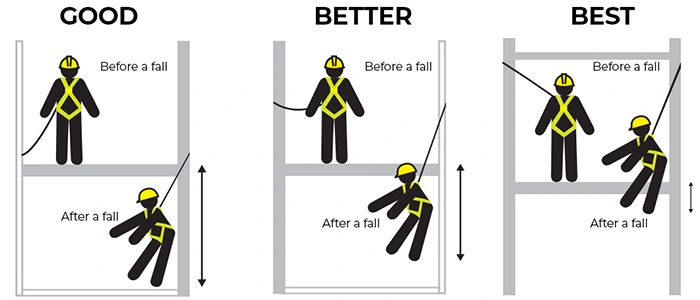
A full body harness with a 1.8 m (6 ft) lanyard does not mean the worker only needs 1.8 m of clearance below. The total fall clearance must account for the lanyard length, the deceleration distance of the energy absorber (typically up to 1.07 m), the D-ring height on the body (~1.5 m from the feet), and a safety margin. The total required clearance can exceed 6 meters. Working without this calculation on low rooftops or low-clearance platforms is extremely dangerous.
Harness webbing that is twisted, crossed, or routed through the wrong loops will not distribute fall arrest forces correctly across the body. This is a common post-donning error, particularly when workers are in a hurry or dressing in confined areas. All webbing must lie flat and untwisted before work begins.
Textile-based PPE degrades over time due to UV exposure, chemical contact, abrasion, and humidity. Most manufacturers specify a maximum service life of 5–10 years from the date of manufacture, with some recommending retirement after 10 years regardless of condition. Yet harnesses with frayed webbing, faded tags, or visibly worn buckles continue to be used in the field because they have never been formally retired.
Snap hooks that are loaded against their gate, loaded in a way that allows the gate to open under force (rollout), or connected to objects of a diameter that prevents the gate from fully closing, are potential single points of failure. Self-locking and self-closing snap hooks (double-action) must always be used for fall arrest applications. Never use a non-locking snap hook for fall protection connections.
This is a procedural mistake rather than an equipment error, but it is inseparable from safe harness use. Suspension trauma (orthostatic intolerance) can begin within 3–5 minutes of a worker hanging motionless in a harness after a fall arrest. Without a documented and practiced rescue plan, a successfully arrested fall can still result in death. OSHA and major safety standards require that a rescue plan be in place before any work at height begins.
Correct harness use is not just about wearing the equipment; it is a complete behavioral and procedural discipline. The following best practices should be integrated into every job hazard analysis (JHA) and toolbox talk involving work at height.
Match the harness class and configuration to the specific hazard. A fall arrest harness (full body, dorsal D-ring) is required whenever a worker could free-fall more than 1.8 m (or 1.2 m in certain jurisdictions). Consult the task’s fall protection plan and do not substitute equipment classes.
Develop a consistent, repeatable donning sequence: untangle and hold the harness by the dorsal D-ring → insert arms into shoulder straps → fasten chest buckle → fasten leg straps → adjust all straps to the two-finger standard → perform a buddy check. Consistency eliminates the risk of forgotten steps under time pressure.
Do not add additional carabiners, knots, or webbing to a harness system. Do not substitute components from different manufacturers or different model lines. Every component of a fall arrest system must be compatible and certified as a system. Substitutions invalidate certification and can catastrophically reduce system performance.
Each harness should have a unique identifier (tag or serial number) and an associated inspection log. The log should record the date of each inspection, the name of the inspector, and any findings. When a harness is retired, it should be physically destroyed to prevent re-entry into service.
Perform this inspection before every use. If any item fails, remove the harness from service immediately and tag it for evaluation by a competent person.
Even when usage practices are correct, the performance of a safety harness ultimately depends on the quality of the equipment itself. A body harness that meets certified standards, such as EN 361, ANSI Z359.11, or SNI 7037, has been tested to withstand forces generated in a fall arrest scenario and to maintain structural integrity through those forces.
Harnesses sourced from uncertified suppliers may not use webbing with the rated tensile strength, may use hardware that fails below rated loads, or may have stitching patterns that have not been tested under dynamic conditions. For safety-critical applications, purchasing equipment from verified suppliers who provide full certification documentation is not a cost optimization question; it is a fundamental requirement of a legally compliant and morally defensible safety program.
The most common mistake is skipping the pre-use inspection. Workers frequently assume a harness is safe because it looks intact, but internal webbing degradation, corroded hardware, or damage from a previous fall event can make a visually normal harness structurally unsafe.
A visual inspection by the user should be performed before every single use. A formal, documented inspection by a competent person should be conducted at least annually, or immediately following any fall arrest event, exposure to chemicals, or other incident that may have affected the harness.
Most manufacturers specify a maximum service life of 5 to 10 years from the date of first use, but no more than 10 years from the date of manufacture, whichever comes first. A harness that has arrested a fall must be retired immediately from fall protection service, regardless of its age.
Suspension trauma (also called harness-induced pathology or orthostatic intolerance) occurs when a worker hangs motionless in a harness after a fall arrest. The leg straps restrict blood flow back to the heart, which can cause loss of consciousness and cardiac arrest within 3 to 30 minutes. A rescue plan must be in place before any work at height begins.
No. ANSI Z359.1 requires that anchor points for personal fall arrest systems be capable of supporting at least 5,000 lbs (22.2 kN) per attached worker. The anchor must be a designated, engineered structural element, not improvised from available site structures like pipes, conduits, or scaffold components.
The two-finger rule is a standard fitting guideline: after adjusting all harness straps, you should be able to slide no more than two flat fingers underneath any strap. This ensures the harness is snug enough to distribute fall arrest forces correctly without restricting circulation.
No. Chest D-rings are designed for vertical ladder climbing restraint or confined space rescue, not general fall arrest. The dorsal D-ring, located at the center of the upper back between the shoulder blades, is the correct connection point for fall arrest lanyards and self-retracting lifelines.
The mistakes in using a safety harness covered in this article are not theoretical scenarios — they are documented failure modes that have contributed to real worker fatalities. The encouraging reality is that every one of these errors is preventable. Prevention requires three things working together: correct selection of certified equipment, consistent and competent pre-use inspection, and disciplined donning and connection practices on every single shift.
For HSE professionals and field supervisors, the goal is to build a workplace culture where these practices are not treated as bureaucratic requirements but as fundamental professional standards — the same standard a skilled technician applies to any other aspect of their craft.
When selecting body harnesses for your organization, always demand full certification documentation, inspect equipment upon delivery, and establish a formal lifecycle management program. The right harness, correctly used, is the difference between a near-miss and a fatality.