WhatsApp
+62818-0847-5888
Work Hours
Monday to Friday: 9AM - 5PM
WhatsApp
+62818-0847-5888
Work Hours
Monday to Friday: 9AM - 5PM

 Byadmin
A Technical Guide to Fall Protection Requirements, Working at Height Regulations, and PPE Compliance
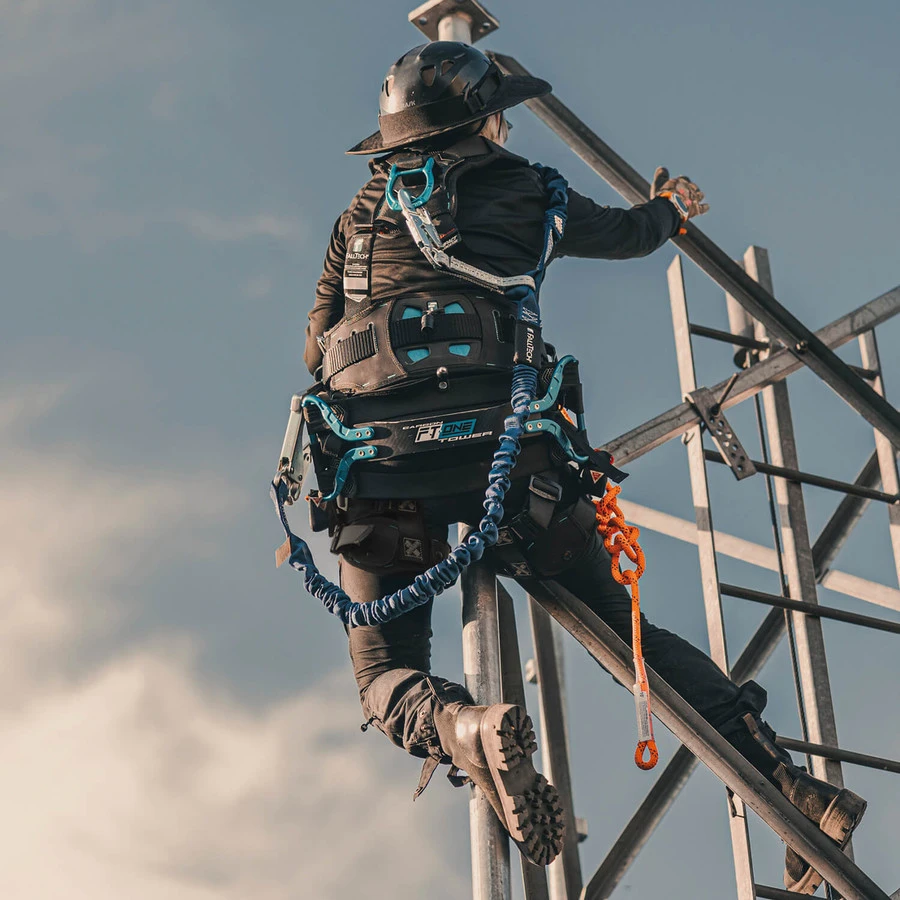
A full body harness is mandatory whenever a worker is exposed to a fall risk and a fall arrest system is required as the primary means of protection. Under OSHA standards, this applies at heights of 4 ft in general industry, 6 ft in construction, and 8 ft in longshoring. EN 361-compliant harnesses are required across Europe under the Work at Height Regulations.
Falls from height remain one of the leading causes of fatal and serious injuries in workplaces worldwide. In the United States alone, falls account for a substantial proportion of occupational fatalities each year. Across Europe, work at height is consistently identified as one of the most hazardous activities in construction, maintenance, and industrial operations.
Despite this, confusion persists around a fundamental compliance question: when is full body harness mandatory, and when can simpler forms of fall protection be used instead? The answer depends on the type of work, the height involved, the fall protection system deployed, and the applicable regulatory framework, whether that is OSHA in the United States, the Work at Height Regulations in the UK, or harmonised EN standards across the European Union.
This article provides a detailed, regulation-grounded answer. It is intended for safety managers, site supervisors, HSE professionals, and workers who need to understand their legal obligations and make compliant equipment choices.
A full body harness is a type of personal protective equipment (PPE) designed to arrest a fall and distribute the forces generated during fall arrest across the wearer’s body, specifically across the thighs, pelvis, chest, and shoulders. This distribution is critical: it reduces the risk of injury that would otherwise be concentrated at a single attachment point, as occurs with older-style waist belts or work positioning belts.
Full body harnesses are designed and tested to specific standards:
EN 361 is the most widely referenced international standard. A harness certified to EN 361 must withstand a test force of 15 kN and limit the force transmitted to the wearer during arrest to no more than 6 kN. It must also include a sternal (front), dorsal (back), or sternal-and-dorsal attachment point depending on its intended use category.
A full body harness is mandatory when a fall arrest system is the selected method of fall protection. This applies when collective protection measures (guardrails, safety nets) are not reasonably practicable, and when a worker must be connected to a fall arrest lanyard or self-retracting lifeline anchored above them.
The mandatory requirement for a full body harness is triggered by the type of fall protection system selected, not solely by the height at which work is performed. The critical distinction is between:
In practical terms, a full body harness is mandatory in the following situations:
Any time a worker connects to a fall arrest lanyard, whether a shock-absorbing lanyard, twin-leg lanyard, or self-retracting lifeline, a full body harness is the required connection point. A simple waist belt or chest harness is not permitted for fall arrest because it cannot safely distribute the arrest forces and creates a severe risk of internal injury or harness flip-over.
Height thresholds at which fall protection becomes mandatory, and therefore where a full body harness is required if fall arrest is the chosen control, vary by jurisdiction:
| Jurisdiction | General Industry | Construction | Regulation |
|---|---|---|---|
| United States (OSHA) | 4 ft (1.2 m) | 6 ft (1.8 m) | 29 CFR 1910 / 1926 |
| United Kingdom | No fixed threshold — risk-based | No fixed threshold — risk-based | Work at Height Regs 2005 |
| European Union | No fixed threshold — risk-based | No fixed threshold — risk-based | Directive 2001/45/EC |
| Australia | 2 m (general) | 2 m (construction) | Model WHS Regulations |
| Canada (Federal) | 3 m (10 ft) | 3 m (10 ft) | Canada OHS Regs |
Regulations in most jurisdictions require employers to follow a hierarchy of fall protection controls. Collective measures, primarily fixed guardrails and safety nets, take priority over personal fall protection equipment. Only when these cannot be implemented, or where the nature of the work makes them impractical (e.g., work on a fragile roof, access to confined spaces, work on a ladder or scaffold edge), does PPE become the primary control, triggering the harness requirement.
Certain activities trigger a mandatory harness requirement regardless of height because the fall risk is inherent and fall arrest is the only practical control:
Under OSHA, fall protection, including full body harness use when fall arrest is the chosen method, is required at 4 ft in general industry (29 CFR 1910.28), 6 ft in construction (29 CFR 1926.502), and 8 ft in longshoring. OSHA mandates that personal fall arrest systems include a full body harness; body belts are explicitly prohibited for fall arrest.
OSHA’s fall protection standards are among the most comprehensive in the world. The key provisions relevant to full body harness requirements are:
This standard governs fall protection in the construction industry. It requires that personal fall arrest systems, when used as the selected fall protection method, consist of an anchorage, connectors, and a body harness. The standard explicitly states that body belts may not be used as part of a personal fall arrest system. The system must limit the maximum arresting force on the employee to 1,800 lbf (8 kN).
Effective January 2017, OSHA updated its general industry fall protection standard. It mirrors the construction standard in prohibiting body belts for fall arrest and requires full body harnesses. It also introduced requirements for fall protection plans, regular harness inspections, and competent person oversight.
Key OSHA requirements for a compliant fall arrest system include:
In Europe, fall protection requirements flow from the EU Framework Directive (89/391/EEC) and the Temporary or Mobile Construction Sites Directive (92/57/EEC), as implemented nationally. In the UK, the primary instrument is the Work at Height Regulations 2005. Across the EU, Directive 2001/45/EC on the minimum safety requirements for work equipment used in temporary work at height provides the framework.
All fall arrest PPE placed on the European market must be certified under the EU Personal Protective Equipment Regulation (EU) 2016/425. Full body harnesses must meet EN 361, while associated components must comply with:
The Work at Height Regulations 2005 do not specify a fixed height threshold. Instead, employers must assess the risk and implement appropriate controls. Where fall arrest PPE is selected, EN 361-compliant full body harnesses are required.
On scaffolding with compliant guardrails (top rail, mid rail, toe board), a full body harness is not automatically required, the guardrail system provides collective fall protection. However, a full body harness becomes mandatory when workers must operate outside the protected area, during scaffold erection and dismantling, or when working from a scaffold platform without adequate edge protection.
This is one of the most commonly misunderstood areas of working at height regulation. The answer is situation-dependent:
Under OSHA 29 CFR 1926 Subpart Q (Scaffolding), fall protection is required at 10 ft for most scaffold types. Personal fall arrest systems, requiring a full body harness, are mandatory when guardrails are not provided or are insufficient.
No. A safety belt (waist belt) cannot replace a full body harness in a fall arrest system. Safety belts are only permitted for fall restraint or work positioning where the worker is prevented from reaching the fall edge. In a fall arrest scenario, body belts are explicitly prohibited by OSHA (29 CFR 1926.502) and do not comply with EN 358 for the forces generated in a free fall.
This distinction is critical from both a safety and compliance perspective. The key differences are:
| Feature | Safety Belt (Waist Belt) | Full Body Harness |
|---|---|---|
| Force distribution | Concentrated at waist | Distributed across body |
| Fall arrest use | Prohibited (OSHA, EN standards) | Required for all fall arrest |
| Injury risk in fall | High — spinal, internal organ | Significantly reduced |
| Suspension tolerance | Very low — minutes only | Higher — designed for suspension |
| Standard | EN 358 (positioning only) | EN 361 (fall arrest) |
| Restraint use | Permitted | Permitted |
| Work positioning | Permitted (some systems) | Preferred, required for PPE Reg |
Employers who provide safety belts where full body harnesses are required are in breach of OSHA standards, UK Work at Height Regulations, and EU PPE requirements. They are also exposed to significant civil liability in the event of a fall incident.
A full body harness is only as effective as the anchor point it is connected to. Regulatory requirements for anchor points are stringent and form an integral part of the fall protection system:
The anchor point requirement is frequently underestimated on site. Connecting a full body harness to an unsuitable anchor, such as a scaffold tube not rated for the purpose, or a plant fitting not designed as a fall protection anchor, renders the entire fall arrest system non-compliant, regardless of the quality of the harness itself.
Use this checklist to determine whether a full body harness is required for a specific task:
A compliant fall protection programme does not end with selecting the right harness. Ongoing inspection and maintenance are legal requirements:
Before every use, the worker or a competent person must inspect the harness for: cuts, abrasions, chemical or heat damage to webbing; corrosion, deformation, or cracking of metal components; correct function of all buckles, adjusters, and connectors; legibility of the identification label; and any prior fall arrest loading (which may not be visible but renders the harness unfit for further use).
EN 365 and OSHA both require that fall protection equipment be formally inspected at intervals not exceeding 12 months by a competent person. In high-use or harsh environments, more frequent inspections are appropriate. All inspection records must be retained.
A harness must be immediately withdrawn from service after any fall arrest event, even if no visible damage is detected. The dynamic forces involved in arrest cause internal deformation of fibres that may not be externally visible. Other retirement triggers include: exceeding the manufacturer’s stated service life (typically 10 years maximum from manufacture, regardless of condition); visible webbing damage; failed inspection; or exposure to chemicals, heat, or UV degradation.
| Trigger Condition | Harness Required? | Applicable Standard |
|---|---|---|
| Fall arrest system selected as control | Yes — always | OSHA 1926.502 / EN 361 |
| Rope access / suspension work | Yes — always | IRATA, EN 358 + EN 361 |
| Working at height >6 ft (construction, US) | Yes — if fall arrest used | 29 CFR 1926.502 |
| Working at height >4 ft (general industry, US) | Yes — if fall arrest used | 29 CFR 1910.140 |
| Scaffold erection/dismantling | Yes — unless fully guarded | OSHA Subpart Q / WAH Regs |
| Guardrail system in place and compliant | Not mandatory | EN 13374 / OSHA 1926.502 |
| Fall restraint system only | Recommended, not always mandated | EN 358 / OSHA 1910.140 |
| Using a safety belt for fall arrest | Prohibited — harness required | OSHA 1926.502(d) |
A full body harness is mandatory whenever a fall arrest system is the selected method of fall protection. This includes work at heights of 4 ft (general industry) or 6 ft (construction) under OSHA, and any working-at-height scenario in Europe where collective protection is not practicable and a fall-arrest lanyard or SRL is connected to an anchor point.
On fully guarded scaffold platforms with compliant guardrails, a full body harness is not automatically required. It becomes mandatory during scaffold erection and dismantling, when guardrails are absent or incomplete, or when a fall arrest system is connected. OSHA requires fall protection on scaffolds at 10 ft, with harness use required where guardrails are not provided.
No. Safety belts are explicitly prohibited for fall arrest under OSHA (29 CFR 1926.502) and do not meet EN 361 requirements. They concentrate arrest forces at the waist, risking spinal and internal organ injury. Safety belts are only permitted for fall restraint or work positioning where the worker cannot reach the fall edge.
Under OSHA, fall protection (including harness use when fall arrest is selected) is required at 4 ft in general industry, 6 ft in construction, and 8 ft in longshoring. In the UK and EU, no fixed threshold applies, a risk assessment determines when harness use is required, meaning a harness may be needed even at low heights if the fall risk warrants it.
In the US, OSHA 29 CFR 1926.502 and 29 CFR 1910.140 require full body harnesses for all personal fall arrest systems. In Europe, the Work at Height Regulations 2005 (UK) and EU Directive 2001/45/EC set the framework, with EN 361 as the mandatory product standard for harnesses used in fall arrest applications.
Understanding when a full body harness is mandatory is the first step. Selecting the correct harness, lanyard, and anchor system for your specific application, roof work, steel erection, rope access, or scaffold operations, requires matching your risk assessment findings to equipment specifications.
A reputable safety equipment provider should offer:
Whether you are equipping a single worker or managing a fleet of fall protection equipment across multiple sites, working with a specialist supplier ensures your programme is built on technical accuracy, regulatory compliance, and genuine operational understanding, not just catalogue selection.
This article is produced for informational and safety guidance purposes. Always consult the specific regulatory requirements applicable in your jurisdiction and seek advice from a competent person for your specific work at height activities.