WhatsApp
+62818-0847-5888
Work Hours
Monday to Friday: 9AM - 5PM
WhatsApp
+62818-0847-5888
Work Hours
Monday to Friday: 9AM - 5PM

 Byadmin
The Complete Technical Reference for Load Restraint Systems
For Logistics Professionals | Truck Operators | Cargo Handlers | Warehouse Managers | Industrial Procurement Teams
Every year, improperly secured cargo causes thousands of road accidents worldwide, resulting in injuries, fatalities, infrastructure damage, and significant economic losses. For logistics operators, fleet managers, and cargo handlers, mastering the science and practice of load restraint is not merely a regulatory obligation: it is a core professional competency.
This guide provides a comprehensive, standards-referenced examination of ratchet lashing systems: what they are, how they work, which international standards govern their use, and how to select, inspect, and maintain them correctly. Whether you are procuring load restraint equipment for a fleet, managing warehouse dispatch operations, or seeking compliance with FMCSA, EN 12195-2, or ISO standards, this document is your authoritative reference.
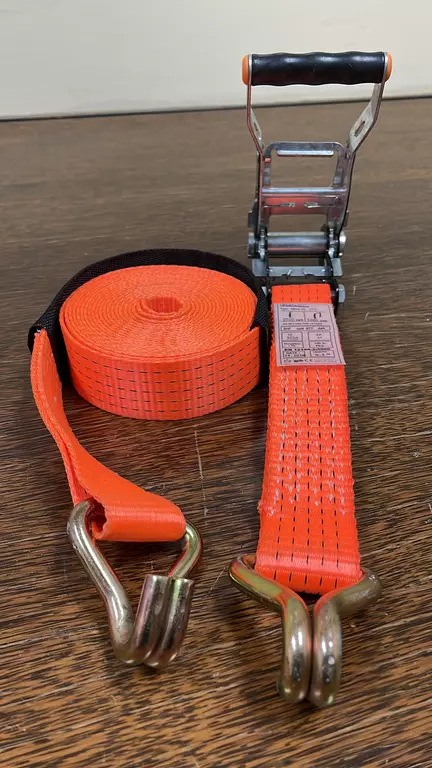
Ratchet lashing is a mechanical cargo securing system that uses a webbing strap, typically made from polyester, combined with a ratchet tensioning mechanism to apply and maintain controlled tension over a load during transport. The ratchet device converts manual handle strokes into progressive strap tightening, locking each increment of tension so it cannot reverse.
The fundamental operating principle relies on a toothed gear (pawl-and-ratchet mechanism) that engages with each stroke of the handle, incrementally shortening the effective strap length and thereby increasing the restraining force on the cargo. When correctly applied, the strap exerts a compressive and stabilising force that prevents the load from shifting, tipping, or sliding during acceleration, braking, and cornering.
| Definition: Ratchet lashing is a load restraint system consisting of a polyester webbing strap, a ratchet tensioning device, and end fittings (hooks or flat hooks), designed to secure cargo to a vehicle or transport platform by applying and maintaining calibrated tension. |
A complete ratchet lashing system consists of several interdependent components. Each element must be correctly matched and maintained for the system to perform to its rated capacity.
| Component | Function | Common Material |
|---|---|---|
| Ratchet Buckle (Tensioner) | Houses the mechanical pawl-and-gear system; applies and holds tension | Galvanised or zinc-plated steel |
| Webbing Strap | The load-bearing textile element that transmits tension to the cargo | High-tenacity polyester (PES) |
| End Fittings (Hooks) | Connect the strap assembly to vehicle anchor points or cargo lashing rings | Forged or stamped steel |
| Flat Hook / Claw Hook | Alternative end fittings for flat-bar or ring anchor points | Forged alloy steel |
| Delta Ring / Connecting Link | Intermediate connection hardware for indirect lashing configurations | Alloy steel |
| Protective Sleeve / Edge Guard | Protects webbing from abrasion at sharp cargo edges | Rubber, PVC, or heavy canvas |
The webbing strap is the primary tensile element of any ratchet lashing assembly. Quality straps are manufactured from high-tenacity polyester yarns woven to precise width and thickness specifications. Common commercial widths include 25 mm, 35 mm, and 50 mm, with 50 mm being the standard for heavy cargo applications.
Understanding the difference between Working Load Limit, Lashing Capacity, and Breaking Strength is fundamental to correct equipment selection and safe use. These are frequently misunderstood or conflated terms, and the confusion can have serious safety consequences.
| Term | Abbreviation | Definition | Typical Ratio |
|---|---|---|---|
| Working Load Limit | WLL | The maximum load the device is rated to carry in a straight pull under normal conditions | 1/3 of Breaking Strength |
| Lashing Capacity | LC | The maximum securing force the strap assembly is rated to contribute in a lashing arrangement (per EN 12195-2) | Defined on CE label |
| Breaking Strength | BS / MBL | The actual tensile force at which the strap or assembly fails: a laboratory-measured figure | Baseline reference |
| Standard Tension Force | STF | The pre-tension force applied to the strap during lashing; typically 50% of LC | Defined by EN 12195-2 |
| Pre-tension Force | STF (alt.) | The initial tension applied before dynamic loading; resists cargo movement | 10% of LC minimum |
| Key Distinction: Working Load Limit (WLL) refers to the device’s rated direct-tension capacity. Lashing Capacity (LC) is the force contribution of the strap in a specific lashing arrangement and is the correct figure to use when calculating load restraint adequacy under EN 12195-2. |
International standards require a minimum safety factor: typically a ratio of 3:1 (Breaking Strength to WLL) or higher for certain applications. The WSTDA (Web Sling and Tie Down Association) specifies a 3:1 safety factor for tie-down straps, while the European EN 12195-2 standard uses a different methodology based on LC and STF. Always consult the rated label on the device for authoritative capacity values.
Ratchet lashing systems are governed by a range of national and international standards. Compliance with the applicable standard in your jurisdiction is a legal and operational requirement.
EN 12195-2 is published by CEN (Comité Européen de Normalisation) and is the primary European standard for webbing lashing systems used for securing cargo on road vehicles. It specifies minimum requirements for:
Equipment compliant with EN 12195-2 must carry a label showing the LC (in daN) and the STF. Load calculations under this standard use a specific formula accounting for the number of lashings, lashing angles, friction coefficients, and dynamic forces.
The WSTDA-T1 standard, published by the Web Sling and Tie Down Association, is the North American reference for polyester webbing tie-down assemblies. Key provisions include:
The Federal Motor Carrier Safety Administration (FMCSA) enforces cargo securement requirements for commercial motor vehicles operating in the United States under 49 CFR Part 393. Key requirements include:
The Load Restraint Guide published by the National Transport Commission (NTC) of Australia provides performance-based requirements aligned with AS/NZS standards. The guide specifies that cargo must be restrained to withstand acceleration forces of 0.8g forward, 0.5g rearward, and 0.5g lateral: broadly consistent with European EN 12195-1 performance criteria.
| Standard / Body | Region | Key Scope |
|---|---|---|
| EN 12195-2 / CEN | Europe (EU/EEA) | Webbing lashing assemblies: LC, STF, testing, marking |
| WSTDA-T1 | USA / North America | Polyester webbing tie downs: WLL, safety factor, marking |
| 49 CFR Part 393 / FMCSA | USA | Commercial vehicle cargo securement: minimum WLL, configurations |
| ISO 27955 / ISO | International | Cargo securing in light vehicles |
| AS/NZS / NTC Load Restraint Guide | Australia / New Zealand | Performance-based load restraint requirements |
| OSHA 29 CFR 1910 | USA (Workplace) | General industry safety: rigging and materials handling |
Ratchet lashing straps can be deployed in several distinct configurations. The correct method depends on cargo type, weight, dimensions, vehicle platform, and available anchor points.
In direct lashing, the strap runs directly between the cargo and the vehicle anchor point. The strap acts in tension to resist movement in a specific direction. Direct lashing is highly effective when multiple straps are applied from opposing angles.
Tie-down lashing involves running the strap over the top of the cargo and anchoring both ends to the vehicle deck. The resulting pre-tension creates a compressive clamping force between the cargo and the deck, relying on friction to resist horizontal movement.
Diagonal lashing applies straps at oblique angles: typically 30 to 60 degrees from the longitudinal axis of the vehicle, to resist lateral and longitudinal movement simultaneously. This method is particularly effective for securing cargo against cornering forces.
| Method | How It Works | Best For | Friction Reliance |
|---|---|---|---|
| Direct Lashing | Strap connects cargo to the anchor point: direct tensile restraint | Machinery, coils, vehicles, equipment | Low: direct tension |
| Tie-Down (Over-top) | Strap over cargo; compressive clamping force relies on friction | Pallets, crates, boxes, bulk goods | High: friction critical |
| Diagonal Lashing | Straps at oblique angles resist multi-directional movement | Pipes, lumber, steel sections, long cargo | Moderate |
The angle at which a ratchet lashing strap is applied has a significant and often underestimated effect on its effective securing force. Understanding load angle geometry is essential for correct calculation and safe cargo restraint.
When a strap is applied at an angle to the vertical, the vertical component of the strap force decreases as the angle from vertical increases. The effective restraining force is calculated as:
| Effective Vertical Force = Strap Tension x cos(angle from vertical). Example: A strap tensioned to 2,000 daN applied at 30° from vertical contributes: 2,000 x cos(30°) = 1,732 daN vertically. |
In the horizontal plane, a strap applied at an angle to the direction of travel contributes a reduced component in the longitudinal direction. For lashings intended to resist forward or rearward movement, the horizontal angle should be minimised.
| Angle from Load Direction (degrees) | Efficiency Factor (cos θ) | Effective Force (% of rated) |
|---|---|---|
| 0° (straight pull) | 1.000 | 100% |
| 10° | 0.985 | 98.5% |
| 20° | 0.940 | 94.0% |
| 30° | 0.866 | 86.6% |
| 45° | 0.707 | 70.7% |
| 60° | 0.500 | 50.0% |
Practical implication: At 45 degrees, a strap rated for 2,500 daN contributes only 1,768 daN of effective force in the direction of load movement. Always calculate the number and placement of lashings based on effective force, not rated capacity alone.
When using tie-down lashing, the friction between the cargo base and the vehicle deck amplifies the effective restraint. The restraining force (R) is calculated as:
| R = (Pre-tension x Number of Straps x 2) x COF, where COF = coefficient of friction between cargo base and deck surface.Typical COF values: Dry wood on steel: 0.30 Rubber mat on steel: 0.50-0.60 Anti-slip mats: up to 0.60 |
Anti-slip mats and friction-enhancing dunnage are strongly recommended to improve tie-down efficiency, reduce the number of straps required, and improve load stability.
Ratchet lashing equipment is subject to progressive wear, UV degradation, mechanical damage, and chemical exposure. A rigorous inspection and maintenance programme is not optional: it is mandated by EN 12195-2 and best-practice guidelines from manufacturers including Kinedyne, SpanSet, Gunnebo Industries, RUD, and Crosby.
In addition to pre-use checks, all lashing assemblies should undergo formal periodic inspection:
Field analysis and incident investigation data consistently identify the same cluster of failure modes in ratchet lashing applications. Understanding these failure causes is the first step to preventing them.
| Failure Cause | Mechanism | Prevention |
|---|---|---|
| Over-tensioning | Strap loaded beyond WLL / LC due to excessive ratcheting; internal yarn failure | Train operators; use torque-limiting tools; know STF limits |
| Edge damage / cutting | Sharp cargo edges cut webbing under load | Always use edge protectors / corner guards |
| UV degradation | Prolonged sun exposure breaks polyester polymer chains | Store indoors; inspect for fading / brittleness |
| Chemical attack | Acids, alkalis, or solvents degrade polyester or corrode hardware | Know cargo chemistry; use chemical-resistant straps where required |
| Incorrect anchor points | Anchors rated below strap WLL fail before the strap | Use rated anchor points; verify vehicle lashing ring ratings |
| Wrong lashing configuration | Tie-down used where direct lashing required; insufficient strap count | Apply correct method per cargo type and weight |
| Worn / damaged ratchet | Pawl slippage releases tension during transit | Regular inspection; replace worn ratchet assemblies |
| Improper loading of strap | Twisted or kinked strap reduces effective cross-section | Thread strap flat; inspect before closing ratchet |
| Industry Data Point: According to studies by transport safety agencies, operator error (incorrect rigging, insufficient strap count, and failure to use edge protectors) accounts for the majority of cargo securement failures, not equipment defects. Training and standard operating procedures are therefore the most effective risk mitigation measures. |
Selecting the right ratchet lashing assembly for a specific application requires a structured approach. The following framework covers the key decision variables.
Calculate the total weight of the cargo unit and identify its centre of gravity. Cargo with a high centre of gravity is more susceptible to tipping forces and may require additional lateral lashings.
Calculate the total securing force required based on the applicable standard (e.g., EN 12195-1 for Europe, FMCSA 49 CFR Part 393 for the USA). Dynamic forces typically range from 0.5g to 1.0g depending on the transport mode and route conditions.
Match the rated Lashing Capacity of the selected strap to the required securing force per lashing point. Common LC ranges:
The aggregate LC of all applied lashings must meet or exceed the calculated total securing force requirement. Divide the required total force by the effective LC per strap (adjusted for angle) to determine minimum strap count.
Each vehicle anchor point must be rated to accept at least the full LC of the attached strap. Never attach a 2,000 daN strap to a 500 daN lashing ring. Consult vehicle documentation or body builder data for anchor point ratings.
Match hook type (flat hook, claw hook, delta ring) to the configuration of available anchor points. Flat hooks suit flat bar systems; claw hooks are suited to D-rings and square bars; delta rings are used in indirect lashing configurations.
For marine, chemical transport, or high-UV applications, specify enhanced polyester or PES-coated hardware. Leading manufacturers including Kinedyne, Lift-All, SpanSet, and RUD offer application-specific assemblies for demanding environments.
| Cargo Type | Recommended Method | Minimum Strap Width | Key Consideration |
|---|---|---|---|
| Palletised goods (< 1,000 kg) | Tie-down (over-top) | 35 mm | Ensure adequate friction surface; use anti-slip mats |
| Machinery/equipment (1,000–5,000 kg) | Direct lashing + supplemental tie-down | 50 mm | Identify rated lashing points on equipment |
| Steel coils/metal products | Direct lashing with cradles | 50–75 mm | Use chocks; heavy edge guard required |
| Vehicles on transporters | Direct (4-point minimum) | 50 mm | Connect to chassis/axle; avoid body panels |
| Timber/pipes (long loads) | Diagonal spring lashing | 50 mm | Ensure the headboard or front bunk is rated |
| Bulk bags / flexible IBCs | Tie-down + side wall containment | 35–50 mm | Verify bag loop ratings; distribute load evenly |
Ratchet lashing is a cargo securing system that uses a polyester webbing strap and a mechanical ratchet tensioning device to apply controlled, progressive tension to hold cargo securely to a vehicle or transport platform. It is one of the most widely used load restraint methods in road freight, construction, and industrial logistics.
Working Load Limit (WLL) is the maximum permissible load in a straight-line direct pull under normal conditions: it is a general-purpose rating. Lashing Capacity (LC) is the specific securing force contribution of a lashing assembly as defined under EN 12195-2. LC is the correct figure to use when calculating cargo restraint adequacy under European standards. WLL remains the appropriate reference for WSTDA and FMCSA calculations in North America.
The minimum number of straps depends on the cargo weight, the LC of each strap, the angle of application, the securing method (tie-down or direct), and the applicable regulatory standard. As a general rule under FMCSA, the aggregate WLL of all tie-downs must be at least 50% of the cargo weight. For European operations, use the EN 12195-1 calculation method incorporating dynamic forces, friction coefficient, and angle factors. When in doubt, use more straps: there is no penalty for over-securing.
There is no fixed calendar-based replacement interval. Equipment should be retired from service when it fails inspection criteria: visible strap damage, missing or illegible label, deformed hardware, or dysfunctional ratchet mechanism. Regular inspection (pre-use and periodic) is the correct approach. In high-cycle operations, equipment may need replacement within months; in low-use applications, a single assembly may serve for several years if properly maintained.
No. Ratchet lashing straps and tie-down assemblies are specifically designed and rated for cargo securing (horizontal tension) applications. They are not rated for overhead lifting, which requires dedicated lifting slings (e.g., to EN 1492-1 for flat woven webbing slings) with specific safety factors for that application. Using a tie-down strap for lifting is a serious safety violation.
High-tenacity polyester (PES) webbing retains adequate mechanical performance across a temperature range of approximately -40°C to +100°C for short durations. Prolonged exposure above 80°C may cause a measurable reduction in strength. For applications involving elevated temperatures, always consult manufacturer’s data sheets and consider specialised materials.
Yes. Vehicle anchor points (lashing rings, floor fittings, and body rails) should comply with applicable vehicle construction standards and be rated to accept the tension forces of the attached lashing assemblies. In Europe, EN 12640 specifies requirements for lashing rings on commercial vehicles. Always verify anchor point ratings from vehicle body builder documentation before applying lashing loads.
The global ratchet lashing and load restraint market is served by a number of established manufacturers with engineering expertise and compliance-tested product lines. Notable entities in this field include:
When procuring lashing equipment, always request and verify compliance documentation, CE markings (for EN 12195-2 products), and test certifications. Reputable manufacturers provide full technical data sheets, load ratings, and application guidance as standard.
Effective cargo securing through correctly applied ratchet lashing systems is a fundamental responsibility for everyone in the logistics and transport chain. This guide has covered the technical foundations: how ratchet lashing works, the critical distinctions between WLL and LC, the international standards framework spanning EN 12195-2, WSTDA, FMCSA, and ISO, and the practical methodology of load angle calculation and method selection.
The principles outlined here reflect the consensus of leading standards bodies, industry associations, and manufacturers. Applying them consistently, through correct equipment selection, proper rigging technique, regular inspection, and operator training, reduces cargo loss, prevents road incidents, ensures regulatory compliance, and ultimately protects people and assets.
For specific applications involving unusually heavy, fragile, or high-value cargo, consult a qualified load restraint specialist or contact the technical team of your chosen equipment manufacturer. The investment in professional guidance is always justified by the protection it provides.
This document is intended for informational and educational purposes only. Always comply with local regulations, applicable standards, and manufacturer instructions. Consult a qualified lifting engineer for critical or complex lifting operations.
© sebatek.id | “Ratchet Lashing & Cargo Securing Guide” | Indonesia Polyester Manufacture