How a round sling is built, and why that matters
A round sling has two parts that do two different jobs, and confusing them is the most common source of unsafe use.
The core is a continuous bundle of polyester yarns wound into an endless loop. This is the only part that carries load. The number of yarn turns determines the working load limit.
The cover is a woven sleeve that encloses the core. It carries no load at all. Its job is to protect the core from abrasion, cutting, and ultraviolet exposure, and to hold the yarn bundle in shape.
This structure produces a practical rule that has no equivalent in flat webbing slings: if the cover is damaged badly enough that core yarns are visible, the sling is finished. Not degraded, not reduced in capacity. Finished. Once the core is exposed there is no way to assess how many yarns have been cut, and the label no longer describes the sling in your hands.
The endless construction has a second consequence worth using deliberately. Because there is no fixed bearing point, the sling can be rotated between lifts so that wear is distributed around the loop rather than concentrated at one contact point. On high cycle operations this materially extends service life.
Round sling colour codes and capacity
Under EN 1492-2, the colour of the cover identifies the working load limit. This gives a crew a capacity check at a glance, which matters on a site running several ratings at once.
| Working load limit | Cover colour | |
|---|
| 1,000 kg | Violet | |
| 2,000 kg | Green | |
| 3,000 kg | Yellow | |
| 4,000 kg | Grey | |
| 5,000 kg | Red | |
| 6,000 kg | Brown | |
| 8,000 kg | Blue | |
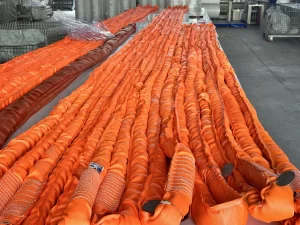
| 10,000 kg and above | Orange | |
Two cautions about reading colour.
First, the colour code applies to slings manufactured to EN 1492-2. A sling built to a different standard may use the same colours for different ratings, or no colour system at all. Colour is a quick check, not a substitute for reading the label.
Second, colour tells you the working load limit in a straight vertical lift only. It says nothing about the capacity in choker or basket configuration, and nothing about the reduction that applies once the sling legs sit at an angle.
Because Sebatek manufactures to EN 1492-2:2000+A1:2008, the colour on a Sebatek round sling corresponds to the table above. Where a sling comes from another source, confirm the governing standard before reading capacity from colour.
Which standard the rating comes from
The working load limit on a label means nothing without the standard behind it, because the two standards in common use apply different safety factors.
Under EN 1492-2, round slings are manufactured to a minimum safety factor of 7:1. Under ASME B30.9, synthetic roundslings are rated at 5:1.
Two slings marked with the same working load limit are therefore not equivalent products. The EN sling contains more material for the same rating. A buyer comparing quotes on price alone, where one supplier quoted to EN and another to ASME, is comparing two different things.
State the standard on the request, not just the tonnage. On projects with an audit requirement, confirm which standard the project specification recognises before the purchase order is issued rather than after the slings arrive.
Sebatek manufactures its polyester round slings to EN 1492-2:2000+A1:2008, the current consolidated edition of the standard. The 7:1 minimum safety factor above is therefore the factor these slings are built to. A certificate is issued for each individual sling, and every sling carries a label attached to the product. For a lifting equipment register, that means a sling can be identified and traced on the floor without going back to the purchase documentation.
For the equivalent discussion on flat webbing, see EN 1492-1 webbing sling standard.
Lifting modes and why the label figure is not the whole answer
The working load limit printed on the label applies to a straight vertical lift. Two other configurations are in daily use, and each changes the figure.
Straight or vertical lift. The sling hangs directly between hook and load. This is the reference condition and the mode the label rating describes.
Choker. The sling passes around the load and back through itself. This grips the load but forces the sling to bend sharply at the choke point, and the rated capacity is reduced accordingly.
Basket. The sling passes under the load with both eyes on the hook. With both legs perfectly vertical, capacity is higher than a straight lift. As the legs move away from vertical, that advantage falls away quickly.
Sling angle is the factor most often left out of the calculation. Two legs at a wide included angle carry substantially more tension each than the same load split evenly would suggest, and at shallow angles the tension rises fast enough to exceed the rating on a load that looked comfortably within capacity.
The mode factors and angle calculations are covered in detail in how to calculate sling load. Read the factors from the sling label and the governing standard, not from memory.
Round sling or flat webbing sling
Both are polyester, both are synthetic, and they are not interchangeable.
A round sling is more flexible, conforms closely around irregular shapes, and can be rotated to distribute wear. Its bearing surface is narrower, so it concentrates contact pressure on a smaller area of the load.
A flat webbing sling presents a wide bearing surface that spreads pressure across the load, which suits soft or crushable items, and its flat profile is more predictable when the sling has to lie against a surface.
The practical decision usually comes down to load geometry and surface sensitivity rather than capacity. A full comparison is in webbing sling vs round sling, and the flat webbing range is covered on the polyester webbing sling page.
For lifts where weight becomes the constraint, high modulus polyethylene offers a substantially better strength to weight ratio than polyester. See the HMPE sling technology guide.
Inspection and removal from service
Round slings are inspected before every use and thoroughly at defined intervals by a competent person. Service life is determined by condition, not by elapsed time.
Withdraw a round sling from service when any of the following is present:
- Cover damage exposing the core. Immediate removal, no assessment required.
- Cuts, snags, or holes in the cover, even where the core is not yet visible.
- Abrasion that has worn the cover thin at any point around the loop.
- Heat damage, including glazing, hardening, or melted fibres.
- Chemical exposure, indicated by discolouration, stiffness, or powdering of the fibres.
- A missing or unreadable label. Without it, the capacity and the standard cannot be verified.
- Knots, whether tied deliberately or formed accidentally under load.
- Distortion of the loop, such as a section that has flattened or bunched and will not return to shape.
The inspection method carries across from flat webbing. The procedure is set out in how to inspect slings according to ASME B30.9.
A sling removed from service should be cut through the core before disposal. A discarded sling that still looks usable will return to the floor.
What causes round slings to fail
Sharp edges account for most failures. Tension concentrates the cutting force at a single point, and a loaded sling can be cut through far faster than most operators expect. Edge protection is not optional on any load with an edge radius smaller than the sling is thick.
Chemical contact is the second cause and the least visible. Polyester resists most mineral acids but degrades on contact with alkalis. A sling stored next to cleaning chemicals can lose strength without any external sign.
Ultraviolet exposure is the third. Slings left outdoors between lifts degrade steadily, and the cover protects the core from this only while it remains intact.
Overloading through poor angle management is the fourth, and the one that most often surprises the crew, because nothing about the load looked heavy enough to matter.
What to specify when requesting a quote
Six items determine whether the sling you receive is the sling you had in mind.
- Working load limit and the standard it is derived from. EN 1492-2 at 7:1 or ASME B30.9 at 5:1.
- Lifting mode. Vertical, choker, or basket. The rating is quoted for a specific mode.
- Effective working length. For an endless round sling this is the loop measured flat, not the length of material used.
- Edge and surface conditions. State the sharp edge everyone on site knows about. A manufacturer cannot specify protection for a hazard that was never communicated.
- Chemical or thermal exposure. Name the substance and its concentration, or the temperature range.
- Labelling and traceability. Confirm the serial numbering format is compatible with your lifting equipment register before production begins.
The same discipline applied to flat webbing is set out in custom webbing sling specification, and most of it transfers directly.
Manufacturing at Sebatek
PT Sebatek Prima Tunggal produces polyester round slings, webbing slings, and ratchet lashing at its facility in Citeureup, Bogor. Standard production starts at a working load limit of 1 tonne, manufactured to EN 1492-2:2000+A1:2008. Quality control is carried out in-house by the Sebatek engineering team rather than outsourced.
EN 1492-2 sets out rating and testing methods for roundslings up to 40 tonnes working load limit in a straight lift. Above that figure the standard provides no rating method, which is why capacities beyond it are confirmed individually rather than read from a table. The largest round sling produced at this facility to date has a working load limit of 120 tonnes.
Producing in Indonesia has two practical consequences for a buyer. Custom configurations do not carry an import lead time, and a specification that is still being drafted can be reviewed by the production team before it is fixed, rather than after a container has shipped.
| Manufacturing standard | EN 1492-2:2000+A1:2008 |
|---|
| Minimum safety factor | 7:1 |
|---|
| Construction | Endless polyester core yarns in a woven polyester cover |
|---|
| Standard WLL range | From 1 tonne; EN 1492-2 rating methods apply up to 40 tonnes |
|---|
| Largest WLL produced to date | 120 tonnes |
|---|
| Quality control | In-house, by the Sebatek engineering team |
|---|
| Documentation | Certificate issued per sling; label attached to each sling |
|---|
| Facility | Citeureup, Bogor Regency, Indonesia |
|---|
For any requirement above 40 tonnes, send the load weight, the lifting mode, and the effective working length. The production team will confirm the design basis and the verification method before quoting.