WhatsApp
+62818-0847-5888
Work Hours
Monday to Friday: 9AM - 5PM
WhatsApp
+62818-0847-5888
Work Hours
Monday to Friday: 9AM - 5PM

 Byadmin
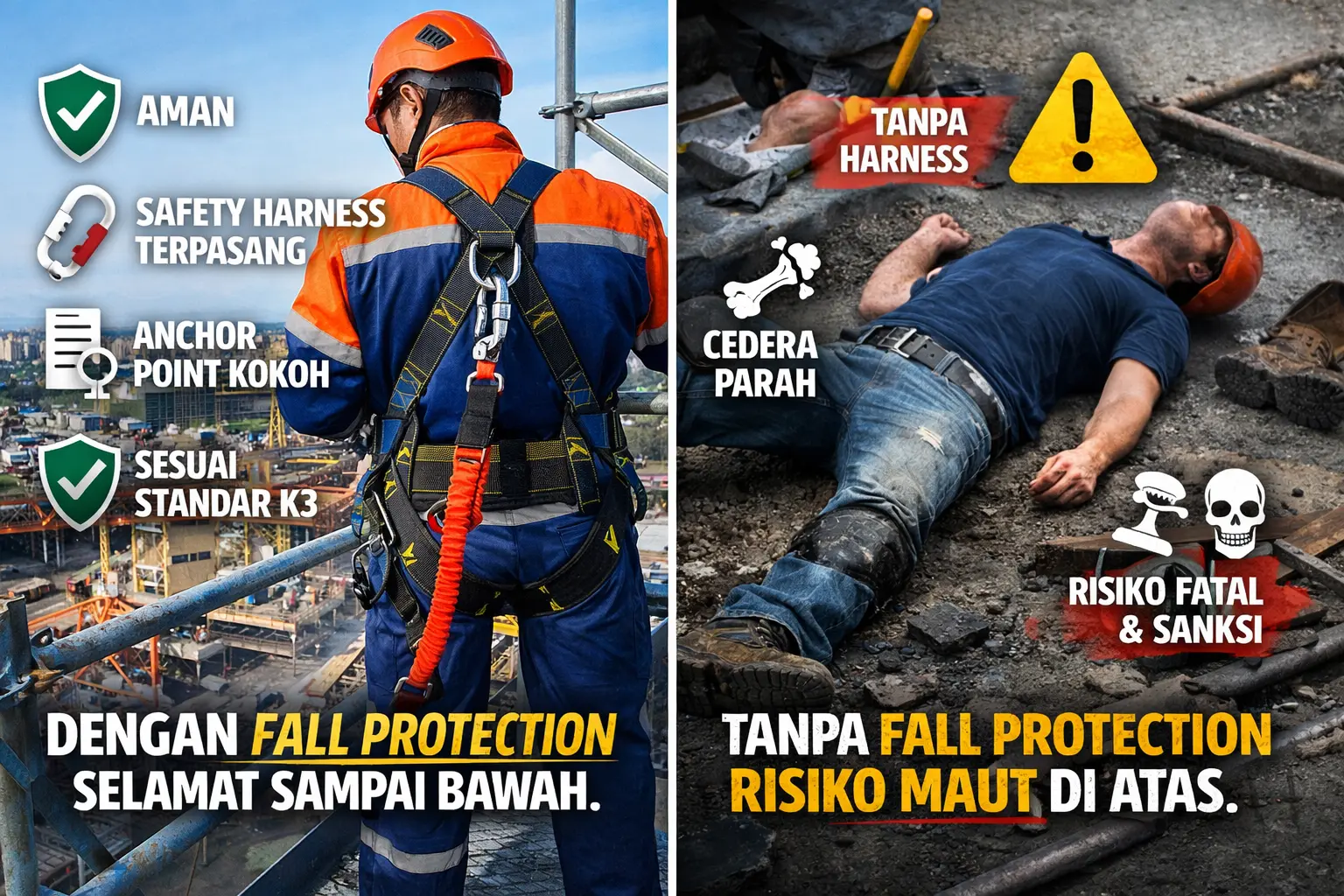
Workplace accidents resulting from falls from height remain the highest contributor to fatalities in the construction and industrial sectors. Despite continuous tightening of occupational safety regulations, fall protection implementation in the field is often neglected or inadequately executed. This article explains why fall protection is not merely an administrative obligation, but a vital system that saves workers’ lives.
Fall protection is a workplace safety system designed to prevent or arrest the fall of workers from height. This system encompasses equipment, procedures, and engineering methods that work in an integrated manner to protect workers from fall risks. Fall protection is not only about using a body harness, but also includes hazard identification, system planning, anchor point installation, and user training.
In the context of occupational safety, fall protection is part of the risk control hierarchy. This system generally consists of three main components: anchor point, connecting device (such as lanyard or lifeline), and body support (full body harness). All three elements must meet safety standards and be properly installed for the system to function effectively when a fall occurs.
Based on various international standards, work at height areas are defined as work locations where there is potential for workers to fall from an elevation that could cause serious injury or death. OSHA (Occupational Safety and Health Administration) stipulates that work at height begins at an elevation of 1.8 meters (6 feet) or more in general industry, while in construction the standard is 1.8 meters above a lower surface.
In Indonesia, K3 regulations that refer to international standards generally establish similar limits. Work at height areas include various conditions such as:
What needs to be understood is that the definition of work at height is not only about absolute height numbers. Risk also depends on the condition of the surface below, falling from 2 meters onto a concrete surface has different risks compared to falling into an area with sharp materials or operating machinery.
Data from various global occupational safety agencies shows that falls from height are consistently among the top three causes of worker fatalities. Risks of working at height without adequate fall protection systems include:
Fatal and Serious Injuries:
Risk Factors That Increase Hazards:
One often overlooked aspect is the concept of fall clearance. Even with a fall protection system, if clearance distance is not calculated correctly, a falling worker can strike objects below before the full arrest system engages. This is why technical understanding of fall distance, lanyard stretch, and deceleration distance is crucial.
Fall protection is a legal obligation in almost all jurisdictions with occupational safety regulations. However, beyond mere compliance, there are fundamental reasons why this system cannot be ignored:
1. Legal Obligation and Liability
Companies that fail to provide adequate fall protection can face legal sanctions, fines, and even operational shutdowns. Moreover, in cases of fatal accidents, management can be held criminally liable. Company liability also extends to civil aspects, including compensation for victims and families.
2. Preservation of Human Life
No operational aspect is more important than worker safety. Effective fall protection can be the difference between minor injury and death. Investment in fall protection systems is an investment in protecting a company’s most valuable asset—people.
3. Operational Continuity
Serious workplace accidents cause significant operational disruption. Accident investigations, work stoppages, impact on team morale, and company reputation are consequences that must be faced. Robust fall protection systems ensure operations run without interruption caused by safety incidents.
4. Cost of Non-Compliance
The direct and indirect costs of workplace accidents far exceed the investment in fall protection systems. Direct costs include medical treatment, compensation, and legal fees. Indirect costs encompass productivity loss, training replacement workers, investigation costs, and potential litigation.
Fall protection implementation must refer to internationally recognized standards. Several major regulations and frameworks that serve as industry references:
OSHA Standards (United States):
ANSI Standards:
ISO Standards:
European Standards:
In Indonesia, occupational safety standard implementation refers to K3 regulations issued by the Ministry of Manpower, with many adoptions from international standards. Global best practices emphasize the hierarchy of controls: hazard elimination, substitution, engineering controls, administrative controls, and lastly personal protective equipment (PPE).
Fall protection systems can be categorized based on their function and protection method:
1. Fall Restraint Systems
This system prevents workers from reaching fall hazard areas. Using lanyards with limited length connected to anchor points, ensuring workers cannot fall from edges. This is the most effective prevention method because it eliminates the possibility of falling.
2. Fall Arrest Systems
Systems that stop a worker’s fall after it has occurred. Consists of full body harness, shock absorbing lanyard, and anchor point capable of withstanding impact forces. This system must be able to stop a fall within a safe distance and distribute arrest forces to strong parts of the body.
3. Horizontal Lifeline Systems
Rails or cables installed horizontally, allowing workers to move freely along work areas while remaining connected to the system. Suitable for applications such as roofing, steel erection, or areas with multiple work positions.
4. Vertical Lifeline and Rope Access Systems
Used for vertical access such as ladder climbing or work positioning. Equipped with rope grab or fall arrester that moves with the worker and locks when a fall occurs.
5. Guardrail and Passive Systems
Physical barriers that do not require active interaction from workers. Guardrail systems are the preferred method in the control hierarchy because they provide collective protection without relying on human compliance.
6. Safety Net Systems
Passive fall arrest that catches falling workers. Used in areas where personal fall arrest systems are difficult to implement. Must be installed with strict clearance and strength requirements.
System selection depends on work task analysis, site conditions, and operational requirements. In many cases, a combination of several systems provides optimal protection.
Despite clear regulations and available equipment, fall protection implementation in the field often experiences failures. Common errors found:
Equipment and Installation Errors:
Procedural Errors:
Human Factors:
Addressing these errors requires a combination of technical solutions, administrative controls, and safety culture improvement.
Choosing the right fall protection system is not just about buying the most expensive or popular equipment. This process requires a systematic approach:
1. Conduct Site-Specific Hazard Assessment
Identify all potential fall hazards, work elevations, work tasks, and environmental conditions. Assessment must be documented and conducted by a competent person who understands fall protection requirements.
2. Determine Appropriate Protection Method
Follow the control hierarchy: can the hazard be eliminated? Is passive protection like guardrails feasible? Only then consider personal fall arrest systems if other methods are not practical.
3. Calculate Fall Clearance
Calculate total fall distance including free fall, lanyard/lifeline elongation, deceleration distance, and safety margin. Ensure adequate clearance to prevent striking lower levels or obstructions.
4. Verify Anchor Point Adequacy
Anchor points must be certified for a minimum of 5,000 lbs per attached worker (OSHA) or 22 kN (European standards). For engineered systems, structural engineers must verify anchor strength.
5. Ensure Compatibility and Compliance
All components must be compatible and comply with applicable standards. Verify certification from third-party testing labs such as ANSI, CE, or other certification bodies.
6. Consider Operational Factors
Evaluate ease of use, mobility requirements, frequency of use, and maintenance burden. Systems that are too complex or uncomfortable tend not to be used correctly in the field.
7. Plan for Emergency Rescue
A fall protection plan is incomplete without a rescue plan. Determine how suspended workers will be rescued, who is trained for rescue, and what equipment is available.
As an industrial workplace safety solution provider, Sebatek understands the complexity of fall protection implementation across various sectors from construction, manufacturing, to oil and gas. Experience working with HSE professionals and project managers provides deep insights into challenges faced in the field, from selecting the right equipment to compliance with multiple standards.
Sebatek provides consultation for fall protection system design tailored to specific site needs. This approach begins with hazard assessment, system engineering, through to implementation and training for end users. With understanding of local regulations and international standards, Sebatek helps companies build fall protection programs that are not only compliant, but also practical and sustainable in long-term operations.
Commitment to product quality and technical support makes Sebatek a reliable partner for organizations that place worker safety as the top priority in their operations.
Fall protection is not a choice, but a fundamental requirement in every operation involving work at height. Existing regulations are not merely bureaucratic requirements, but results of decades of industry experience and analysis of fatal accidents. Effective fall protection system implementation saves lives, protects companies from liability, and ensures operational continuity.
Investment in fall protection systems, training, and safety culture is an investment in human capital and sustainable operations. HSE officers and safety managers have critical responsibility to ensure there is no compromise in this aspect. With proper understanding of risks, applicable standards, and best practice implementation, organizations can create work environments where every worker returns home safely every day.