WhatsApp
+62818-0847-5888
Work Hours
Monday to Friday: 9AM - 5PM
WhatsApp
+62818-0847-5888
Work Hours
Monday to Friday: 9AM - 5PM

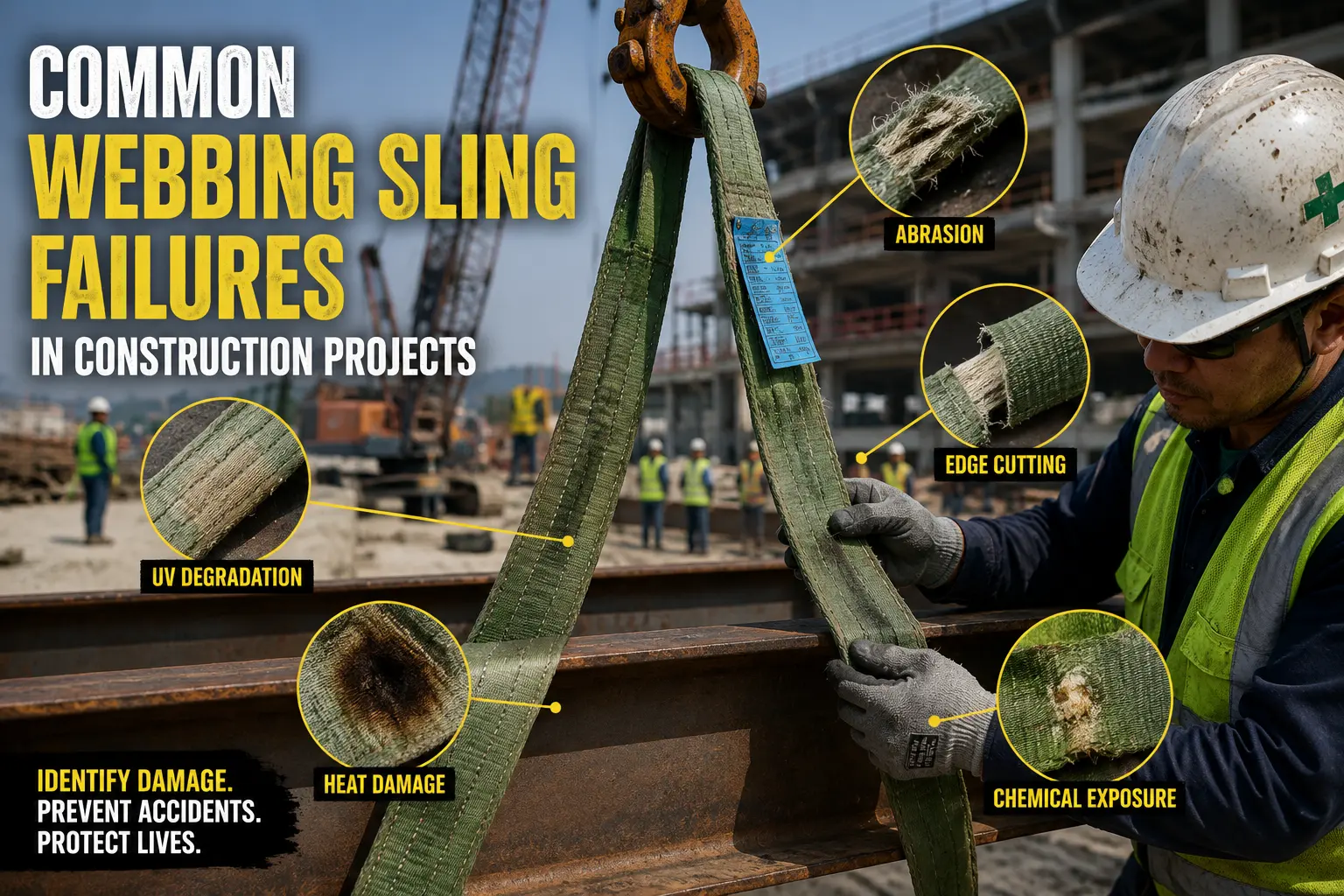
If you have spent any time managing lifts on a construction site, you know that a failed sling is not just an equipment problem. It is a potential fatality.
Webbing slings are everywhere in construction. They are affordable, lightweight, and flexible enough to handle irregular loads. But that accessibility comes with a risk most crews underestimate: webbing slings degrade fast, they hide damage well, and when they fail, they fail without warning.
I have inspected hundreds of slings on active jobsites, from high-rise steel erection projects to industrial plant shutdowns. What I keep seeing is the same pattern. Workers grab a sling from the rigging bin, give it a quick look, and hook it up. No one checks the load rating. No one looks at the stitching. No one asks when it was last inspected.
This article breaks down the most common webbing sling failures in construction projects, what causes them, how to spot them before they cause an incident, and what the regulations actually require.
No fluff. Just what you need to run safer lifts.
According to OSHA data, rigging failures are among the leading causes of crane and lifting-related fatalities in construction. A dropped load does not just injure the person beneath it. It can collapse scaffolding, strike adjacent workers, and trigger secondary failures across the entire lift zone.
Webbing slings are particularly vulnerable because they are organic materials operating in a harsh environment. UV radiation, chemical exposure, abrasion, and improper storage all shorten their working life dramatically.
The problem is compounded by how slings are treated on most sites. They get tossed in buckets, dragged across concrete, hung over rusted beams, and used by workers who received no formal rigging training. By the time visible damage appears, the sling may already be well past its safe working limit.
A single lifting sling failure on a structural steel lift can drop a multi-ton load. That is not a recoverable situation.
Before getting into specific failure types, it helps to understand the basics.
What is a webbing sling? A webbing sling is a flexible lifting device made from woven synthetic fiber, most commonly polyester. It is used to attach a load to a crane hook or hoist. Polyester webbing slings are preferred in many construction applications because polyester resists UV degradation better than nylon and does not stretch significantly under load.
What is Working Load Limit (WLL)? WLL is the maximum load a sling is rated to carry under normal, controlled conditions. It is printed on the sling’s label and is derived from the minimum breaking strength divided by a safety factor, typically 5:1 for synthetic webbing slings per ASME B30.9.
The critical point: WLL assumes the sling is undamaged, properly rigged, and used within its rated configuration. Any deviation from those conditions reduces the actual load capacity below the rated WLL.
When you rig a sling in a basket hitch, the WLL increases. When you rig it in a choker hitch, it drops to approximately 75-80% of the vertical hitch rating. When the sling is worn, chemical-exposed, or shock loaded, that rating means nothing.
What it is: Gradual erosion of the outer webbing fibers caused by contact with rough, sharp, or abrasive surfaces.
This is the most common failure mode on construction sites. Slings dragged over concrete edges, rubbed against rebar, or pulled across rough steel surfaces lose fiber integrity quickly. The outer layers of the webbing sacrifice themselves to protect the load-bearing core, but once the outer yarns are significantly worn, the inner fibers follow.
Real example: On a commercial tower project, a choker sling used daily to lift concrete panels was found with the entire outer layer worn through on one side. The sling had been running against a concrete wall edge on every pick. The core fibers had no protection left. It was removed before failure, but it had made dozens of lifts in that condition.
What it is: Physical severing or penetration of webbing fibers by sharp edges, wire rope, or protruding hardware.
A partially cut webbing sling is one of the most dangerous tools on a jobsite because it still looks usable. A cut through even 20% of the webbing width significantly reduces its capacity, but from a distance, the sling appears intact.
Sharp steel edges on structural members, wire rope contact, and even poorly stored hardware can cause cuts. Edge protection should always be used when a sling contacts any edge with a radius less than the sling’s thickness. Flat nylon or polyester sleeves and corner protectors are inexpensive. A dropped load is not.
What it is: Weakening of polyester or nylon fibers caused by exposure to acids, alkalis, solvents, or other corrosive materials.
Polyester webbing slings are resistant to many chemicals, but not immune. Acid exposure causes fiber embrittlement. Alkali exposure attacks nylon webbing at the molecular level. The problem is that chemical damage is often invisible. The fibers look fine, feel normal, and show no discoloration, but their tensile strength has been reduced dramatically.
On projects involving concrete work, battery acid, cleaning solvents, or fuel spills, slings must be inspected more frequently and retired earlier. If a sling has been exposed to an unknown chemical, pull it from service immediately.
What it is: Breakdown of synthetic fiber polymer chains caused by prolonged exposure to ultraviolet radiation.
This failure mode is insidious on long-duration outdoor projects. A sling left hanging on a crane hook or stored on an outdoor rack for weeks can lose significant tensile strength from UV exposure alone. Polyester handles UV better than nylon, but neither material is immune to prolonged solar exposure.
UV-degraded webbing often becomes stiff, brittle, or slightly discolored. But by the time you notice stiffness, the damage is already substantial.
What it is: A sudden, dynamic force applied to a sling that exceeds its WLL, typically caused by a dropped load or a jerky crane operation.
Shock loading occurs when a load in free fall is suddenly arrested by the sling. Even a load dropped a few inches can generate forces many times its static weight. A 2,000 lb load dropped 12 inches and arrested suddenly can generate a dynamic load of 10,000 lb or more, far exceeding the sling’s WLL.
This is a failure mode that construction crews consistently underestimate. Operators who pick loads with a sudden jerk, or loads that slip and catch, are shock loading their slings regularly. The webbing may not fail on the first overload, but the cumulative damage accumulates invisibly in the fiber structure.
ASME B30.9 explicitly prohibits shock loading of slings. OSHA 1910.184 requires that slings subjected to shock loading be removed from service immediately and inspected before reuse.
What it is: Using a sling in a configuration that exceeds its design parameters, such as extreme choker angles or basket hitch angles below 45 degrees.
Sling angle matters enormously. As the angle between the sling leg and the horizontal decreases below 60 degrees, the tension in each sling leg increases significantly. At a 30-degree horizontal angle, the tension in each sling leg is double the weight being lifted.
Many construction workers have never seen a sling angle chart. They rig a two-leg bridle at a tight angle, load it up, and wonder why the sling failed when it was “rated for more than that.”
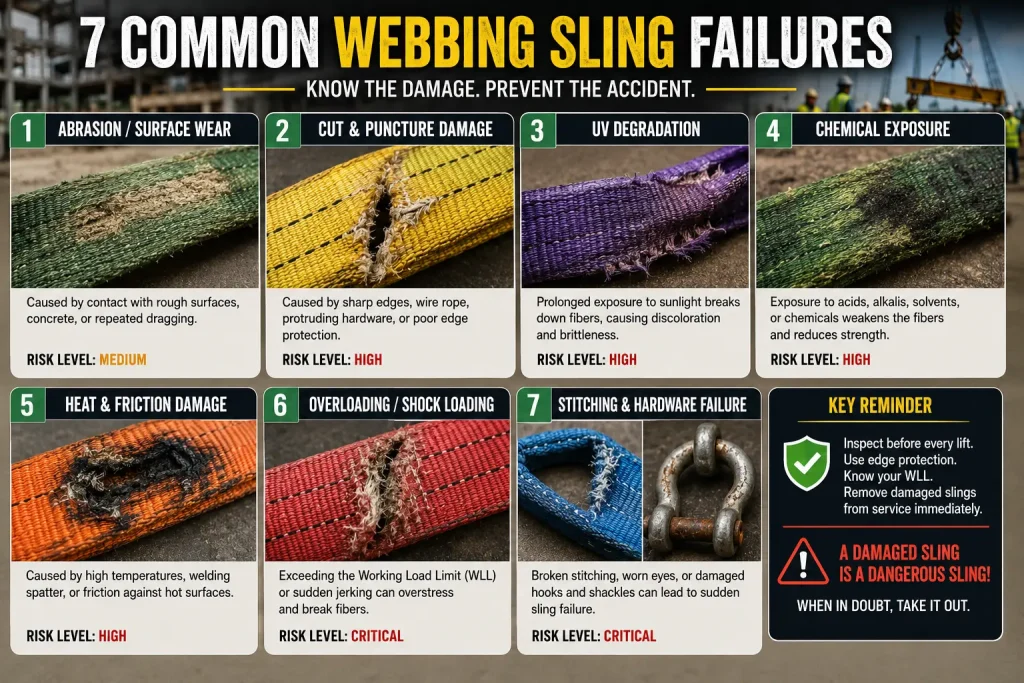
Failure at the sling’s eyes, end fittings, or the hooks and shackles connecting it to the load or crane.
The webbing body of a sling gets most of the inspection attention, but the eyes and hardware connections are equally critical. Worn eye protection sleeves, spread or deformed master links, and incorrect hook sizing can all lead to catastrophic failures even when the webbing itself is in good condition.
A hook with a gate that does not close properly, or a shackle pin that is hand-tight instead of properly torqued, can release under load. These are rigging failures that fall under the same category as sling failure from a liability and safety standpoint.
Experienced riggers know to look beyond the obvious. Here are the damage indicators that frequently get missed on pre-use inspections:
| Symptom Observed | Likely Cause | Required Action |
|---|---|---|
| Cuts, tears, or holes | Sharp edge contact | Remove from service immediately |
| Abrasion through outer layers | Surface wear | Remove from service if core is exposed |
| Stiff or brittle webbing | UV or chemical damage | Remove from service, do not use |
| Missing or illegible ID tag | Unknown history | Remove from service immediately |
| Discoloration (not dirt) | Chemical exposure | Remove from service, investigate chemical contact |
| Distorted or melted fibers | Heat or friction damage | Remove from service immediately |
| Worn or damaged eye sleeves | Normal use wear | Inspect stitching; remove if compromised |
| Puckering or wavy webbing | Internal fiber damage / overload | Remove from service immediately |
| Deformed end hardware | Overload or improper use | Remove from service, inspect all hardware |
| Any kinking or twisting | Shock load or improper storage | Remove from service, inspect before reuse |
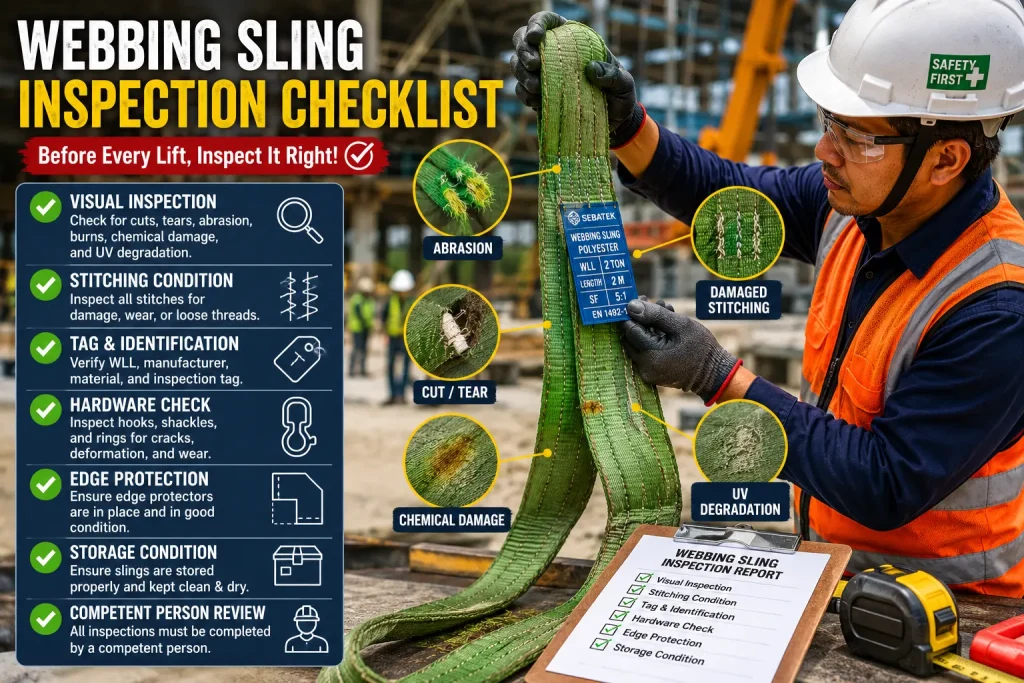
Use this checklist before every lift. A “No” answer on any item means the sling does not go on the hook.
Two regulatory frameworks govern webbing sling use in construction and general industry.
OSHA 1910.184 (Slings) covers sling inspection, use, and removal from service for general industry. Key requirements include:
OSHA 1926 Subpart CC and 1926.251 address rigging requirements in construction, incorporating similar sling safety requirements for construction worksites.
ASME B30.9 (Slings) provides the technical standard that defines WLL calculations, inspection criteria, and sling configuration limits. Key provisions include:
A competent person under both OSHA and ASME is someone who can identify existing and predictable hazards in the rigging environment and has the authority to take corrective action. This is not simply anyone with a hard hat. It requires demonstrated knowledge of rigging principles, sling types, and failure indicators.
Prevention is cheaper than incident investigation. Here is what actually works on construction sites:
Tag out damaged slings immediately. Do not leave them in the rigging bin “for later.” Cut them or mark them permanently destroyed so they cannot be accidentally reused.
Use edge protection every time. Flat webbing corner protectors, edge sleeves, or even folded rubber should be standard practice when slings contact structural steel edges or concrete corners.
Train riggers on sling angle effects. Post a sling angle capacity chart at every rigging station. Workers who understand the math make better decisions on the ground.
Implement a sling inventory system. Each sling should have a unique identifier, an inspection log, and a retirement date. Rotating through anonymous slings from a shared bin is a recipe for using degraded equipment.
Store slings properly. Clean, dry, away from sunlight, chemicals, and heat. Not draped over a beam or thrown in the back of a pickup.
Brief operators on smooth picks. Sudden crane movements kill slings. A culture of controlled lifting protects equipment and people.
Remove any webbing sling from service immediately if any of the following conditions exist:
When in doubt, it goes out of service. No lift is worth a fatality.
The rigging and lifting safety industry is not standing still. Several developments are worth monitoring:
RFID-tagged slings are emerging in industrial applications, allowing digital inspection records linked directly to individual slings. A scanner reads the tag and pulls up the full maintenance history before the sling is rigged.
Smart shackles and load cells are becoming more affordable, giving operators real-time load data during picks. This reduces overloading and shock loading incidents by alerting the crew when forces exceed parameters.
Drone-assisted pre-lift inspection is being piloted on large construction projects, allowing inspectors to examine slings and rigging from angles that are difficult or dangerous to reach manually.
Synthetic fiber monitoring research is advancing, with some manufacturers working on fibers that change color when exposed to chemicals or UV degradation above a threshold level, providing a built-in visual warning system.
These tools will improve safety across the industry. But none of them replace the fundamental requirement: a trained, attentive rigger conducting a thorough inspection before every lift.
Webbing sling failures in construction are not random events. They are predictable, preventable, and almost always traceable back to damaged equipment that should have been pulled from service.
The seven failure types covered here, from abrasion and chemical degradation to shock loading and improper rigging configurations, account for the vast majority of sling-related incidents on construction sites. Every one of them can be caught before they cause a dropped load, if the pre-use inspection is taken seriously and conducted by someone who knows what they are looking for.
OSHA 1910.184 and ASME B30.9 set the minimum baseline. Good rigging programs go further: documented inspection records, trained and designated riggers, edge protection as standard practice, and a culture where pulling a questionable sling is the expected behavior, not the exception.
The cost of a quality rigging audit or a professional sling inspection program is a fraction of what a single serious incident costs in workers’ compensation, litigation, project delays, and human loss.
If your site has not had a professional lifting safety audit in the last 12 months, or if your rigging team has not been formally trained on sling inspection and failure indicators, consider scheduling a consultation with a certified rigging engineer or construction safety consultant. A thorough sling safety audit can identify exposure your team may not even know exists.
Safe lifts do not happen by accident.
References: OSHA 1910.184 (Slings), OSHA 1926.251 (Rigging equipment for material handling), ASME B30.9 (Slings), ASME B30.26 (Rigging Hardware)
