WhatsApp
+62818-0847-5888
Work Hours
Monday to Friday: 9AM - 5PM
WhatsApp
+62818-0847-5888
Work Hours
Monday to Friday: 9AM - 5PM

 Byadmin
HSE (Health and Safety Executive) guides employers through systematic risk assessment, regulatory compliance, and hierarchy-of-control principles to select appropriate fall protection systems. This includes evaluating work-at-height hazards, specifying technical parameters such as fall clearance and anchor point loading, and determining whether restraint or fall arrest systems are required.
Falls from height remain one of the leading causes of fatal workplace injuries across construction, utilities, and industrial maintenance sectors. Selecting the right fall protection system is not simply a purchasing decision, it is a risk management process governed by a structured HSE methodology. The Health and Safety Executive’s Work at Height Regulations 2005 (as amended) establish a clear framework that employers must follow, and understanding that framework is essential for anyone responsible for specifying or procuring fall protection equipment.
This article explains how HSE guidance shapes risk assessment practices, system selection criteria, and compliance obligations, with practical context for those working in construction, warehousing, telecommunications infrastructure, and general industry.
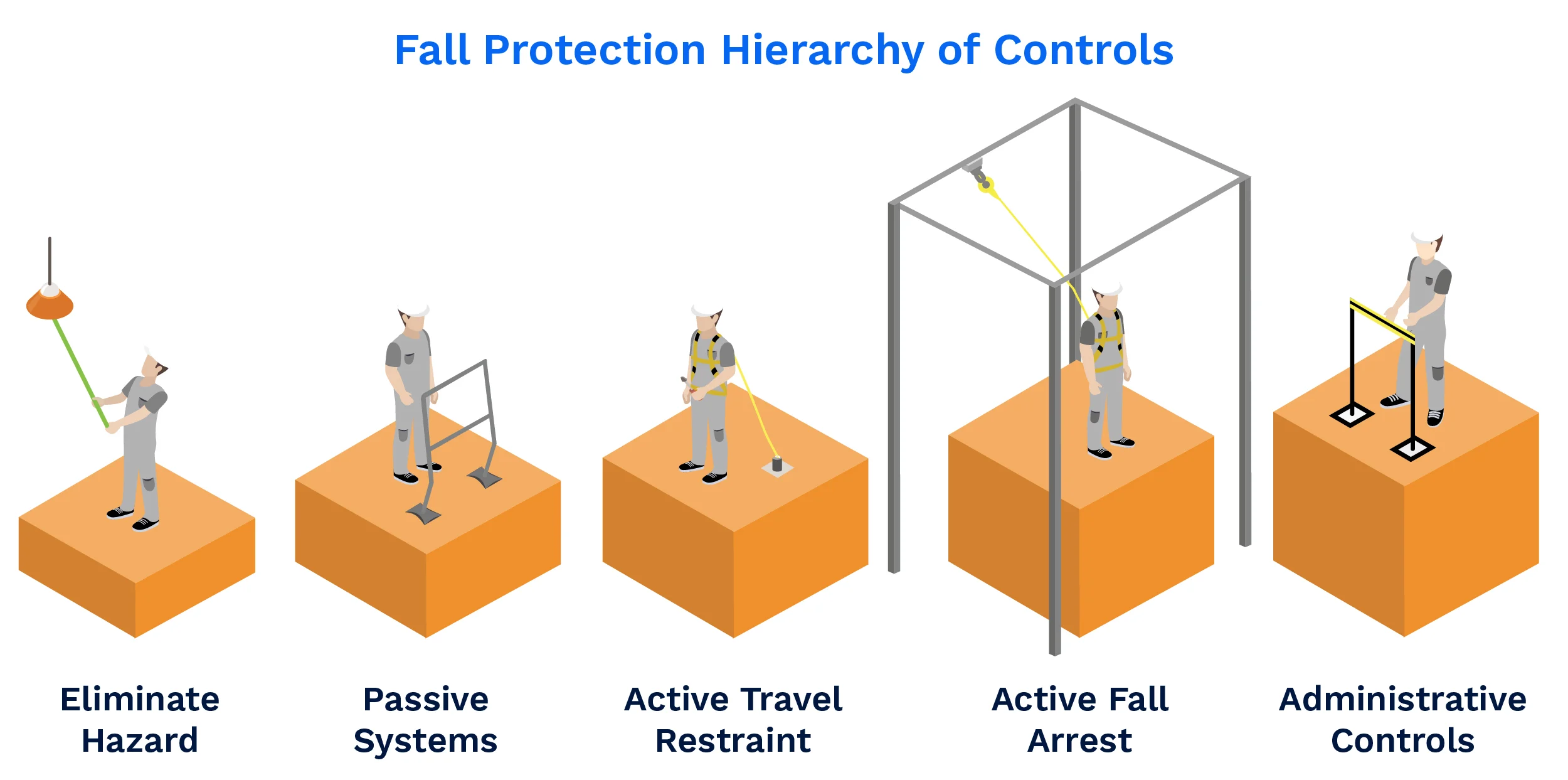
Before any fall protection product is specified, HSE requires employers to work through a defined hierarchy of control. This is not optional guidance, it is a legal obligation under Regulation 6 of the Work at Height Regulations 2005.
The hierarchy operates in three tiers. First, employers must determine whether work at height can be avoided entirely, for example, by redesigning a maintenance task so it can be completed from ground level using long-reach tools or remote technology. If avoidance is not reasonably practicable, the next step is to prevent a fall from occurring through the use of physical barriers such as edge protection, guardrails, or working platforms with toe boards. Only where prevention is not practicable should mitigation systems, including personal fall protection equipment, be selected.
This sequence matters significantly in practice. A roofing contractor who installs fall arrest lanyards without first evaluating whether a collective protection system (such as edge guardrail) is feasible is not complying with the hierarchy and may face enforcement action following an HSE inspection.
Risk assessment is the foundation of every fall protection decision. HSE’s guidance requires a structured evaluation that considers the nature of the task, the working environment, the duration of exposure, and the competency of workers involved.
A thorough risk assessment begins with identifying all surfaces or edges from which a person could fall. In a steel-frame construction project, this might include unprotected floor edges, roof perimeters, stairwell openings, and fragile roof materials. In a warehouse setting, elevated mezzanine platforms and loading bay edges represent distinct hazard categories, each requiring separate evaluation.
HSE guidance directs assessors to consider not only the height of a potential fall but also what lies below, a fall of 2 metres onto a hard concrete surface carries different consequences than a fall of the same height into a safety net.
The risk assessment must weigh the likelihood that a fall will occur against the likely severity of injury. HSE encourages the use of established risk rating tools, but the process should not become purely numerical. A low-probability event that could result in a fatal outcome, such as a worker losing balance on an unguarded rooftop, must be treated with the same seriousness as a high-probability, low-severity hazard.
Once the risk has been characterised, HSE guidance directs system selection based on specific technical parameters. Getting these parameters right is critical, undersizing a system or miscalculating clearance can turn a fall arrest event into a fatality.
Fall clearance is the total vertical distance required below a worker’s anchor point to ensure they are arrested before striking a lower surface. It is not simply the length of a lanyard. A standard 2-metre energy-absorbing lanyard, when fully deployed, adds approximately 1.75 metres of extension during arrest. Add worker height (typically calculated from the dorsal D-ring at approximately 1.4–1.5 metres from the ground), and the minimum clearance required below the anchor point approaches 6 metres in many configurations.
HSE guidance, supported by BS EN 363 and associated standards, requires that fall clearance be calculated for every individual anchor point location before a fall arrest system is specified. Where insufficient clearance exists, the system design must change, either by selecting a shorter self-retracting lifeline (SRL), repositioning the anchor point, or reconsidering whether fall arrest is even appropriate.
HSE requires that anchor points used with personal fall protection systems be capable of withstanding the dynamic forces generated during arrest. Under EN 795, a single-person anchor must withstand a test force of 12 kN. Where two or more users are connected, the anchor must be rated accordingly, or a dedicated multi-user anchor system must be installed.
In practice, this means structural engineers or competent installers must assess the substrate before any anchor is fitted. A steel purlin in a light industrial building, for example, may not have adequate capacity to serve as a fall arrest anchor without additional engineering assessment.
One of the most consequential decisions in fall protection specification is whether a restraint system or a fall arrest system is appropriate. HSE guidance is clear on the distinction. A restraint system prevents a worker from reaching a fall hazard, the lanyard length is set so the worker physically cannot get close enough to an unprotected edge to fall. No fall event occurs, and no arrest forces are generated.
A fall arrest system, by contrast, is designed to stop a worker after a fall has begun. It generates significant arrest forces, typically 6 kN or more at the dorsal attachment point, and requires the fall clearance calculations described above.
In practical terms, a telecoms engineer working on a rooftop parapet might use a restraint lanyard set to a length that keeps them 1 metre from the unprotected edge. If the task requires them to lean over the edge, a restraint system is no longer appropriate, and a fall arrest solution with adequate clearance below the working position must be specified.
Selecting the right system is only part of the obligation. HSE guidance under the Work at Height Regulations requires that all persons involved in planning, supervising, and carrying out work at height are competent to do so. This applies to those specifying fall protection equipment, those installing anchor points, and the workers who use the equipment daily.
A fall protection plan should be prepared or reviewed by a competent person, someone with the combination of training, knowledge, and experience to identify and control the risks involved. In high-risk environments such as telecommunications mast climbing or structural steelwork, this typically means an individual with relevant formal training (such as IPAF, PASMA, or manufacturer-specific instruction) and documented site-specific experience.
HSE inspectors routinely examine whether competency records are available and current during site visits. Employers who cannot demonstrate that the person who selected their fall protection system had appropriate competency may face prohibition or improvement notices.
Use this checklist when reviewing or specifying a fall protection system for any work-at-height task.
Site and Hazard Assessment
Hierarchy of Control Applied
Technical Parameters Verified
Equipment and Installation
People and Process
The role of HSE in determining fall protection systems extends well beyond regulatory compliance. The HSE framework, grounded in the hierarchy of control, systematic risk assessment, and clearly defined technical parameters, provides a decision-making structure that, when followed correctly, significantly reduces the likelihood of a fatal or serious fall event. From calculating fall clearance to specifying anchor point capacity and distinguishing between restraint and arrest applications, every element of the selection process carries consequences for worker safety.
Employers, safety managers, and procurement professionals who engage with this framework proactively, rather than reactively, are better positioned to select systems that are not only compliant but genuinely protective.
HSE does not mandate specific brands or products. Instead, it requires that any fall protection equipment meet the relevant harmonised European standards (now retained in UK law as UKCA-marked products post-Brexit), that the selection is based on a suitable and sufficient risk assessment, and that the system is appropriate for the task and environment. Employers have flexibility in product selection provided these conditions are met.
For personal fall arrest systems, anchor points must withstand a minimum test load of 12 kN for a single user, in accordance with EN 795. This is a dynamic test requirement. Structural assessment by a competent engineer is required before any anchor is installed, as the rated capacity of the anchor must account for the substrate to which it is fixed, not just the hardware itself.
A restraint system should be used when the hazard can be fully eliminated by preventing the worker from reaching the fall edge. It is the preferred option where it is practicable because it eliminates the risk of a fall entirely, avoids the need for complex clearance calculations, and removes suspension trauma risk. Fall arrest should only be specified where restraint is not practicable for the task.
Yes. The Work at Height Regulations 2005 require employers to ensure that procedures are in place for rescuing a worker following a fall arrest event. Suspension trauma, a potentially life-threatening condition, can develop within minutes in a suspended harness. A rescue plan must be site-specific, practicable with the resources available, and all relevant personnel must be trained in its execution.
HSE requires pre-use checks by the wearer before each use and formal periodic inspections by a competent person at intervals not exceeding 12 months (or more frequently if the manufacturer or risk assessment dictates). Any equipment involved in a fall arrest event must be immediately withdrawn from service, regardless of visible condition, and returned to the manufacturer or a competent inspector for assessment before any decision to return it to use.
This article is intended for informational purposes. Always consult current HSE guidance, applicable British and EN standards, and a competent fall protection specialist when specifying systems for your specific work environment.
© sebatek.id | HSE Role in Selecting Fall Protection Systems | Indonesia