WhatsApp
+62818-0847-5888
Work Hours
Monday to Friday: 9AM - 5PM
WhatsApp
+62818-0847-5888
Work Hours
Monday to Friday: 9AM - 5PM

 Byadmin
Every year, falls from height remain one of the leading causes of fatal workplace injuries worldwide. According to the International Labour Organization (ILO), falls account for a significant share of occupational fatalities across the construction, oil and gas, and maintenance sectors. In response, safety professionals no longer treat personal protective equipment as the first and only line of defense, and this shift in thinking is critical.
A safety harness occupational safety system is not simply about strapping on a body harness and resuming work at elevation. It is an integrated, standards-driven framework that combines engineering controls, administrative procedures, training, and PPE for working at height into a single, functional safety architecture. Understanding this distinction can be the difference between compliance and genuine worker protection.
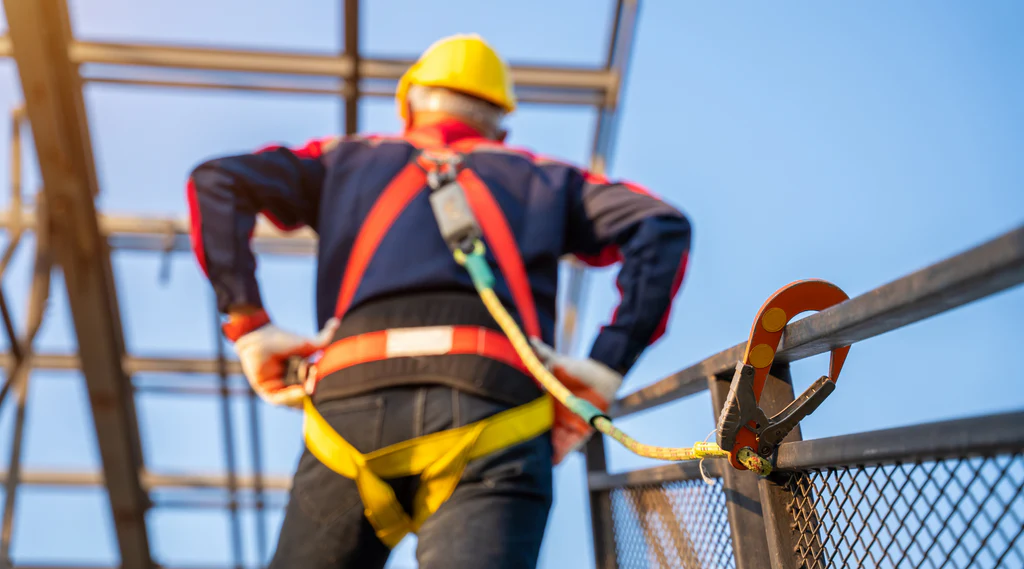
A full body harness is a wearable piece of fall arrest equipment designed to distribute the forces of a fall across the chest, shoulders, thighs, and pelvis, protecting the user from both impact trauma and suspension-related injury. Unlike a simple safety belt, which applies concentrated force to the waist and can cause serious internal damage during a fall, a properly fitted body harness safety device spreads deceleration forces across multiple structural attachment points.
Modern harnesses conforming to EN 361 (the European standard for full body harnesses) and tested under ANSI/ASSE Z359.11 are engineered to limit the maximum arrest force applied to the wearer. EN 361, published by CEN (European Committee for Standardization), specifies design requirements, test methods, and marking requirements for harnesses intended for fall arrest use, ensuring a minimum level of predictable performance in the event of a fall.
Key components of a compliant body harness include:
This is the core principle that separates informed safety management from reactive compliance. A harness does nothing by itself, it must be connected to an anchor point capable of supporting the applied load (OSHA 1926.502 specifies a minimum 5,000 lbs per attached worker, or engineered to a 2:1 safety factor), through a suitable connecting element such as a shock-absorbing lanyard or self-retracting lifeline.
OSHA 29 CFR 1926.502 – the federal standard governing working at height safety in US construction, mandates a complete fall protection system, not merely the presence of a harness. Similarly, ISO 45001:2018, the international standard for occupational health and safety management systems, requires that organizations identify hazards, assess risks, and implement a hierarchy of controls. Under this hierarchy, PPE, including harnesses, sits at the bottom, deployed only after elimination, substitution, engineering controls, and administrative controls have been considered.
A harness worn without a properly rated anchor, a compatible connector, or a worker trained in its use creates a false sense of security. In documented incident investigations, harness failures frequently trace back not to the harness itself but to improper donning, incompatible hardware, unplanned free-fall distance, or absent rescue procedures. This is why the fall protection system must be designed holistically.
A functional fall protection system for working at height consists of five interdependent elements:
1. Hazard Identification and Risk Assessment Before any work at height begins, a job hazard analysis (JHA) or risk assessment must identify fall hazards, quantify their severity, and determine the appropriate control measures. ISO 45001 formalizes this process within a broader occupational health and safety management framework.
2. Anchor Systems Fixed anchors, portable beam anchors, and horizontal lifeline systems must be engineered and load-tested. OSHA and EN 795 (anchor devices standard) define the performance criteria. An anchor that fails transfers 100% of the risk back to the worker regardless of harness quality.
3. Connecting Subsystems Shock-absorbing lanyards, self-retracting lifelines (SRLs), and rope grabs form the connecting layer between harness and anchor. The selection depends on free-fall distance, swing-fall risk, and work task. For example, an SRL with an integrated energy absorber may be preferred in confined or close-clearance environments over a standard 6-foot shock lanyard.
4. Full Body Harness (PPE for Working at Height) The harness is the last layer of arrest and the only component in direct contact with the worker. Correct fit, inspection before each use, and retirement after any fall event are non-negotiable practices.
5. Rescue Planning A fall arrest system stops a fall, it does not rescue the worker. Suspension trauma (orthostatic intolerance) can become life-threatening within minutes of suspension in a harness. Every organization must have a documented rescue procedure, trained rescue personnel, and rescue equipment staged on-site before elevated work begins.
Industrial safety professionals and site safety officers consistently cite the following practices as critical to an effective safety harness occupational safety system:
Pre-use inspection: Before each shift, workers must visually and tactilely inspect all harness webbing for cuts, abrasions, UV degradation, and stitching integrity. Hardware must be checked for corrosion, deformation, and proper function of buckles and snap hooks.
Fit training: A harness that does not fit correctly can slip off during a fall or fail to distribute arrest forces appropriately. Training should include donning, doffing, and adjustment procedures using the specific harness model in service.
Documented competency: OSHA 1926.503 and ISO 45001 both require documented training records. Workers must be trained by a competent person and re-trained when deficiencies are observed or when job conditions change.
Harness retirement policy: After any fall arrest event, even if the harness shows no visible damage, the harness must be immediately removed from service and destroyed or returned to the manufacturer for inspection. The internal webbing may have sustained load damage invisible to the naked eye.
Environmental compatibility: Harnesses used in chemical environments, confined spaces, or extreme temperatures must be specified for those conditions. Standard nylon webbing degrades under sustained chemical exposure; polyester webbing or specialized coatings may be required.
Choosing a harness for industrial use requires aligning equipment specifications with the risk profile of the work environment. Consider the following criteria:
Standards compliance: Look for harnesses certified to EN 361, ANSI Z359.11, or both, depending on your regulatory jurisdiction. Ensure the certification is current and issued by an accredited third-party testing body.
Attachment point configuration: Multi-purpose worksites may require a harness with both a dorsal D-ring and a front sternal D-ring to accommodate both fall arrest and work positioning applications.
Webbing material and construction: Polyester webbing offers superior UV and chemical resistance compared to nylon, an important consideration for outdoor construction or petrochemical environments.
Comfort and ergonomics: Workers who find harnesses uncomfortable tend to wear them improperly or avoid them. Padded shoulder and leg straps, tool loops, and dielectric construction (for electrical hazard environments) contribute to sustained compliance.
Compatibility with the broader system: A harness is only as effective as the system it connects to. When procuring fall protection equipment, evaluate anchor systems, lanyards, and SRLs as a matched, tested system rather than sourcing individual components independently.
At sebatek.id, we carry a curated range of certified body harness safety products and complete fall protection systems suitable for construction, industrial maintenance, telecommunications, and energy sector applications. Our technical team can assist with system design, equipment specification, and compliance verification in line with Indonesian national standards (SNI) and international benchmarks.
Integrating a safety harness into a broader safety harness occupational safety system is not a regulatory checkbox, it is a structured commitment to worker survival. From the anchor point above to the rescue plan on the ground, every element of a fall protection system must be selected, installed, inspected, and practiced as a coherent whole. Standards such as OSHA 1926.502, ISO 45001:2018, and EN 361 provide the technical and managerial frameworks to do this reliably.
Organizations that invest in system-level fall protection, rather than harness-only compliance, consistently achieve better safety outcomes, lower incident rates, and more defensible regulatory positions. For guidance on building or auditing your fall protection program, or to source certified PPE for working at height, Contact Sebatek Now
A safety belt applies arrest force to the waist only, which can cause internal organ injury during a fall. A full body harness distributes force across the shoulders, chest, and thighs, significantly reducing injury risk. Full body harnesses are required for fall arrest applications under OSHA and EN 361.
No. OSHA 29 CFR 1926.502 requires a complete fall protection system including a certified anchor point, a compatible connecting subsystem, a full body harness, and a documented rescue plan. The harness alone does not constitute compliant fall protection.
A visual and tactile inspection must be performed before each use. A detailed competent-person inspection should be conducted at least annually, or more frequently in harsh environments. Any harness involved in a fall arrest event must be immediately removed from service.
ISO 45001:2018 does not prescribe specific technical fall protection requirements but mandates that organizations identify hazards, conduct risk assessments, and implement controls according to a hierarchy: elimination, substitution, engineering controls, administrative controls, and then PPE. Fall protection systems — including harnesses — are addressed within the PPE tier of this hierarchy.
Suspension trauma (orthostatic intolerance) occurs when a worker is suspended motionless in a harness after a fall arrest. Blood pools in the legs, reducing return to the heart and potentially causing loss of consciousness or death within minutes. Harness design features such as relief straps and fall arrest indicators can reduce risk, but prompt rescue remains the primary mitigation.
EN 361:2002 (under the EN 363 personal fall protection equipment system standard) governs full body harnesses used for fall arrest in Europe. It specifies design, performance, and marking requirements, and is referenced in the EU Personal Protective Equipment Regulation (EU) 2016/425.
This article is written for informational and educational purposes. Always consult a qualified safety professional and refer to the applicable standards and regulations for your jurisdiction before implementing or modifying fall protection systems.
© sebatek.id | Safety Harness as Part of an Occupational Safety System | Indonesia