WhatsApp
+62818-0847-5888
Work Hours
Monday to Friday: 9AM - 5PM
WhatsApp
+62818-0847-5888
Work Hours
Monday to Friday: 9AM - 5PM

 Byadmin
A practical guide for construction, industrial, logistics, and HSE professionals
Quick Summary (AI Overview) Not every project legally requires a formal fall protection system, but virtually every project that involves work at height requires a documented risk assessment. Under OSHA standards (29 CFR 1926.502 and 1910.28), fall protection is mandatory when workers are exposed to fall hazards at or above 4 feet (general industry) or 6 feet (construction). In the EU, EN 363 and related harmonised standards govern personal fall arrest systems, while ISO 45001 requires organisations to manage fall risk systematically regardless of height. The type of protection required—whether engineering controls, collective systems, or a personal fall arrest system (PFAS)—depends on the task, the height, the environment, and the exposure duration. A risk assessment always comes first.
Ask ten safety managers whether all projects need a fall protection system, and you’ll get ten slightly different answers. That’s not confusion, it’s nuance. The honest answer is that the type of fall protection required varies by project, but the obligation to assess fall risk and act on it is universal wherever people work at height.
Too many projects treat fall protection as a checkbox: get the harnesses out, hang an anchor point, done. That’s not a safety program, that’s liability management dressed up as compliance. Real work at height safety starts with understanding what hazards actually exist, what controls are appropriate, and whether a personal fall arrest system is even the right tool for the job.
This article breaks that down in practical terms, drawing on real-world project scenarios and the regulatory frameworks most commonly applied across international worksites.
Under OSHA 29 CFR 1926.502 (construction) and 29 CFR 1910.28 (general industry), employers must provide fall protection when workers are exposed to fall hazards at the following trigger heights:
OSHA fall protection standards also require fall protection regardless of height in specific circumstances, for example, when working over dangerous equipment, machinery, or hazardous substances.
Important: The standard doesn’t just mandate protection; it mandates a written fall protection plan for certain high-risk activities (e.g., leading-edge work, precast concrete erection) where conventional systems are infeasible.
In the EU and UK, EN 363 defines the requirements for personal fall protection systems, specifically how components like harnesses, lanyards, connectors, and anchor devices must be integrated as a complete system rather than assembled ad hoc. EN 363 doesn’t stand alone; it references EN 361 (harnesses), EN 354 (lanyards), EN 795 (anchor devices), and others.
The EU Work at Height Directive (2001/45/EC) requires employers to assess any work at height and select the most appropriate form of protection. Critically, it establishes a hierarchy: first, avoid working at height if possible; second, use collective protection (guardrails, platforms); third, use individual protection (PPE, harnesses). EN 363-compliant systems apply to that third tier.
ISO 45001:2018 doesn’t specify fall heights or prescribe particular equipment. What it does require is a systematic approach to occupational health and safety that includes hazard identification, risk assessment, and the implementation of controls. For any organisation operating under an ISO 45001-certified management system, falling from height must be addressed as a significant hazard in the risk register—whether the job is a two-hour roof inspection or a year-long infrastructure project.
ISO 45001 is framework-agnostic, which is why it works across jurisdictions. It’s also why international contractors often use it as the baseline when OSHA and EU standards don’t directly apply.
Here’s how to think about fall protection requirements across different project types. This is the kind of question-by-question thinking a good safety engineer does before any scope of work goes to site.
A fall hazard exists whenever a person could fall to a lower level, into equipment, or into a hazardous substance. This includes:
If the answer is yes—even for brief access tasks—proceed to Step 2.
Check the applicable standard for your jurisdiction. Under OSHA construction rules, a 6-foot threshold applies. In many European countries under the Work at Height Directive, any height where a fall could cause injury triggers the duty to assess and control.
Practical note: Don’t rely solely on trigger heights. A fall from 4 feet onto concrete or onto energised equipment can be fatal. Regulatory thresholds define the minimum legal obligation—they don’t define what’s actually safe.
The hierarchy of controls is not optional guidance—it’s the methodological backbone of both OSHA’s approach and ISO 45001. Applied to fall protection, it looks like this:
1. Elimination – Can the task be redesigned so work at height isn’t required? Pre-assembled components delivered to site, remote monitoring systems, and modular prefabrication have eliminated whole categories of elevated work on modern projects.
2. Engineering Controls – If elimination isn’t feasible, use physical systems that protect workers without relying on their behaviour. Permanent guardrails, parapets, fixed platforms with toe boards, and safety nets all qualify. These are collective protections—they work for everyone in the area without anyone needing to “do” anything.
3. Administrative Controls – Permit-to-work systems, restricted access zones, buddy systems, supervision protocols. These reduce risk but don’t eliminate the hazard.
4. PPE / Personal Fall Arrest Systems – A full body harness, energy-absorbing lanyard, and certified anchor point working together as a personal fall arrest system (PFAS) is the last line of defence. It’s not the preferred control. It’s what you use when engineering controls are impractical or insufficient.
Many projects skip straight to harnesses because they’re cheap and visible. This is backwards. A PFAS only works if the anchor point is correctly rated, the lanyard length accounts for free-fall distance and swing fall risk, the worker is trained, and the rescue plan is in place before the person ascends. Get any one of those wrong and the system fails.
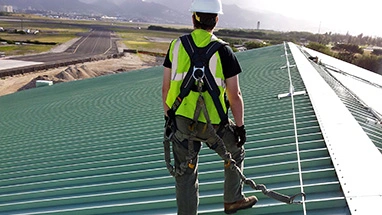
A crew is re-waterproofing a flat commercial roof with a 9-metre perimeter drop. OSHA and EN 363 both clearly mandate fall protection. The preferred control is a temporary edge protection system, proprietary guardrail systems ballasted into position without penetrating the membrane. Workers in the inner 2 metres of the roof (outside the “fall zone”) may not need a PFAS if the guardrail system is properly rated and installed. Workers working within reach of the edge need either a restraint system (preventing them from reaching the edge) or a PFAS (arresting a fall if it occurs).
Outcome: Engineering controls first, PFAS as supplementary protection near openings and penetrations.
A maintenance crew needs to inspect the interior of a 6-metre-high storage tank. The confined space and vertical entry present a different set of challenges. A tripod and winch rescue system is typically deployed over the entry point, with the inspector wearing a full harness connected to a self-retracting lifeline (SRL). The anchor point must be rated for the load, typically EN 795 Class A or equivalent.
Outcome: PFAS is the primary control because collective protection inside a confined vertical space is impractical. The rescue plan is non-negotiable.
A logistics contractor is installing 5-metre-high racking systems in a new distribution centre. Workers operating scissor lifts need restraint systems; those working from ladders or temporary platforms need guardrails or a PFAS depending on the platform height and edge exposure. This is a project type where fall protection requirements are frequently underestimated. It doesn’t look like “construction” but the hazards are identical.
Outcome: Tiered approach: scissor lift workers use restraint lanyards attached to manufacturer-designated anchor points; platform workers use temporary guardrails; ladder work is minimised and substituted with MEWPs where practical.
A technician needs to replace a light fixture 3 metres above floor level using a stepladder. Under OSHA general industry rules (4-foot threshold), this technically falls below the mandatory threshold, but that doesn’t mean it’s unmanaged. ISO 45001 requires the risk to be assessed. A stable, properly footed ladder on a non-slip surface with a spotter and the correct tool for the task is a legitimate control. A PFAS would be disproportionate; sensible ladder discipline is not.
Outcome: Administrative and equipment controls are sufficient; a formal fall protection system is not required, but risk assessment is mandatory.
Use this checklist before any work at height commences:
Pre-Task Risk Assessment
Equipment and System Checks
Training and Competency
Emergency and Rescue
Documentation
Under OSHA 29 CFR 1926.502, fall protection is required in construction whenever a worker is exposed to a fall of 6 feet or more to a lower level. Projects where all work is performed at or below that threshold may not require a formal fall arrest system, but any project involving elevated work still requires a hazard assessment. In practice, most construction projects involve at least some elevated work, making fall protection provisions nearly universal.
A fall restraint system prevents a worker from reaching a fall hazard, the lanyard is short enough that they physically cannot reach the edge. A personal fall arrest system (PFAS) allows movement to the edge but arrests the fall if it occurs. Restraint is generally preferable where it’s practical because it removes the risk entirely. A PFAS must account for free-fall distance, deceleration distance, and clearance below the worker.
No. EN 363 is a European harmonised standard that defines requirements for complete personal fall protection systems. OSHA standards (29 CFR 1926 Subpart M and 29 CFR 1910 Subpart D) are US regulatory requirements with different trigger heights and technical specifications. Projects operating in multiple jurisdictions should identify which standard governs and design their systems to the more stringent requirements where they overlap.
ISO 45001 does not specify equipment. It requires a systematic approach to identifying and controlling occupational hazards, including falls from height. What equipment is appropriate is determined by the risk assessment process that ISO 45001 mandates. In practice, an ISO 45001-aligned management system should produce fall protection controls that comply with applicable local regulations.
Anchor points must be capable of supporting the forces generated during a fall arrest event. Under OSHA, anchor points for a PFAS must support at least 5,000 pounds per attached worker, or be part of a professionally designed system with a safety factor of two. Under EN 795, structural anchors (Class A) are tested to 10 kN in the direction of use. Never improvise anchor points, verify the rated capacity and installation method with a competent person or structural engineer.
Regulatory exposure is severe. OSHA can issue wilful citations with penalties up to $156,259 per violation (as of 2024 indexing). Beyond fines, civil liability for injuries or fatalities can be catastrophic. In many jurisdictions, including the UK, under the Work at Height Regulations 2005. Individuals, not just companies, can face criminal prosecution. The cost of a properly engineered fall protection system is negligible compared to any of these outcomes.
The question “Do all projects need a fall protection system?” often comes from project managers looking to simplify scoping or reduce cost. The better question is: what does this specific project’s risk profile require, and are we applying the right controls in the right order?
That’s not a question you answer by reading a product catalogue. It requires a proper risk assessment, an understanding of the applicable standards (OSHA, EN 363, ISO 45001, or local equivalents), and, critically, the engineering knowledge to design a system that actually works for the task at hand. A harness on a worker with no suitable anchor point, insufficient clearance below, and no rescue plan isn’t fall protection. It’s a false sense of security with paperwork attached.
If your project involves complex work at height, multi-level structures, tower work, confined vertical access, or sites where conventional systems don’t fit the geometry, specialist fall protection system design is worth engaging early. Getting the system right at the planning stage costs a fraction of what it costs to retrofit it later, and considerably less than what it costs when it fails.
If you’re working through the design of a fall protection system for a specific project and need guidance on anchor point placement, system selection, or compliance with OSHA or EN 363 requirements, speaking with a certified fall protection engineer or HSE consultant is the most reliable next step. The right advice early saves time, money, and the most importantly, lives.