WhatsApp
+62818-0847-5888
Work Hours
Monday to Friday: 9AM - 5PM
WhatsApp
+62818-0847-5888
Work Hours
Monday to Friday: 9AM - 5PM

 Byadmin
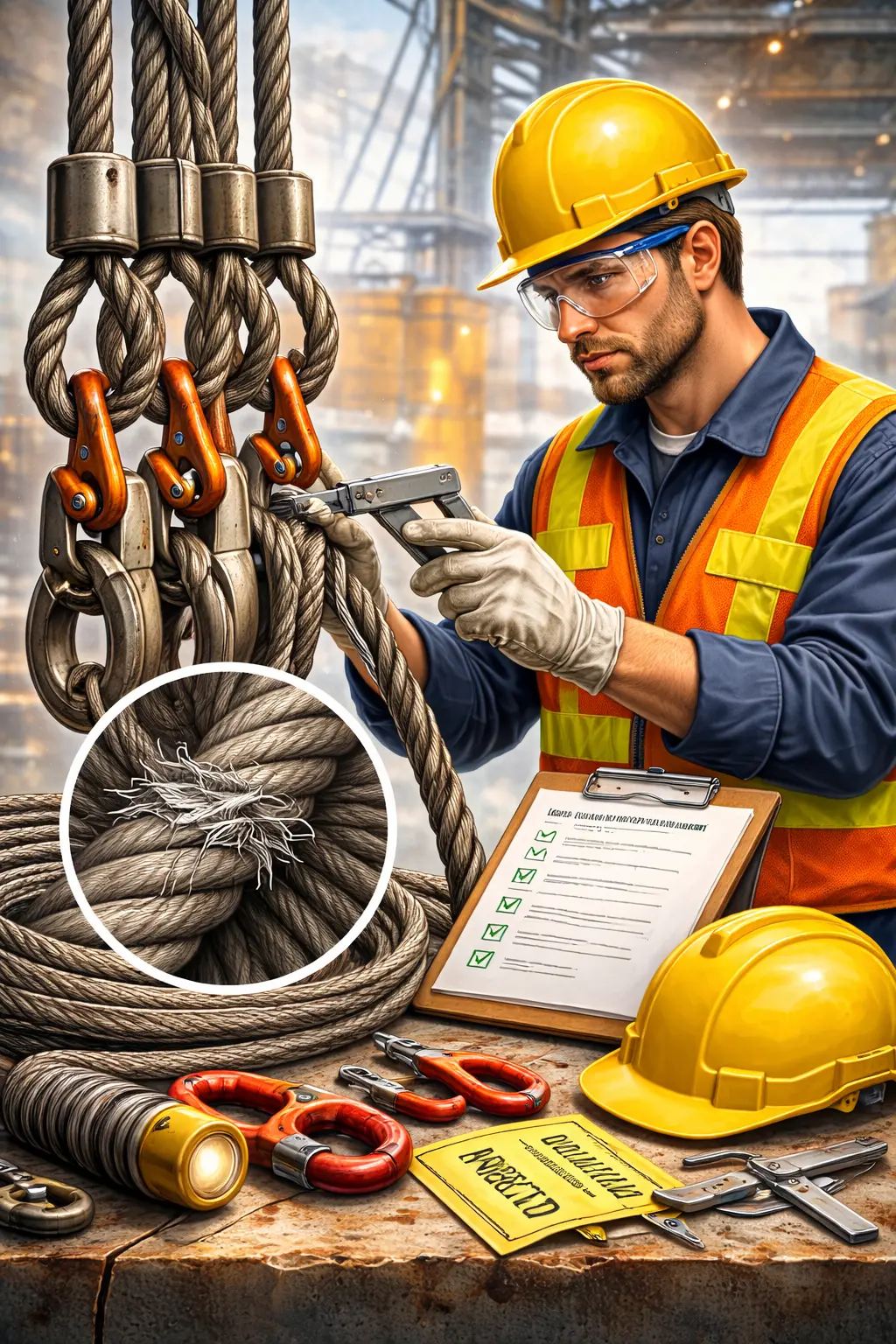
Sling inspection is the process of examining lifting slings to detect damage, wear, or defects that could reduce their load capacity. According to OSHA 1910.184 and ASME B30.9, inspections must be performed before use, regularly during operation, and periodically based on service conditions.
Every year, lifting equipment failures contribute to serious injuries and fatalities in industrial workplaces. A significant share of those incidents trace back to one preventable cause: slings that were never properly inspected. Whether you are working in construction, manufacturing, marine operations, or any rigging-heavy environment, a solid sling inspection guide is not optional. It is a legal requirement and a life-safety necessity.
This guide breaks down everything you need to know about sling inspection procedures, removal criteria, and maintenance best practices. References are grounded in OSHA 29 CFR 1910.184 (for general industry) and ASME B30.9 (the widely recognized standard for slings). If you supervise a lift or rig one, this is your reference.
Sling inspection is the structured process of examining a lifting sling before, during, and after use to identify any physical damage, wear, deformation, or degradation that could compromise its safe working load. Inspections are conducted by competent persons and follow criteria defined by OSHA and ASME standards. The goal is simple: catch problems before the load is ever in the air.
Sling inspection is critical because even minor damage can reduce load capacity and lead to sudden failure.
The physics of lifting do not forgive negligence. A sling rated for 5,000 pounds does not stay at that capacity forever. Every lift, every chemical splash, every drag across a sharp edge chips away at its structural integrity. When that capacity drops below what the load demands, the failure can be instantaneous.
OSHA 1910.184 is explicit. Damaged or defective slings must be immediately removed from service. Not tagged for later review. Not set aside for “light duty.” Removed.
Key risks associated with skipping sling inspections:
One detail that is often overlooked: sling failure does not always happen at maximum rated load. Damaged slings can fail at a fraction of their original capacity, especially when dynamic loading, angular hitches, or shock loads are involved.
OSHA 1910.184 and ASME B30.9 define three distinct inspection types. Each serves a different purpose, and all three are required for a complete compliance program.
| Inspection Type | Who Performs It | When It Happens | Purpose |
| Initial Inspection | Competent person | Before first use on any new or repaired sling | Confirm sling is undamaged and properly identified |
| Frequent Inspection | Competent person | Each shift or each day of use | Catch visible damage from daily operations |
| Periodic Inspection | Qualified inspector | Monthly to annually based on service conditions | In-depth examination, documented records required |
Each type builds on the last. Think of frequent inspection as your daily filter and periodic inspection as the deeper audit that catches what daily checks might miss.
Not every sling gets used the same way. ASME B30.9 recognizes this by categorizing service conditions into three levels, each calling for different periodic inspection intervals.
This covers regular industrial use with predictable loads at or below rated capacity, in reasonably controlled environments. A typical warehouse or manufacturing setting where slings lift uniform loads on a scheduled basis would fall here.
Recommended periodic inspection interval: Annually, at minimum.
Slings used in environments with abnormal operating conditions fall into this category. Think steel mills, scrap yards, foundries, or any setting involving high heat, abrasive surfaces, frequent shock loading, or exposure to corrosive substances.
Recommended periodic inspection interval: Monthly.
Any use that falls outside normal or severe categories and may include unusual load types, extremely high cycle counts, or unique environmental hazards. The inspector and responsible person must define the interval based on actual conditions.
Recommended periodic inspection interval: As determined by a qualified person.
In real-world lifting operations, many facilities under-categorize their service conditions. A sling used in a shipyard grinding environment is in severe service, not normal service, even if the loads are light. The environment drives the classification, not just the load weight.
Every sling must carry legible identification. OSHA 1910.184 requires that slings be marked with their rated load capacity, type of material, and other identifying information. ASME B30.9 reinforces this with specific requirements for tags, labels, or permanently attached markings.
When a sling loses its tag or marking, the safe working load is unknown. And an unknown capacity means an unknown risk. That sling must come out of service immediately.
What a compliant sling identification tag should include:
What to do when a tag is missing:
This is a non-negotiable requirement. Using an untagged sling is a direct OSHA violation and exposes both the worker and the employer to serious liability.
| Checkpoint | Status |
| Identification tag present | Required |
| No visible cut or abrasion | Required |
| No deformation or distortion | Required |
| No heat or chemical damage | Required |
| Fitting in good condition | Required |
A thorough sling inspection is not just a glance. Here is a field-oriented procedure that covers the core elements for any sling type. Tailor the detail criteria to the specific sling material as covered in the next section.
Before you start: Make sure you are a competent person as defined by OSHA. This means trained, knowledgeable, and authorized to identify hazards and take corrective action.
Different sling materials fail in different ways. Here is what to look for based on each sling type.
Wire rope slings are strong and durable, but they develop specific failure patterns over time. ASME B30.9 defines clear removal criteria for wire rope slings.
Discard conditions for wire rope slings:
Wire rope sling inspection requires running the full length through your hands carefully, as internal wire breaks may not be visible from the outside. Rotate the sling to examine all sides.
Webbing slings are popular because of their flexibility and load-friendly surface. But synthetic fibers degrade in ways that are not always obvious.
Discard conditions for synthetic web slings:
One thing worth noting: a synthetic sling with chemical exposure may look fine on the surface but have severely degraded fiber strength internally. If there is any doubt about chemical contact, remove the sling.
Chain slings are built for tough, high-heat environments, but they are not indestructible. Chain inspection requires examining every individual link.
Discard conditions for chain slings:
For periodic inspection of chain slings, a documented record including individual link measurements is best practice and is recommended by ASME B30.9.
Round slings consist of a core of synthetic fibers wrapped in a protective cover. The core carries the load; the cover protects the core. This layered design creates a unique inspection challenge.
Discard conditions for round slings:
The tricky part with round slings: you cannot always see when the core is damaged. If the cover is compromised in any way, the sling comes out of service, full stop. There is no safe way to assess internal fiber damage by eye.
Use this table as a fast reference during field inspections. If any condition below is present, the sling must be removed from service immediately.
| Sling Type | Removal Condition |
| Wire Rope | 10+ broken wires per lay; kinking; corrosion; heat damage; deformed fittings |
| Wire Rope | Wear exceeding 1/3 wire diameter; bird-caging; 5+ broken wires in one strand per lay |
| Synthetic Web | Cuts, tears, holes; broken stitching; UV or chemical damage; any knots |
| Chain | 10%+ wear at bearing points; 3%+ elongation; cracks; bent links; any field welds |
| Round Sling | Exposed core fibers; cover damage of any kind; knots; missing label |
| All Types | Missing or illegible identification tag; deformed or cracked end fittings; unknown load history |
Even experienced riggers fall into habits that compromise inspection quality. Here are the most common mistakes seen in the field.
1. Skipping the tag check. Inspectors often jump straight to the sling body and forget the tag entirely. A sling can look perfect but have an illegible tag that voids its safe use.
2. Inspecting while the sling is coiled or stacked. You cannot inspect what you cannot see. A sling folded on itself hides contact points, wear zones, and end fittings. Always lay it out flat.
3. Ignoring the end fittings. Most visual attention goes to the sling body, but the end fittings are where failures concentrate. Cracks near the hook throat or distorted master links are easy to miss when you are focused on the webbing.
4. Relying on casual glance inspections. A proper frequent inspection takes a few minutes. Running your hands along the sling and actually feeling for irregular texture or stiffness catches things the eyes miss, especially with wire rope.
5. Not documenting anything. For periodic inspections, documentation is a compliance requirement. But even for daily checks, a simple sign-off creates accountability and a paper trail that matters when incidents are investigated.
6. Keeping damaged slings in the area “just in case.” Slings that have been removed from service must leave the rigging environment. Leaving them nearby invites reuse during a rush.
7. Underestimating environmental damage. UV exposure, chemical splash, or even intermittent heat exposure can degrade a sling without leaving obvious markings. If you know a sling has been exposed to unusual conditions, treat it as suspect.
Proper maintenance does not extend a sling’s life indefinitely, but it absolutely prevents premature degradation. Here is how to treat slings between uses.
A sling that has been removed from service is not a paperweight or a shop rag. Improper disposal creates a genuine risk that someone will reuse it.
Steps for safe sling disposal:
The goal here is simple: make sure a condemned sling cannot end up back in service by accident or misuse.
A sling inspection guide is only useful if it gets applied in the field, consistently, every time. The standards exist because the consequences of skipping this step are real and well-documented. OSHA and ASME did not create these requirements arbitrarily. They reflect decades of incident data, engineering research, and hard lessons learned.
Build your sling inspection program around competent people, clear procedures, documented records, and a zero-tolerance approach to using condemned equipment. That combination is what separates a well-run rigging operation from a liability waiting to happen.
If you are building or updating your facility’s sling inspection program, consider formal training for all rigging personnel and periodic third-party audits to validate your internal inspection practices against current standards.
References: OSHA 29 CFR 1910.184 (Slings); ASME B30.9 (Slings); ASME B30.20 (Below-the-Hook Lifting Devices)
PT. Sebatek Prima Tunggal | Lifting Equipment & Rigging Solutions
Supplying industrial lifting and rigging equipment tested to international standards – with the documentation to back it up.
© sebatek.id | “HMPE Sling Technology Guide” | Indonesia Polyester Manufacture