WhatsApp
+62818-0847-5888
Work Hours
Monday to Friday: 9AM - 5PM
WhatsApp
+62818-0847-5888
Work Hours
Monday to Friday: 9AM - 5PM

 Byadmin
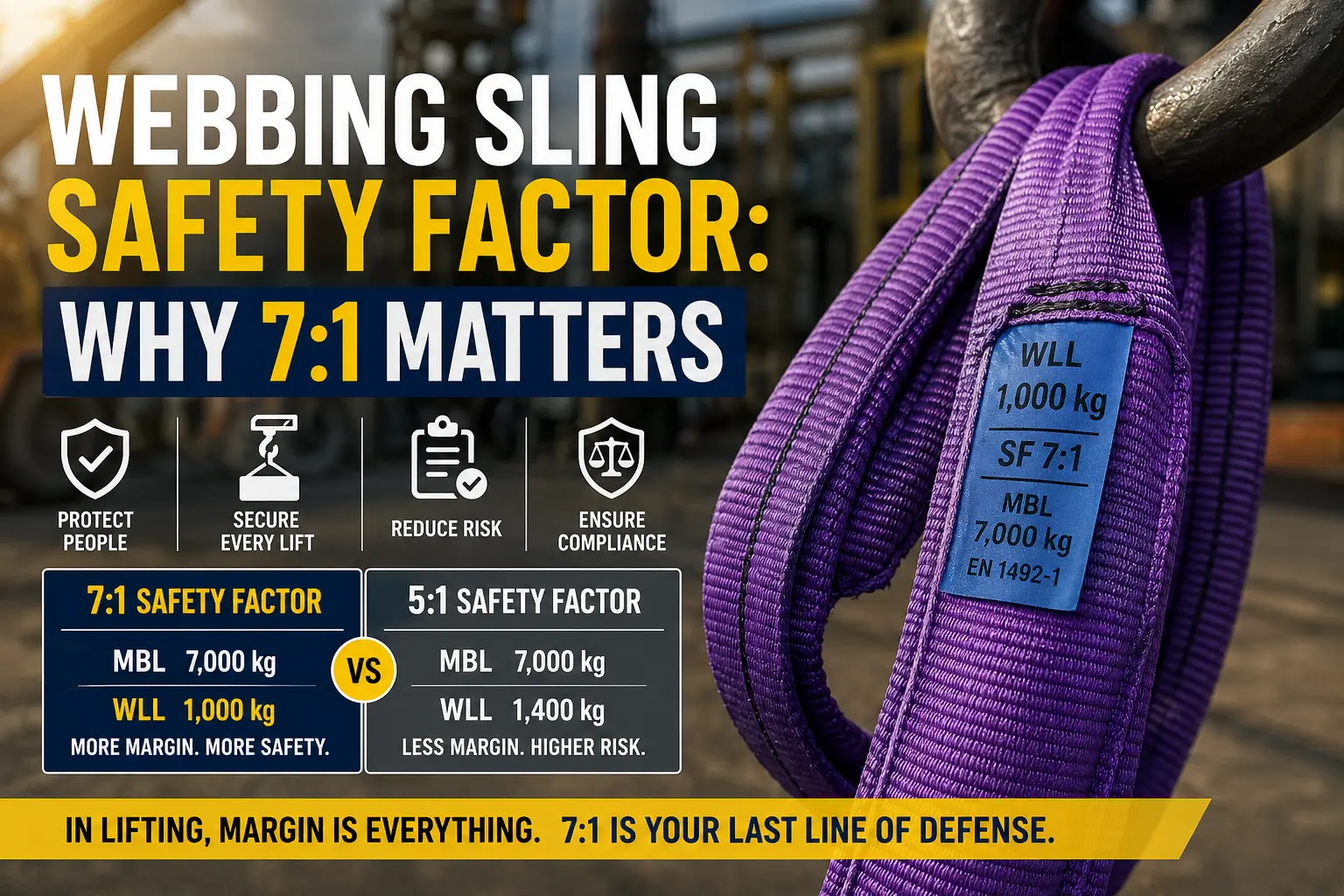
Most lifting incidents do not happen because someone ignored the rules. They happen because someone followed a rule they did not fully understand. The webbing sling safety factor is one of the most referenced numbers in rigging, and also one of the most misunderstood.
If your team is still choosing slings based on the WLL number alone, this is where problems usually start.
There is a common assumption in the field that a sling rated at 1,000 kg can safely lift 1,000 kg in any situation. That is only true in controlled testing conditions.
Real lifting environments are not controlled.
Operators often treat WLL as the maximum capability of the sling, instead of the safe operating limit under variable conditions. This mindset quietly removes the safety margin that the system depends on.
Now add real variables:
Suddenly, that “1,000 kg capacity” is no longer as safe as it looks.
The real question is not whether the sling can lift the load in theory. The real question is whether it can handle that load in imperfect, unpredictable conditions.
Safety Factor is the ratio between how strong a sling is and how much load it is allowed to carry in actual use. Two key values define this:
The relationship is simple:
WLL = MBL / Safety Factor
Example:
If the same sling uses a 5:1 factor:
The sling is identical. The difference is how much risk you are willing to take.
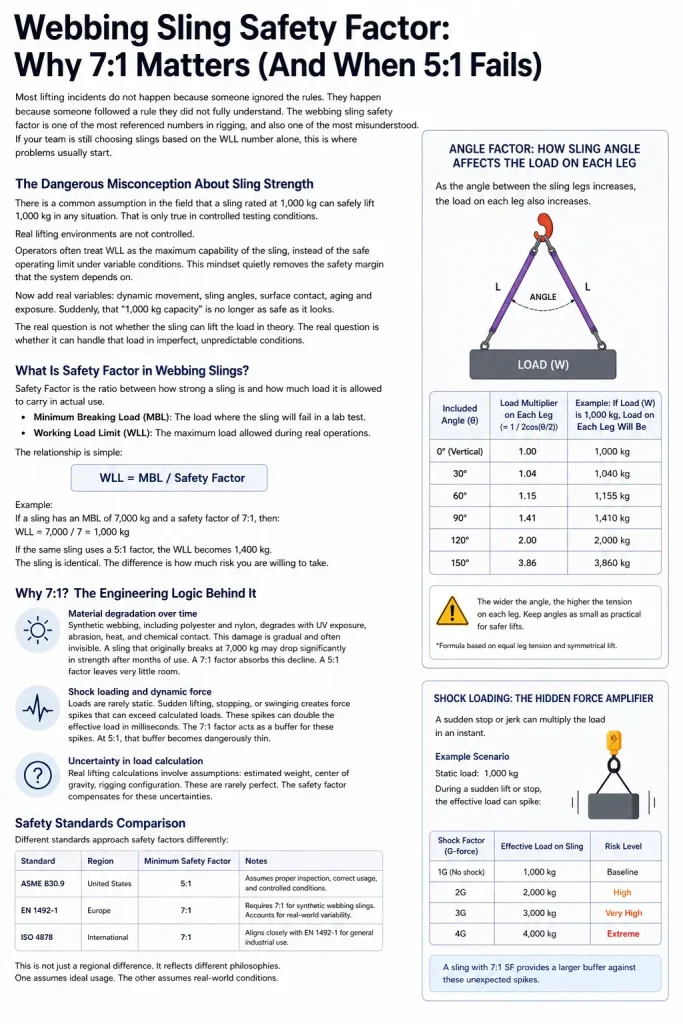
The 7:1 ratio exists because real-world conditions are unpredictable and often harsher than expected.
Synthetic webbing, including polyester and nylon, degrades with:
This damage is gradual and often invisible. A sling that originally breaks at 7,000 kg may drop significantly in strength after months of use. A 7:1 factor absorbs this decline. A 5:1 factor leaves very little room.
Loads are rarely static. Sudden lifting, stopping, or swinging creates force spikes that can exceed calculated loads.
These spikes can double the effective load in milliseconds. The 7:1 factor acts as a buffer for these spikes. At 5:1, that buffer becomes dangerously thin.
Real lifting calculations involve assumptions:
These are rarely perfect. The safety factor compensates for these uncertainties.
Different standards approach safety factors differently:
This is not just a regional difference. It reflects different philosophies. One assumes ideal usage. The other assumes real-world conditions.
The difference becomes obvious when things go slightly wrong.
A 900 kg load suddenly experiences a force spike to 1,800 kg.
That gap is where incidents either happen or get avoided.
Sharp edges can reduce sling strength by 20 to 30 percent.
After long exposure to sunlight, sling strength can drop significantly.
One of the biggest risks with webbing slings is invisible damage. Internal fibers can weaken while the outer surface still looks fine. Common hidden risks:
Relying only on visual inspection is not enough.
A sling can pass inspection visually and still fail under load.
Every sling tag contains critical information, but it is often misunderstood.
Key configurations:
The biggest mistake is ignoring sling angle. As the angle widens, the load on each leg increases significantly. The tag shows capacity, but it does not calculate your actual setup.
Some mistakes appear small but have serious consequences:
Each of these reduces the safety margin without being obvious.
Using a sling with MBL of 7,000 kg:
| Safety Factor | WLL |
| 7:1 | 1,000 kg |
| 5:1 | 1,400 kg |
Now apply real conditions:
The effective capacity drops, and the remaining margin becomes critical. With 7:1, there is still room for error. With 5:1, that room almost disappears.
The argument against 7:1 is usually cost, but that argument ignores failure cost. A single incident can involve:
These costs are far higher than the price difference between sling ratings. There is also lifecycle value:
7:1 is not just safer. It is more economical over time.
The 7:1 safety factor is not excessive. It is a calculated response to real-world uncertainty. Every variable that cannot be perfectly controlled is absorbed by that margin. Choosing 5:1 is not just a technical decision, it is a risk decision. The sling does not care about standards, budgets, or assumptions, it only responds to load.
PT. Sebatek Prima Tunggal | Lifting Equipment & Rigging Solutions
Supplying industrial lifting and rigging equipment tested to international standards – with the documentation to back it up.
© sebatek.id | “Webbing Sling Safety Factor, Why 7:1 Matter” | Indonesia Polyester Manufacture