WhatsApp
+62818-0847-5888
Work Hours
Monday to Friday: 9AM - 5PM
WhatsApp
+62818-0847-5888
Work Hours
Monday to Friday: 9AM - 5PM

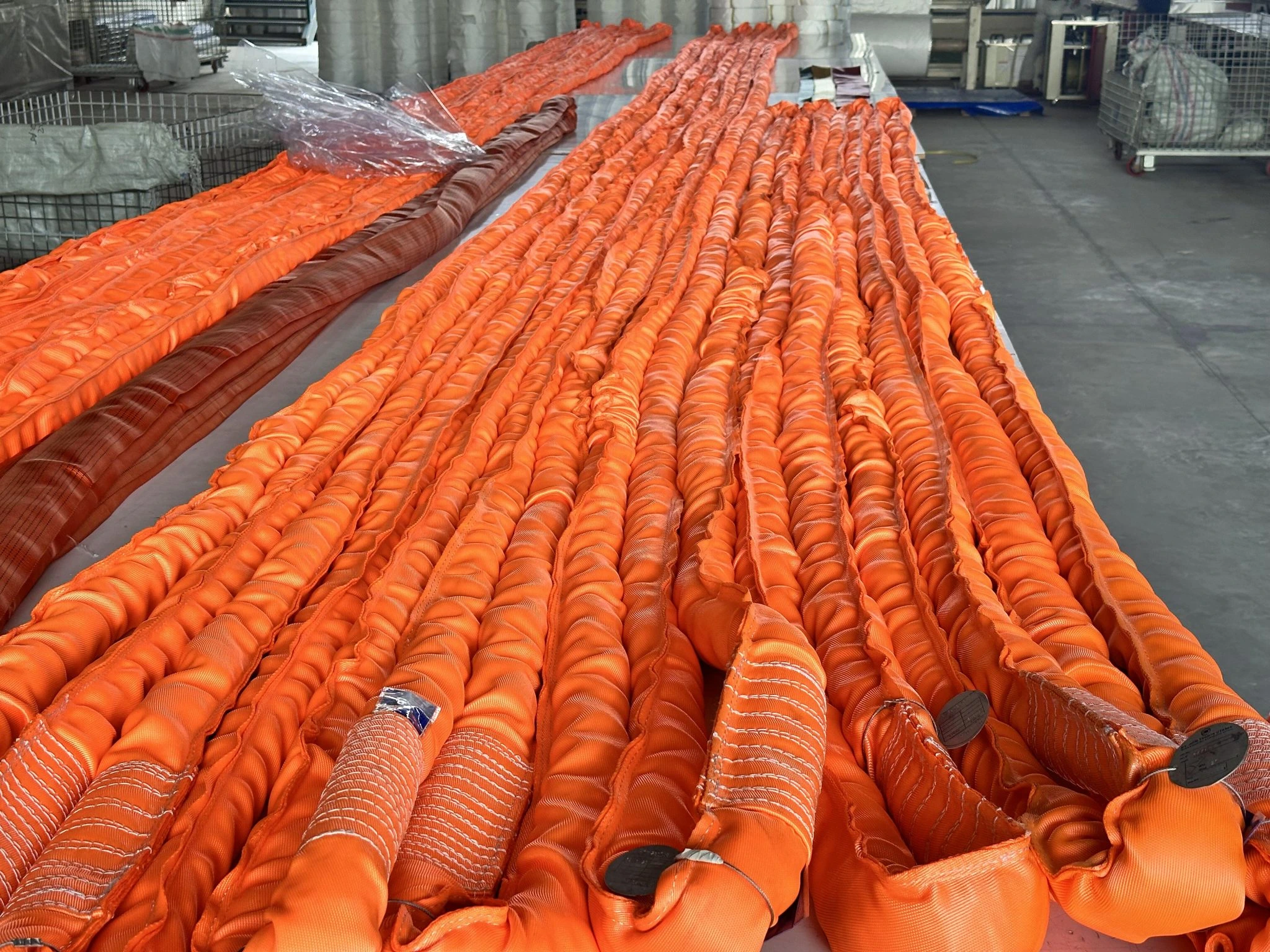
Construction, Standards, WLL Calculation, Inspection, and Industrial Applications
A Comprehensive Reference for Engineers, Rigging Professionals, and Safety Officers
Round slings are among the most widely used synthetic lifting devices in modern industrial operations. From steel fabrication plants and offshore platforms to shipyards and construction sites, round slings play a critical role in safely moving heavy loads. Their flexibility, light weight, and ability to conform to irregular load surfaces make them a preferred alternative to wire rope and chain slings in many applications.
This guide provides a complete technical reference covering every aspect of round sling design, material science, applicable safety standards, working load limit calculation, proper inspection procedures, and common industrial applications. The content is intended for rigging engineers, safety officers, lifting supervisors, and anyone responsible for selecting or managing synthetic lifting slings.
Key Definitions
Round Sling: A type of synthetic lifting sling constructed from continuous load-bearing yarns enclosed inside a woven or tubular protective sleeve. The internal yarns form an endless loop that carries the load, while the outer sleeve protects them from abrasion and environmental exposure.
Working Load Limit (WLL): The maximum load that a lifting device is rated to carry under specific conditions and configurations, as established by the manufacturer and applicable standards.
Minimum Breaking Strength (MBS): The minimum tensile force at which a sling or component will rupture under controlled test conditions. Also referred to as Minimum Breaking Load (MBL).
Hitch Configuration: The method by which a sling is attached to a load and lifting hardware, which directly affects the effective Working Load Limit.
D/d Ratio: The ratio between the diameter of the pin or bearing surface (D) and the diameter or thickness of the sling body (d). A higher D/d ratio reduces stress concentration and preserves sling capacity.
A round sling is built around the principle of load sharing among many individual load-bearing yarns. The core yarns, which are typically polyester multifilament fibers, are wound continuously inside a protective sleeve to form an endless loop. Because the load is distributed across hundreds of individual filaments rather than a single element, round slings offer a higher strength-to-weight ratio than metal slings of similar capacity.
The outer sleeve, also called the cover or jacket, is a woven or stitched tube that surrounds and protects the core. The sleeve does not significantly contribute to the sling’s load-bearing capacity. Its primary role is mechanical protection and identification.
The core yarn is the load-bearing element of the round sling. Manufacturers wind the yarn in a continuous pattern under controlled tension to ensure even load distribution. The number of yarn passes determines the rated capacity of the sling. Increasing the number of wraps increases the total cross-sectional area of load-bearing fiber, which raises the Minimum Breaking Strength and therefore the Working Load Limit.
The yarn ends are secured and the loop is completed before the protective sleeve is applied. This continuous construction is what gives round slings their characteristic flexibility and ability to wrap around irregular load shapes without creating stress concentrations.
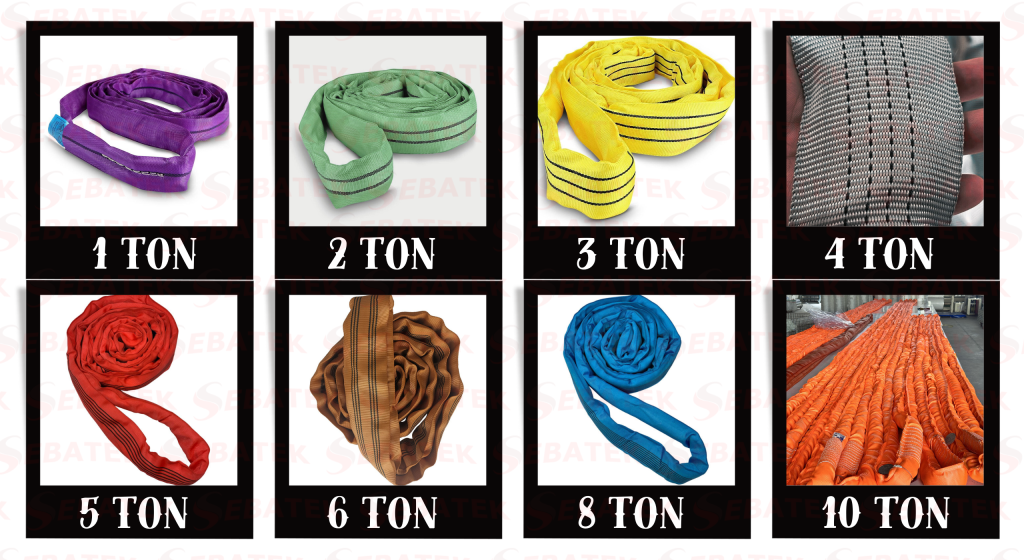
The outer sleeve is manufactured from a flat-woven or tubular textile. Polyester and nylon are the most common materials for both the core yarn and sleeve. The sleeve is color-coded according to the sling capacity rating to allow quick visual identification during rigging operations. Color coding follows internationally recognized standards such as those defined in EN 1492-2 and adopted in WSTDA-RS-1.
| Sleeve Color | WLL Rating (Metric Tons) | Typical Application |
| Purple | 1 tonne | Light assembly, maintenance |
| Green | 2 tonnes | General manufacturing |
| Yellow | 3 tonnes | Medium fabrication |
| Grey | 4 tonnes | Structural steel work |
| Red | 5 tonnes | Heavy construction |
| Brown | 6 tonnes | Offshore and marine |
| Blue | 8 tonnes | Large equipment handling |
| Orange | 10 tonnes | Heavy lift operations |
Table 1: Standard Round Sling Color Coding by WLL (Straight/Vertical Hitch, per EN 1492-2)
Polyester is the dominant fiber used in round sling construction because it combines high tensile strength, low elongation, good resistance to most acids, and excellent UV stability. Polyester is minimally affected by moisture, which makes it well-suited for outdoor and wet environments. It also resists most petroleum-based chemicals and common industrial solvents at moderate concentrations.
The elongation of polyester under load is typically 2 to 4 percent at rated WLL. This low elongation improves load control during lifts, as the sling does not stretch significantly, reducing the risk of load swing or unexpected dynamic loading.
Nylon offers higher elongation than polyester, typically 6 to 10 percent at working loads. This shock-absorbing characteristic makes nylon round slings useful in applications where dynamic or impact loading may occur. However, nylon loses a portion of its strength when wet, with a reduction of approximately 15 percent when fully saturated, and it is more susceptible to damage from acids.
Nylon is generally not recommended for use in alkaline environments or where prolonged water exposure is unavoidable. When properly applied in appropriate environments, nylon round slings provide reliable performance and long service life.
Certain high-capacity applications require slings made from advanced synthetic fibers. High-modulus polyethylene (HMPE), sold under trade names such as Dyneema and Spectra, offers exceptional strength-to-weight ratios. Aramid fibers such as Kevlar and Twaron provide high strength and very low elongation but are sensitive to UV exposure and require careful handling. These materials are typically specified for offshore, aerospace, or precision lifting applications where weight, capacity, or dimensional constraints are critical.
| Property | Polyester | Nylon (Polyamide) | HMPE (Dyneema) |
| Tensile Strength (relative) | High | High | Very High |
| Elongation at WLL | 2-4% | 6-10% | <1% |
| Acid Resistance | Good | Poor | Good |
| Alkali Resistance | Poor | Good | Good |
| UV Resistance | Good | Moderate | Moderate |
| Wet Strength Retention | >95% | ~85% | >95% |
| Typical Application | General industrial | Dynamic loads | Offshore/precision |
Table 2: Fiber Material Comparison for Round Sling Construction
Round slings are subject to a range of national and international safety standards that govern design, testing, marking, and use. Compliance with the applicable standard in your jurisdiction is not optional. It is a legal and safety requirement. The three most widely referenced standards are described below.
ASME B30.9 is published by the American Society of Mechanical Engineers and serves as the primary sling safety standard in the United States. It covers synthetic, wire rope, metal mesh, chain, and fiber rope slings. The section applicable to synthetic round slings establishes requirements for design factors, marking, inspection intervals, removal-from-service criteria, and storage practices.
Under ASME B30.9, synthetic round slings must carry a minimum design factor of 5:1, meaning the Minimum Breaking Strength must be at least five times the rated Working Load Limit in the straight vertical hitch configuration. Slings must be permanently marked with manufacturer information, rated capacity in each hitch configuration, material type, and a serial number or batch identifier.
EN 1492-2 is the European standard issued by the European Committee for Standardization (CEN) and is the governing document for synthetic round slings in European markets. It specifies requirements for design, construction, materials, testing, marking, and use instructions. EN 1492-2 mandates a minimum design factor of 7:1 for polyester round slings, which is more conservative than the ASME requirement.
The standard also defines the color coding system used globally to identify sling capacity. Declarations of conformity under EN 1492-2 form the basis for CE marking, which is required for slings sold into European Economic Area markets.
The WSTDA-RS-1 standard is published by the Web Sling and Tie Down Association and provides detailed guidance on the use, inspection, and retirement of synthetic round slings in North American industrial environments. It closely aligns with ASME B30.9 but includes additional practical guidance on inspection criteria, environmental damage assessment, and storage requirements. WSTDA-RS-1 is widely adopted by crane operators, rigging contractors, and safety programs as an operational reference.
OSHA 29 CFR 1910.184 is the federal regulatory standard governing sling use in general industry in the United States. It establishes minimum requirements for the safe use of slings during material handling operations. The standard requires that slings be visually inspected before each use and inspected by a competent person at regular intervals. It references ASME B30.9 as the applicable design and construction standard and requires that damaged slings be immediately removed from service.
| Standard | Issuing Body | Jurisdiction | Design Factor | Key Focus |
| ASME B30.9 | ASME | USA | 5:1 minimum | Design, marking, inspection, use |
| EN 1492-2 | CEN/CENELEC | European Union | 7:1 minimum | Design, testing, CE marking |
| WSTDA-RS-1 | WSTDA | North America | 5:1 (aligned with ASME) | Operations, inspection, retirement |
| OSHA 1910.184 | OSHA/US DoL | USA (federal) | References ASME | Regulatory compliance, worker safety |
Table 3: Comparative Overview of Round Sling Safety Standards
The Working Load Limit of a round sling is not simply the tensile strength of its core fibers. It is derived from the Minimum Breaking Strength divided by the design factor specified by the applicable standard. The design factor accounts for dynamic loading, shock loading, wear over time, temperature effects, and the consequences of failure.
For example, under EN 1492-2, a round sling with a Minimum Breaking Strength of 35,000 kilograms-force would have a straight hitch WLL of 5,000 kilograms (35,000 divided by 7). Under ASME B30.9 with a 5:1 design factor, the same MBS would yield a WLL of 7,000 kilograms. This difference highlights why it is important to always reference the applicable standard when specifying or selecting slings.
The WLL of a round sling changes depending on how the sling is rigged to the load. In a straight vertical hitch, the sling is used at its rated capacity. In a choker hitch, the sling is bent around itself and the load, which creates a bending stress concentration and reduces the effective capacity. In a basket hitch, the load is supported on a doubled sling leg, which increases the effective capacity relative to the straight hitch.
Angle also plays a critical role. As the sling angle decreases from vertical, the component of force acting along the sling leg increases, even though the lifted weight remains the same. At a 60-degree angle from horizontal, the sling leg load equals the full vertical load divided by the sine of 60 degrees. As the angle approaches 30 degrees, the effective leg load more than doubles, and at very shallow angles, loads can become dangerously high.
| Hitch Configuration | WLL Multiplier | Angle from Horizontal | Effective Capacity |
| Straight/Vertical | 1.0x rated WLL | 90 degrees | 100% of rated WLL |
| Choker Hitch | 0.75x rated WLL | N/A | 75% of rated WLL |
| Basket Hitch | 2.0x rated WLL | 90 degrees | 200% of rated WLL |
| Basket Hitch | 1.73x rated WLL | 60 degrees | 173% of rated WLL |
| Basket Hitch | 1.41x rated WLL | 45 degrees | 141% of rated WLL |
| Basket Hitch | 1.0x rated WLL | 30 degrees | 100% of rated WLL |
| Basket Hitch | 0.5x rated WLL | 15 degrees | 50% – NOT RECOMMENDED |
Table 4: WLL Multipliers for Round Sling Hitch Configurations and Sling Angles
The sling angle factor (also called the tension factor) is calculated using basic trigonometry. The formula below provides the leg tension in a two-leg basket or bridle configuration.
Leg Tension = Total Load Weight / (2 x sin(angle from horizontal))
Worked Example:
A load weighing 4,000 kg must be lifted using a two-leg round sling bridle. The sling angle from horizontal is 45 degrees.
When a round sling bears over a pin, hook, or edge, the bending radius affects the effective capacity. A small pin diameter relative to the sling width creates a tight bend that concentrates stress on the outermost fibers. The D/d ratio quantifies this relationship. As the D/d ratio decreases below 1, the effective WLL can drop significantly.
Most manufacturers provide D/d ratio correction tables in their product documentation. As a general guideline, a D/d ratio of 1 or greater maintains the rated WLL. Below 0.5, capacity can be reduced by 20 percent or more. Riggers should always check manufacturer specifications and replace sharp-edged components with properly radiused shackle bows or spreader beams when operating near the lower D/d limits.
Every round sling must be visually inspected before each lift. OSHA 1910.184 and ASME B30.9 both require this inspection by the operator or rigging technician. Pre-use inspection should take no more than two to three minutes but can prevent a catastrophic failure. The inspector should handle the sling while examining it, as some defects are detected by feel before they are visible.
Inspection should cover the entire length of both the sleeve and any visible areas of the core. Look for cuts, tears, holes, and fraying in the sleeve. Feel for lumps, flat spots, or hard areas that might indicate damaged or bunched core yarn. Check fittings and end attachments for corrosion, deformation, or wear.
In addition to pre-use inspection, round slings require formal periodic inspection by a qualified person. The frequency of periodic inspection should be based on the frequency of use, the severity of service conditions, and the nature of the lifts. Most standards recommend at a minimum a formal annual inspection, but slings used daily in harsh environments may require a monthly documented inspection.
Periodic inspection records should include the sling identifier, inspection date, inspector name, findings, and disposition. Records should be retained for a period defined by company safety procedures or applicable regulatory requirements.
Round slings must be immediately removed from service and destroyed when any of the following conditions are present. Retirement criteria are clearly defined in ASME B30.9, WSTDA-RS-1, and EN 1492-2, and are not discretionary. When in doubt, remove the sling.
| Defect Category | Condition Requiring Removal | Applicable Standard |
| Mechanical damage | Any cut, hole, or abrasion penetrating to core yarns | ASME B30.9, EN 1492-2 |
| Core yarn exposure | Visible load-bearing yarns through sleeve | ASME B30.9, WSTDA-RS-1 |
| Knots or kinking | Any knot tied in the sling body | All standards |
| Chemical attack | Discoloration, brittleness, or softening indicating chemical exposure | ASME B30.9 |
| Heat/UV damage | Glazed, melted, or discolored fibers | EN 1492-2, WSTDA-RS-1 |
| Missing or illegible tag | Identification tag absent or unreadable | ASME B30.9, OSHA 1910.184 |
| Weld spatter | Burned or melted fibers from weld splatter | All standards |
| Distortion | Twisted, kinked, or crushed sleeve indicating core damage | ASME B30.9 |
| Unknown history | Sling cannot be traced to a documented source | OSHA 1910.184 |
Table 5: Round Sling Removal from Service Criteria
Sharp edges on loads or rigging hardware are the leading cause of round sling failure. When a sling is placed over a steel plate edge, a weld bead, or any sharp corner without adequate edge protection, the concentrated force cuts through the sleeve and progressively severs the core yarns. This type of damage can be sudden or progressive. A sling may appear intact after a lift but have internal yarn damage that reduces its capacity significantly. Edge protectors and corner pads must always be used when lifting loads with sharp edges.
Exposure to acids, alkalis, solvents, or bleaching agents can degrade synthetic fibers without producing obvious external symptoms. Polyester is vulnerable to prolonged alkali exposure, while nylon degrades in acidic environments. Contaminated slings may look serviceable but have lost a significant fraction of their strength. Any sling suspected of chemical contact should be tested or retired. Chemical compatibility charts are available from sling manufacturers and should be consulted before using round slings in industrial process environments.
Operating a sling at loads exceeding its rated WLL is a direct path to failure. Overloading can occur through improper hitch selection, disregarding sling angle, failing to account for dynamic loading during crane acceleration or deceleration, or using a sling that has already been damaged. The WLL is the maximum allowable load, not a target. Riggers should confirm the weight of the load before lifting, account for hitch configuration and sling angle, and maintain an appropriate margin.
Ultraviolet radiation degrades synthetic fibers over time. Slings stored or used in direct sunlight for extended periods lose tensile strength gradually. High temperatures accelerate this process. Polyester slings should not be used in environments exceeding 180 degrees Celsius (356 degrees Fahrenheit), and nylon slings should not exceed 120 degrees Celsius (248 degrees Fahrenheit). Temperatures below freezing can increase fiber brittleness and reduce the effective capacity of the sling.
Human error in rigging remains a significant cause of sling failures and lifting accidents. Common mistakes include twisting the sling before attachment, using the wrong hitch for the load geometry, failing to seat the load properly in the sling before lifting, allowing side loading of hooks, and combining slings of different materials or ratings without proper assessment. Competent rigger training and verification of rigging plans before critical lifts are essential preventive measures.
Round slings are extensively used in structural steel erection for lifting beams, columns, and plate girders. Their flexibility allows them to conform to the web and flange geometry of structural sections without the point loading associated with wire rope chokers. When lifting painted or galvanized steel, the soft textile sleeve prevents surface damage that could lead to corrosion at lift points. For steel with sharp flange edges, corner protectors or saddle pads must always be used.
The offshore energy industry relies heavily on round slings for equipment installation, maintenance lifts, and subsea operations. Slings used in offshore environments must be rated for the temperature range of the operating region, resistant to seawater, and compatible with any coatings or preservatives on the equipment. DNVGL-ST-E271 and applicable offshore lifting standards impose additional requirements beyond EN 1492-2 for slings used in offshore lifting operations.
Production facilities use round slings for machine installation, maintenance hoists, and precision placement of machined components. The non-marking, non-conductive properties of synthetic slings make them suitable for lifting sensitive electronic equipment, finished surfaces, and components that must not be scratched or contaminated. In clean room environments, specially coated or enclosed round slings are available that resist fiber shedding.
Shipyards use round slings for hull section assembly, engine installation, and the handling of large marine components. The long lengths available in high-capacity round slings simplify the rigging of large assemblies. Marine applications require slings with good saltwater resistance and the ability to perform reliably in hot, humid environments. Regular inspection intervals are critical in this environment due to the combination of UV exposure, salt, and mechanical wear.
Round slings are used extensively in power plant construction and maintenance for lifting turbine rotors, generator stators, transformer cores, and other heavy rotating or electrical equipment. The non-conductive properties of polyester round slings provide an additional safety margin when working near energized equipment, although round slings should never be used as a primary means of electrical isolation.
Proper storage extends the service life of round slings and preserves their rated capacity. Slings should be stored in a clean, dry environment away from direct sunlight, sources of heat, and chemical exposure. Hanging slings on dedicated pegs or racks prevents floor contamination and allows visual organization by capacity rating. Slings should never be stored in a folded or kinked position for extended periods.
After use in contaminated environments, round slings should be rinsed with clean water and allowed to dry thoroughly before storage. Slings that have been exposed to unknown chemicals should be quarantined and assessed by a qualified person before being returned to service. Slings should never be force-dried with open flames, steam, or high heat.
Labeling and tagging systems should ensure that each sling in service can be traced to its inspection records. Color-coded identification systems, serial number tags, and digital asset management tools are all acceptable methods for managing sling inventories in large facilities.
A round sling is a synthetic lifting device made from continuous load-bearing yarns completely enclosed inside a tubular sleeve. The continuous yarn construction forms an endless loop, which is the defining structural feature. A flat web sling, by contrast, is made from woven flat webbing with eyes formed at each end. Round slings generally offer greater flexibility, higher capacity per unit weight, and better conformance to irregular load shapes compared to flat web slings of similar rating. Flat web slings have a larger bearing surface, which can distribute load more evenly on fragile or polished surfaces.
Start by confirming the exact weight of the load from engineering drawings, scale measurements, or load cell data. Then determine the hitch configuration you plan to use (vertical, choker, or basket) and calculate the sling angle. Apply the appropriate multiplier from Table 4 in this guide to find the minimum required WLL for each sling leg. Add a safety margin by selecting a sling with a rated WLL above the calculated requirement. For critical lifts, a formal lift plan reviewed by a qualified lifting engineer is required.
Round slings can be used outdoors, but prolonged UV exposure degrades polyester and nylon fibers over time. For slings that are stored outdoors or used frequently in direct sunlight, increase inspection frequency and follow manufacturer recommendations on service life limits based on UV exposure. Some manufacturers offer UV-stabilized polyester that provides improved resistance to solar degradation. When storing slings, always keep them covered or indoors when not in use.
The design factor represents the ratio of Minimum Breaking Strength to Working Load Limit. A 5:1 design factor (as required by ASME B30.9) means the sling must not break until the applied load reaches five times the rated WLL under controlled test conditions. A 7:1 design factor (EN 1492-2) provides a larger margin. The design factor accounts for dynamic effects, load sharing uncertainties, service degradation, and the consequences of failure. It does not mean a sling can be loaded to twice its WLL with a safety margin remaining. The WLL is the absolute maximum.
ASME B30.9 and OSHA 1910.184 require a visual inspection before each use by the operator. Periodic inspection by a qualified person should occur at intervals based on service severity, but the general guidance is every 12 months for infrequently used slings and more frequently for slings in daily or heavy-duty service. Many industry programs use quarterly or semi-annual formal inspection cycles for high-use lifting equipment. All inspections should be documented with findings and outcomes.
Round slings are highly engineered lifting devices that offer significant advantages in flexibility, weight, and load protection when properly specified, inspected, and used. The combination of continuous yarn construction, synthetic fiber materials, and internationally standardized capacity ratings makes them a reliable and versatile tool across virtually every industrial sector.
Safe and effective use of round slings requires a clear understanding of the applicable standards, particularly ASME B30.9 in North America and EN 1492-2 in European markets, as well as OSHA 1910.184, where US federal regulations apply. Engineers and safety officers must ensure that slings are selected based on accurate load data, correct hitch configuration factors, sling angle calculations, and D/d ratio requirements.
No lifting program is complete without a rigorous inspection and retirement protocol. Pre-use inspection before every lift, periodic documented inspection by qualified persons, and immediate removal from service upon detection of any defect are non-negotiable requirements that protect both workers and assets.
This guide is intended as a living reference. Standards are periodically revised, and users should always verify that they are working with the current edition of any referenced standard. Consulting a qualified lifting engineer for complex, critical, or non-routine lift planning is always recommended.
This document is intended for informational and educational purposes only. Always comply with local regulations, applicable standards, and manufacturer instructions. Consult a qualified lifting engineer for critical or complex lifting operations.
© sebatek.id | “Round Sling Technical Guide” | Indonesia Polyester Manufacture
