WhatsApp
+62818-0847-5888
Work Hours
Monday to Friday: 9AM - 5PM
WhatsApp
+62818-0847-5888
Work Hours
Monday to Friday: 9AM - 5PM

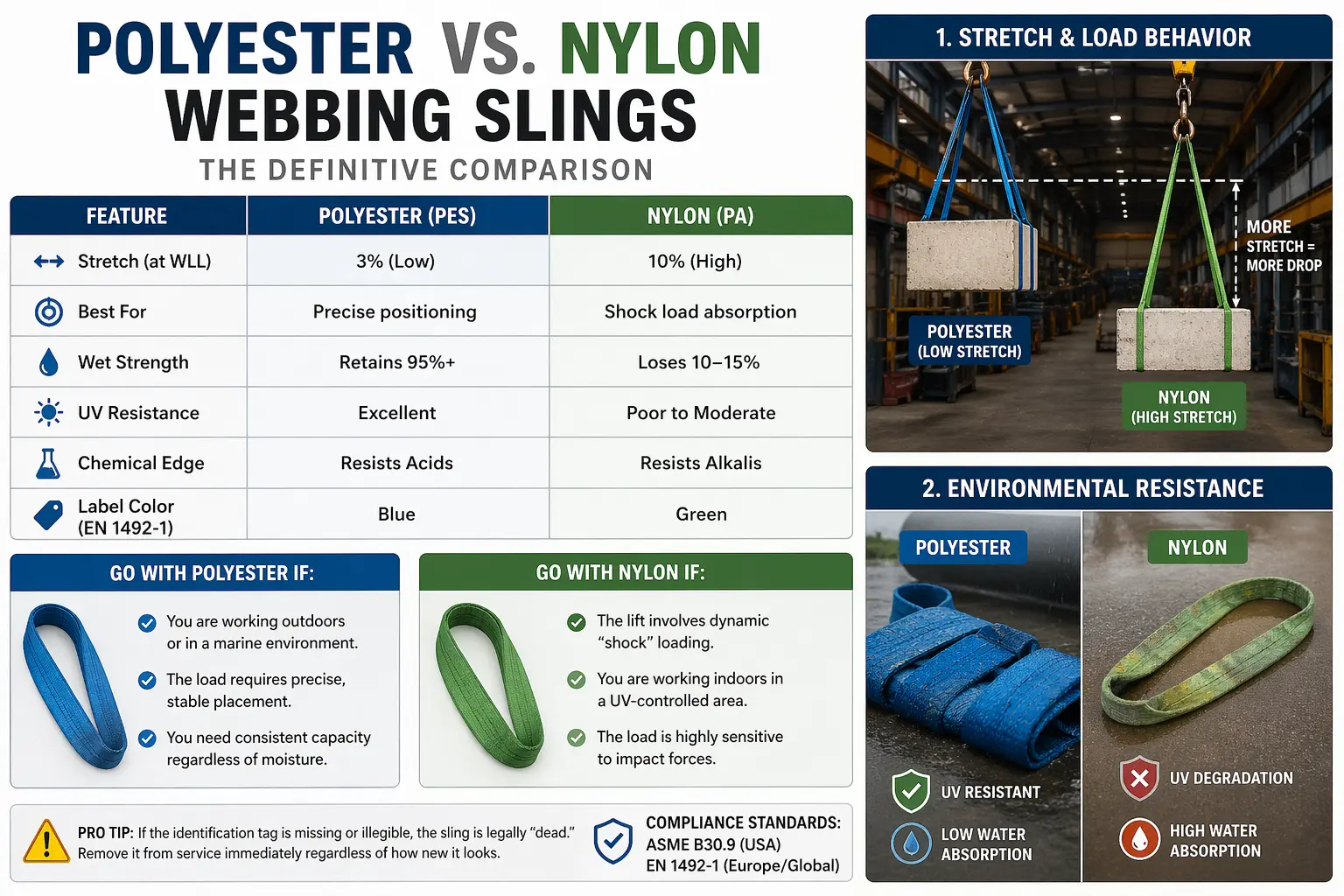
Choosing between polyester and nylon is a technical decision based on physics and environmental chemistry. Picking the wrong one doesn’t just shorten the sling’s life; it changes how the load behaves mid-air.
| Feature | Polyester (PES) | Nylon (PA) |
| Stretch (at WLL) | 3% (Low) | 10% (High) |
| Best For | Precise positioning | Shock load absorption |
| Wet Strength | Retains 95%+ | Loses 10–15% |
| UV Resistance | Excellent | Poor to Moderate |
| Chemical Edge | Resists Acids | Resists Alkalis |
| Label Color | Blue (EN 1492-1) | Green (EN 1492-1) |
Polyester is predictable. With only 3% stretch, the load stays exactly where you set it. This is essential for structural steel or precast concrete.
Nylon acts like a shock absorber. Its 10% stretch cushions the “snap” of a sudden pick-up. Use nylon for sensitive machinery or automotive components where a sudden jolt could cause internal damage.
Polyester thrives outdoors. It shrugs off UV rays and barely absorbs water.
Nylon is vulnerable to the elements. It loses significant strength when wet and degrades quickly under direct sunlight. If your site is a port, construction zone, or offshore rig, polyester is your default.
Never mix polyester and nylon slings on the same lift. Because they stretch at different rates, the polyester sling (the stiffer one) will take the entire load while the nylon sling stays slack. This leads to immediate overloading and potential failure.
A dry nylon sling rated for 5,000 kg might only support 4,250 kg once it gets rained on. If your lift plan doesn’t account for this 15% strength loss, you are operating outside of safety margins. Polyester does not have this issue.
To maintain a defensible safety protocol, all slings must meet:
Pro Tip: If the identification tag is missing or illegible, the sling is legally “dead.” Remove it from service immediately regardless of how new it looks.
Go with Polyester if:
Go with Nylon if:
PT. Sebatek Prima Tunggal | Lifting Equipment & Rigging Solutions
Supplying industrial lifting and rigging equipment tested to international standards – with the documentation to back it up.
© sebatek.id | “Polyester vs Nylon Webbing Sling for Industry” | Indonesia Polyester Manufacture
