WhatsApp
+62818-0847-5888
Work Hours
Monday to Friday: 9AM - 5PM
WhatsApp
+62818-0847-5888
Work Hours
Monday to Friday: 9AM - 5PM

 Byadmin
Synthetic lifting slings are among the most widely used rigging tools in modern industry. From shipyards and steel mills to logistics centers and offshore platforms, these slings are trusted to move heavy loads safely and efficiently. Yet despite their widespread use, misunderstandings about sling types, load ratings, and inspection protocols remain common sources of workplace accidents and equipment damage.
This guide provides a complete technical reference for synthetic lifting slings. It covers how they work, what materials and configurations are available, which safety standards apply globally, how to calculate safe working loads, and what to look for during inspections. Whether you are an engineer selecting slings for a new project, a procurement professional evaluating suppliers, or a safety manager developing inspection procedures, this guide gives you the factual foundation you need.
Sebatek has been manufacturing synthetic lifting slings for industrial applications across a wide range of industries. The information in this guide reflects both established global standards and practical field experience.
A synthetic lifting sling is a flexible load-bearing device made from synthetic fibre materials, used to connect a load to a crane hook, hoist, or other lifting apparatus. Unlike wire rope or chain slings, synthetic slings are made entirely from engineered polymer fibres, making them lighter, more flexible, and less likely to damage sensitive load surfaces.
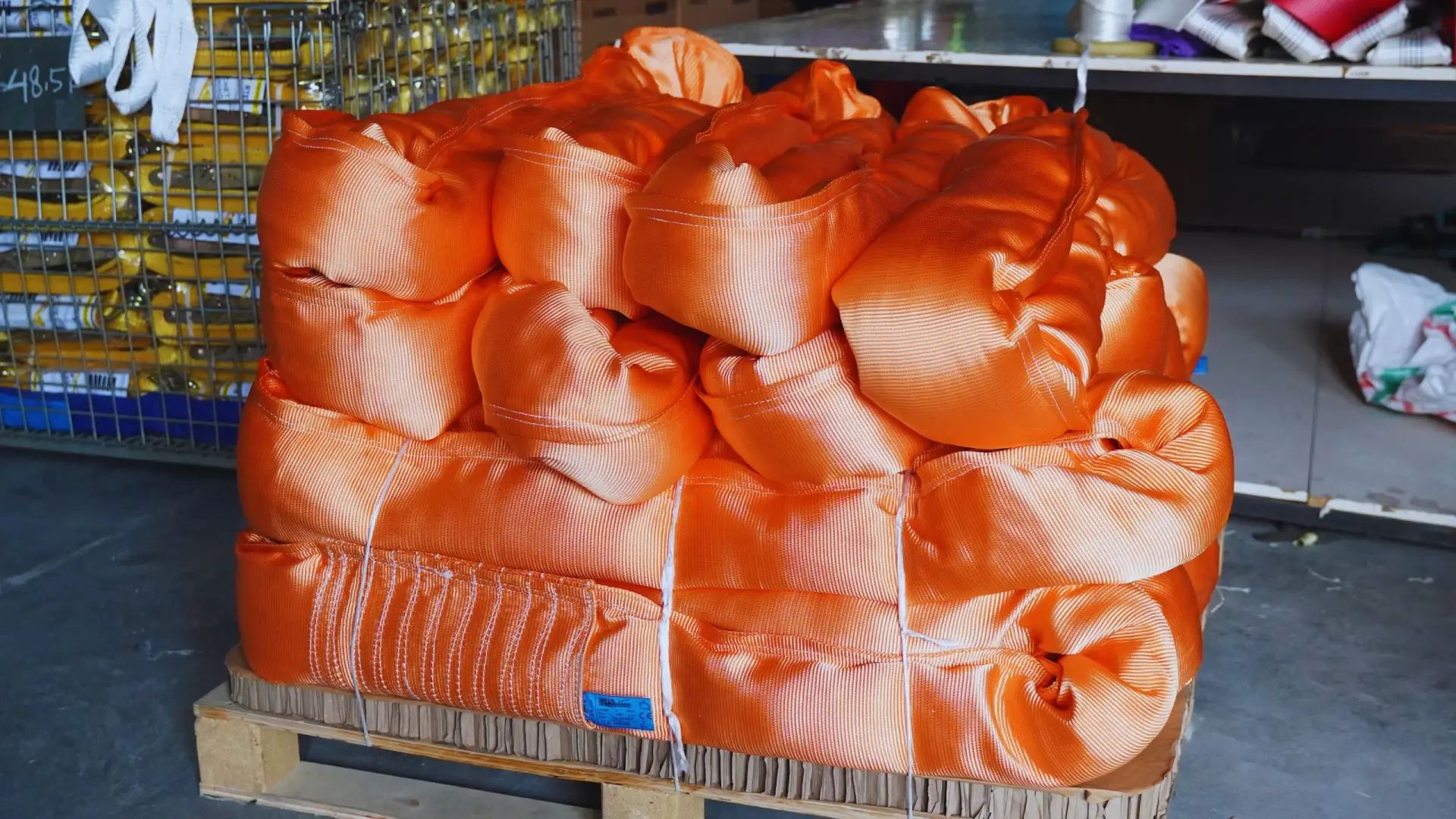
Synthetic slings are manufactured in several forms. Webbing slings use flat woven textile straps. Round slings encase load-bearing fibres inside a tubular protective sleeve. High-Modulus Polyethylene (HMPE) slings use ultra-high-strength fibres arranged in a rope or flat configuration for demanding applications.
All synthetic slings share a common function: they transfer the weight and dynamic forces of a suspended load from the rigging point to the lifting device while distributing stress across a broad contact area.
When a synthetic sling lifts a load, the fibres inside the sling elongate slightly under tension. This elastic behaviour acts as a natural shock absorber, reducing the impact of dynamic loading caused by sudden starts, stops, or crane movements. The distributed contact area of a synthetic sling also spreads the load across a wider surface of the object being lifted, reducing the risk of point-load damage to finished or fragile surfaces.
Sling geometry plays a major role in how forces are distributed. A sling used in a straight vertical hitch transmits load directly along its length. A basket hitch doubles the mechanical advantage, allowing higher effective loads. A choker hitch grips the load securely but reduces rated capacity due to the bend angle at the choke point.
Understanding these mechanics is fundamental to using any sling safely. The rated capacity of a sling is only valid when the sling is used in the specific hitch configuration for which that rating applies.
Wire rope slings have long been the standard in heavy lifting. However, synthetic slings offer meaningful advantages in many applications. The table below compares the two types across the most important performance dimensions.
| Characteristic | Synthetic Sling | Wire Rope Sling |
|---|---|---|
| Weight | Light, easy to handle | Heavy, harder to handle |
| Surface protection | Excellent, soft contact | Can damage surfaces |
| Corrosion resistance | High (no metal) | Requires maintenance |
| Chemical resistance | Material-dependent | Limited |
| High-temperature use | Limited (max ~100 C polyester) | Suitable up to ~400 C |
| Flexibility | Very flexible | Moderate |
| UV sensitivity | Degrades over time | Not affected |
| Load capacity | Moderate to high | Very high |
| Inspection visibility | Damage often visible | Internal damage hidden |
| Cost | Lower initial cost | Higher initial cost |
For applications involving polished metal, glass, stone, or finished assemblies, synthetic slings are often the superior choice because they eliminate the risk of scratching or deforming load surfaces. For extreme heat environments or very high single-point loads, wire rope remains the preferred option.
Chain slings are the most durable option in the lifting industry, capable of withstanding high temperatures, abrasion, and chemical exposure that would destroy a synthetic sling. However, their weight and rigidity can make them impractical in some environments.
| Characteristic | Synthetic Sling | Chain Sling |
|---|---|---|
| Weight | Light | Very heavy |
| Abrasion resistance | Low without protection | Excellent |
| Heat resistance | Poor above 100 C | Excellent, up to 400 C |
| Surface protection | Excellent | Poor |
| Flexibility of use | Very high | Moderate |
| Adjustability | Fixed length | Adjustable with shorteners |
| Lifespan | Finite, retire on damage | Very long with maintenance |
| Cost | Low to moderate | High initial, low long-term |
The practical outcome is that synthetic slings dominate in clean industrial environments, manufacturing, and warehousing, while chain slings remain preferred in foundries, steel plants, and environments with high heat or abrasion exposure.
A webbing sling is a flat lifting strap woven from synthetic yarn, typically polyester or nylon. The flat construction distributes the load across a wide contact area, making webbing slings well-suited for lifting items with flat or regular surfaces such as steel plates, machinery frames, or packaged goods.
Webbing slings are manufactured to EN 1492-1 (Europe) or ASME B30.9 (North America) standards and are colour-coded by Working Load Limit (WLL) under the EN standard. Common configurations include single-leg slings, double-leg slings, and endless (grommet) slings.
Typical WLL range: 1 tonne to 10 tonnes for standard webbing slings, with heavier grades available.
A round sling consists of a core of parallel load-bearing fibres enclosed inside a tubular woven sleeve. The sleeve protects the load-bearing core from abrasion, contamination, and UV radiation. Round slings are more flexible than webbing slings and conform well to irregular shapes, making them useful for lifting cylindrical or oddly shaped objects such as pipes, cables, or sculptural components.
Round slings are manufactured to EN 1492-2 (Europe) and are also colour-coded by WLL. Their circular cross-section reduces pressure on the load surface compared to webbing slings of equivalent capacity, making them preferable for delicate or finished surfaces.
Typical WLL range: 1 tonne to 200 tonnes for specialized high-capacity versions.
HMPE stands for High-Modulus Polyethylene, also known by the brand names Dyneema and Spectra. HMPE slings are made from ultra-high-molecular-weight polyethylene fibres that offer an exceptional strength-to-weight ratio, often exceeding that of steel at a fraction of the weight.
HMPE slings are used in offshore lifting, subsea operations, marine towing, and applications where weight reduction is critical. They have very low stretch compared to polyester or nylon, which allows more precise load control. HMPE is also highly resistant to seawater and most chemicals.
The main limitation of HMPE slings is their sensitivity to heat and friction. At temperatures above 70 to 75 degrees Celsius, HMPE fibres lose strength rapidly. They must also be protected from abrasive contact since HMPE is susceptible to surface wear.
Polyester is the most common material used in synthetic lifting slings globally. It offers low elongation under load (approximately 3 percent at WLL), good resistance to UV radiation, and excellent stability in water, acids, and most industrial chemicals. Polyester slings are not significantly affected by moisture and retain their rated capacity when wet.
Working temperature range for polyester slings is generally -40 degrees Celsius to +100 degrees Celsius. Above 100 degrees Celsius, polyester begins to lose strength. Polyester slings should not be used in contact with strong alkalis, which can degrade the fibre.
Nylon slings, also referred to as polyamide slings, are known for their higher elongation at working load, typically 6 to 8 percent. This elastic behaviour provides excellent shock absorption, making nylon slings a preferred choice in applications where load dynamics are unpredictable or sudden jerking loads are possible.
Nylon absorbs moisture, which reduces its WLL by approximately 10 to 15 percent when wet. Nylon is also more sensitive to UV degradation than polyester. However, nylon slings have strong resistance to alkalis and are a good choice where alkali exposure is likely.
Working temperature range for nylon slings is generally -40 degrees Celsius to +100 degrees Celsius, similar to polyester.

HMPE fibres are the strongest synthetic fibres available commercially. A typical HMPE round sling can achieve a WLL that exceeds a comparable steel wire rope sling at approximately one-fifth of the weight. HMPE slings have an elongation at working load of less than 1 percent, providing high stiffness and precise load positioning.
HMPE is virtually unaffected by seawater, oils, most solvents, and chemicals. However, the material is sensitive to temperatures above 70 degrees Celsius and is susceptible to creep under sustained high loads. HMPE slings must be stored and used away from heat sources and protected from cutting or abrasion.
| Property | Polyester | Nylon (Polyamide) | HMPE |
|---|---|---|---|
| Elongation at WLL | ~3% | 6-8% | <1% |
| UV resistance | Good | Moderate | Excellent |
| Wet strength loss | None | 10-15% | None |
| Alkali resistance | Poor | Good | Excellent |
| Acid resistance | Good | Poor | Excellent |
| Max temperature | 100 C | 100 C | 70-75 C |
| Density vs water | Sinks | Sinks | Floats |
| Relative cost | Low | Low-Moderate | High |
Synthetic slings used in professional lifting operations must comply with applicable standards depending on the country and industry. The primary international standards are listed below.
EN 1492-1 is the European standard covering flat woven webbing slings made from man-made fibres. It defines requirements for design, construction, testing, marking, and the minimum safety factor (minimum breaking load divided by WLL) of 7:1 for general lifting. The standard also establishes a colour-coding system that identifies each sling by its WLL at a glance.
| Colour | WLL (1-leg vertical) |
|---|---|
| Violet | 1 tonne |
| Green | 2 tonnes |
| Yellow | 3 tonnes |
| Grey | 4 tonnes |
| Red | 5 tonnes |
| Brown | 6 tonnes |
| Blue | 8 tonnes |
| Orange | 10 tonnes |

EN 1492-2 applies to round slings made from man-made fibres. The standard specifies the same minimum safety factor of 7:1 and uses the same colour-coding system as EN 1492-1, allowing operators to identify WLL by sling colour regardless of whether the sling is a webbing or round type.
ASME B30.9 is the primary North American standard for slings, published by the American Society of Mechanical Engineers. It covers synthetic webbing slings, round slings, wire rope slings, metal mesh slings, and chain slings. ASME B30.9 specifies design factors, inspection criteria, and operating practices for each sling type.
Under ASME B30.9, the minimum design factor (equivalent to safety factor) for synthetic web slings is 5:1, and for synthetic round slings it is also 5:1. These values are lower than the European 7:1 requirement, which is important to understand when equipment manufactured to one standard is used in a jurisdiction governed by the other.
In the United States, the Occupational Safety and Health Administration (OSHA) regulation 1910.184 governs the use of slings in general industry. It specifies that each synthetic sling must have a legible identification tag showing the rated load in each hitch configuration and the material type. The regulation also defines removal-from-service criteria for synthetic slings, including when a sling must be taken out of use due to visible damage.
The Web Sling and Tie Down Association (WSTDA) publishes voluntary standards for synthetic webbing slings (WS-1) and round slings (RS-1) used in North America. These standards provide supplementary guidance on sling performance, testing, and marking that complements ASME B30.9 and is widely adopted by North American manufacturers and end users.
The Working Load Limit (WLL) is the maximum load that a sling is designed to lift under normal operating conditions, in a specified hitch configuration. WLL is determined by the sling manufacturer based on testing and the applicable standard’s design factor. The WLL is always marked on the sling identification tag.
WLL must never be exceeded in normal operations. Dynamic lifting (where loads are accelerated or decelerated rapidly), side-loading, or environmental degradation can all reduce the effective safe capacity below the stated WLL.
The Minimum Breaking Load (MBL), also called the breaking strength or ultimate load, is the minimum load at which the sling is expected to fail under controlled test conditions. MBL is determined by destructive testing and represents the absolute upper limit of sling capacity before failure.
MBL is not a working value. It is used only to establish the safety factor and to verify that a sling meets the design requirements of its applicable standard.
The safety factor (also called design factor) is the ratio of MBL to WLL. It provides a margin of reserve strength that accounts for dynamic loads, wear, environmental degradation, and uncertainties in load estimation.
Safety Factor = MBL / WLL
For synthetic slings under EN 1492-1 and EN 1492-2, the required safety factor is 7:1. This means a sling with a WLL of 1 tonne must have an MBL of at least 7 tonnes. Under ASME B30.9, the design factor is 5:1 for synthetic slings.
In practice, individual slings often have MBL values that exceed the minimum required by the standard. The safety factor should always be considered when selecting slings for applications that involve shock loading, elevated temperatures, chemical exposure, or other conditions that may reduce sling performance.
A hitch is the way a sling is attached to the load and the lifting hook. The hitch configuration directly affects the effective WLL of the sling. Three fundamental hitches are used in rigging practice.
In a vertical hitch, the sling is attached directly between the crane hook and the load in a straight line. This configuration uses 100 percent of the sling’s rated vertical WLL and is the baseline configuration against which all other hitches are compared.
Vertical hitches provide no mechanical advantage, so the sling must be rated for the full weight of the load. This hitch is most stable when the load has a clearly defined rigging point directly above its center of gravity.
In a choker hitch, the sling is looped around the load and one end is passed through the other end before connecting to the hook. This creates a self-tightening grip on the load as it is lifted. The choker hitch reduces the effective WLL of the sling to approximately 75 to 80 percent of its vertical rating due to the increased fibre stress at the choke point.
Choker hitches are useful for securing irregular loads that might otherwise shift, but they should not be used when the choke angle becomes sharp, as this further reduces capacity and increases wear at the contact point.
In a basket hitch, both ends of the sling are attached to the crane hook and the sling passes under the load. When the sling legs are vertical (0 degrees), the basket hitch effectively doubles the WLL compared to the vertical hitch rating, because the load is shared between two legs.
However, as the angle between the sling legs increases, the tension in each leg also increases, which reduces the effective load capacity. At a sling angle of 60 degrees (measured from vertical), the basket hitch capacity is equal to the vertical WLL. At greater angles, capacity falls below the vertical rating.
| Hitch Type | Capacity vs Vertical WLL |
|---|---|
| Vertical hitch | 100% |
| Choker hitch | 75-80% |
| Basket hitch (0 degrees) | 200% |
| Basket hitch (30 degrees) | 173% |
| Basket hitch (45 degrees) | 141% |
| Basket hitch (60 degrees) | 100% |
| Basket hitch (>60 degrees) | Below 100%, calculate required |
The angle at which a sling operates relative to the vertical is one of the most critical and frequently misunderstood factors in rigging. As the sling angle from vertical increases, the tension in each leg of the sling increases, even though the total load being supported remains constant.
This happens because the vertical component of the sling tension must equal the load weight, but as the sling moves away from vertical, a greater portion of the tension is horizontal and does not contribute to supporting the load. To maintain the vertical component needed, the total tension in each sling leg must increase.
The sling angle factor (or tension factor) quantifies this effect. It is calculated as 1 divided by the cosine of the sling angle from vertical.
| Sling Angle from Vertical | Angle from Horizontal | Tension Factor | Effective Load per Leg |
|---|---|---|---|
| 0 degrees | 90 degrees | 1.000 | 50% of total load |
| 15 degrees | 75 degrees | 1.035 | 51.8% of total load |
| 30 degrees | 60 degrees | 1.155 | 57.7% of total load |
| 45 degrees | 45 degrees | 1.414 | 70.7% of total load |
| 60 degrees | 30 degrees | 2.000 | 100% of total load |
| 75 degrees | 15 degrees | 3.864 | 193.2% of total load |
Rigging practice generally requires sling angles to be kept at 60 degrees or less from horizontal (30 degrees or less from vertical) to maintain manageable leg tensions. Angles shallower than 30 degrees from horizontal should be avoided entirely for most synthetic slings, as the resulting leg tensions can rapidly approach or exceed WLL even with moderate loads.
Regular inspection of synthetic slings is one of the most important safety practices in any lifting operation. Unlike steel components, synthetic slings can suffer internal damage that is not immediately visible, and external damage can progress quickly under load. Both OSHA 1910.184 and EN 1492 standards require documented inspection procedures.
Before every lift, the operator should visually inspect the sling for the following:
In addition to pre-use checks, a formal inspection must be carried out by a competent person at intervals defined by the applicable standard, the frequency of use, and the operating environment. Periodic inspections are documented and the records retained.
During a periodic inspection, the competent person checks all the pre-use criteria above plus:
A synthetic sling must be immediately removed from service and destroyed or quarantined when any of the following conditions are identified. These criteria are derived from OSHA 1910.184, ASME B30.9, and EN 1492 standards.
Slings removed from service must be physically destroyed or marked clearly as condemned to prevent accidental return to use. They must not be repaired except by the manufacturer using original materials and to original specifications, and then only if the manufacturer specifically offers such a service.
Synthetic slings are used across a wide spectrum of industries. Understanding the specific requirements of each application helps in selecting the correct sling type and material.
| Industry | Common Applications | Recommended Sling Type |
|---|---|---|
| Manufacturing | Machine installation, component handling | Webbing or round sling, polyester |
| Construction | Steel beam and precast concrete lifting | Webbing sling, polyester |
| Shipbuilding and marine | Hull sections, equipment modules | Round sling, HMPE for light weight |
| Offshore and subsea | Subsea equipment, wire bundle handling | HMPE round sling |
| Logistics and warehousing | Pallet and packaged goods handling | Webbing sling |
| Power generation | Turbine and transformer installation | Round sling, polyester |
| Oil and gas | Pipe bundles, equipment handling | Round sling, polyester or HMPE |
| Automotive | Vehicle body and component lifting | Webbing sling, polyester |
| Mining | Equipment installation in confined spaces | Round sling |
| Glass and stone | Panels, slabs, monuments | Webbing sling with softener |
The selection of the right sling for each application depends on factors including load weight, load shape and surface finish, available rigging geometry, environmental conditions, and the required frequency of use.
Selecting a synthetic sling requires evaluating several factors systematically. The following process provides a practical framework for making the correct choice.
Calculate or verify the weight of the load. Identify the center of gravity and determine where the rigging points should be located to ensure the load hangs level and stable during the lift.
Based on the load shape and rigging points, determine whether a vertical, choker, or basket hitch is most appropriate. Apply the appropriate reduction factor to determine the minimum required sling WLL.
Using the sling angle and hitch configuration, calculate the actual tension each sling leg will experience at the maximum load. The required WLL must be equal to or greater than this calculated tension.
Identify any chemical exposures, temperature extremes, UV exposure, moisture, or abrasive contact the sling will encounter. Select the material (polyester, nylon, or HMPE) that performs best under those specific conditions.
If the load surface is sensitive to marking or damage, select a sling type with wide contact area such as a webbing sling, or use a round sling in a basket configuration. Add edge protectors or softeners at sharp corners.
Confirm that the selected sling is certified to the applicable standard for your jurisdiction (EN 1492, ASME B30.9, or equivalent) and that it carries the required identification markings.
Before putting the sling into service, establish a documented inspection schedule and ensure the sling is stored correctly: dry, protected from UV, away from chemicals and heat, and not in contact with sharp objects.
The global synthetic sling market is served by a range of manufacturers, from large industrial conglomerates to specialist rigging companies. When evaluating suppliers, procurement professionals and safety managers should look for the following:
Sebatek is a manufacturer of synthetic lifting slings serving industrial customers across multiple sectors. Sebatek slings are produced to comply with EN 1492-1 and EN 1492-2 and are supported by full technical documentation. The company works with engineering and procurement teams to specify the correct sling for each application and guides inspection protocols and storage requirements.
When assessing any supplier, request copies of test certificates, product declarations of conformity, and details of the quality management system in place at the manufacturing facility. A reputable manufacturer will provide this information readily and accurately.
WLL (Working Load Limit) is the maximum load the sling may carry in normal use under a specified hitch configuration. MBL (Minimum Breaking Load) is the load at which the sling will fail during a controlled destructive test. Under EN 1492, the minimum ratio of MBL to WLL (the safety factor) is 7:1. In practical terms, WLL is the operational limit; MBL is used only to verify design compliance and should never be approached in use.
Polyester slings retain their full rated capacity when wet and are generally suitable for wet environments. Nylon slings lose approximately 10 to 15 percent of their WLL when wet due to the moisture absorption characteristics of polyamide fibres, and this reduction must be factored into load calculations. HMPE slings are not affected by moisture and perform fully rated in submerged or marine environments.
All synthetic slings should receive a visual inspection before every use. Formal periodic inspections by a competent person should be carried out at documented intervals, typically every 6 to 12 months for slings in regular service, or more frequently in severe operating environments. The exact frequency depends on the applicable standard, the nature of the application, and the results of previous inspections.
Sling angles shallower than 30 degrees from horizontal (greater than 60 degrees from vertical) should generally be avoided with synthetic slings. At a 30-degree sling angle from horizontal, each sling leg carries twice the tension it would carry at 90 degrees (straight vertical). Below 30 degrees, leg tensions increase rapidly and can quickly exceed the sling WLL even with moderate loads. Most rigging standards recommend maintaining a minimum angle of 45 to 60 degrees from horizontal where possible.
Polyester slings have a maximum recommended service temperature of 100 degrees Celsius. Above this temperature, polyester fibres begin to soften and lose strength. If a polyester sling has been exposed to temperatures above this limit, it must be removed from service immediately, even if no visible damage is apparent, because thermal degradation of the fibres may not be visible to the naked eye.
Synthetic lifting slings are engineered tools that require proper selection, use, and maintenance to perform safely. Understanding the differences between sling types and materials, applying the correct load calculations for each hitch configuration, and following a rigorous inspection and removal-from-service programme are the foundations of safe synthetic sling use.
The standards that govern synthetic slings, including EN 1492, ASME B30.9, and OSHA 1910.184, provide a well-developed technical framework. Applying these standards consistently across procurement, daily operations, and inspection processes significantly reduces the risk of sling failure and the consequences that follow.
For teams selecting or specifying synthetic slings, Sebatek provides technical support, product documentation, and certified slings suitable for a wide range of industrial lifting applications. The goal of this guide is to give every user of synthetic slings the technical knowledge to make better decisions throughout the full sling lifecycle.
© sebatek.id | “Complete Guide to Synthetic Lifting Slings” | Indonesia Polyester Manufacture