EN 1492-1 Webbing Sling Standard

EN 1492-1 Webbing Sling Standard

(7:1 Safety Factor, Color Code & Inspection Guide)

Safety Factor, Color Code & Compliance Guide for Engineers, Safety Officers, and Procurement Teams

EN 1492-1 is a European standard that defines the safety, design, testing, and labeling requirements for flat webbing slings used in lifting operations. It ensures a 7:1 safety factor, standardized color coding for WLL, and strict inspection rules for safe use.

If you are involved in lifting operations, this is not just theory. EN 1492-1 is the line between a controlled lift and a serious incident.

What is EN 1492-1 Standard?

EN 1492-1:2000+A1:2008 is a European standard that governs flat webbing slings made from synthetic fibers.

It is widely used across:

  • construction
  • logistics and warehousing
  • offshore and oil & gas

The goal is simple: ensure every sling meets a consistent minimum safety standard, regardless of manufacturer.

Key Specifications of EN 1492-1

Material Requirements

There are three primary materials:

  • Polyester (PES) → most common, strong, UV and moisture resistant
  • Polyamide (PA / nylon) → more elastic, but loses about 15 percent strength when wet
  • Polypropylene (PP) → good chemical resistance, but lower strength

Practical insight: material selection should match the environment, not just price.

Safety Factor (7:1 Explained)

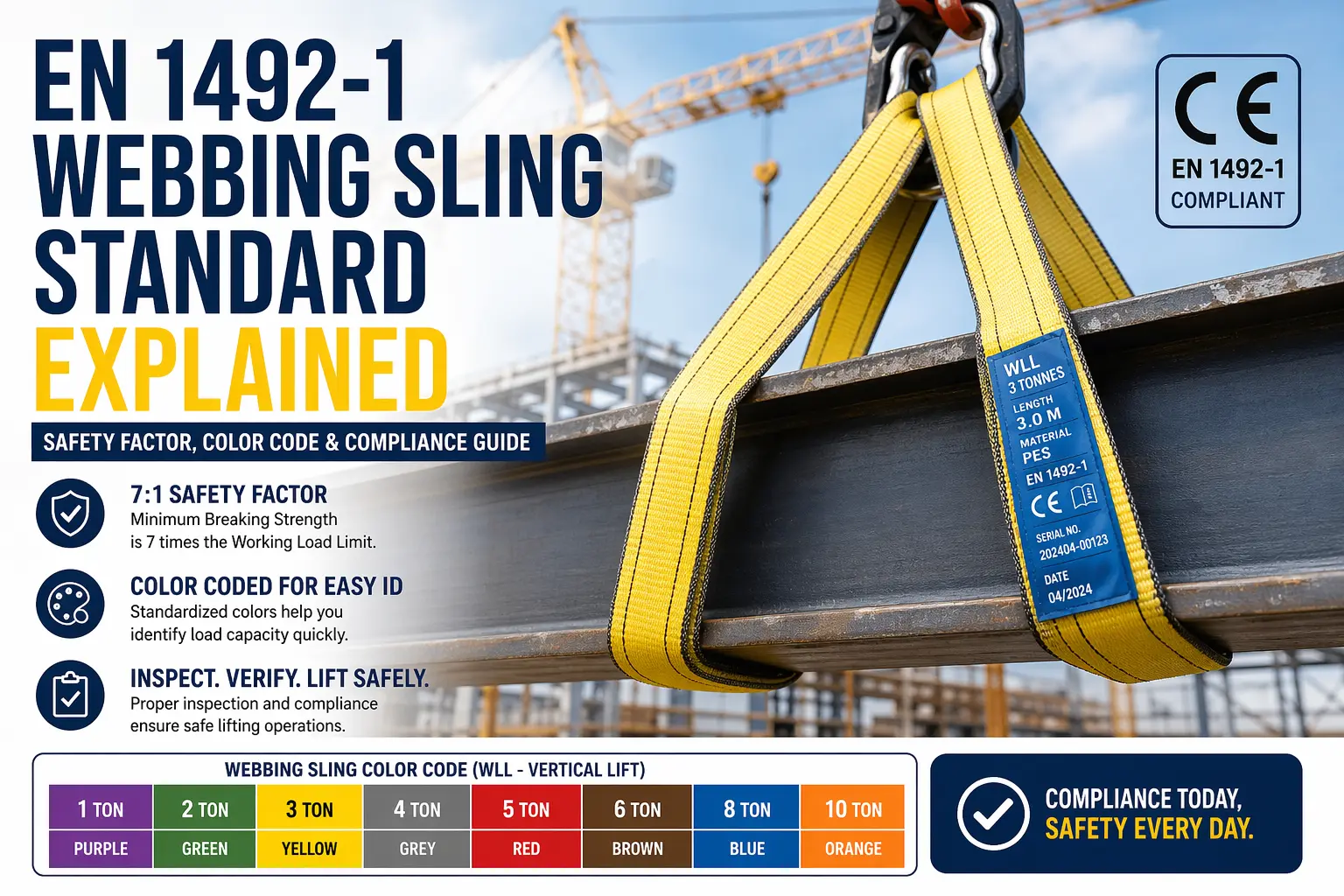
The safety factor in EN 1492-1 is defined as the ratio between Minimum Breaking Strength (MBS) and Working Load Limit (WLL), set at 7:1.

Example:

  • A 2-ton sling must withstand at least 14 tons before failure.

Why so high?

Because real-world lifting is messy:

  • shock loading
  • sling angle stress
  • wear and abrasion
  • human error

This is not overengineering. It is a safety buffer.
Color Coding System (WLL Chart)

webbing sling WLL

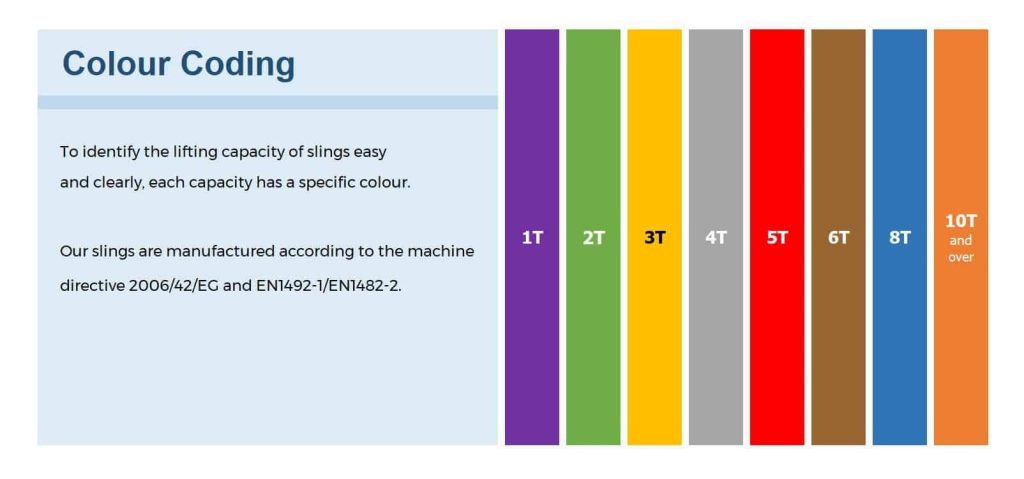
EN 1492-1 uses standardized colors for quick identification:

  • Purple → 1 ton
  • Green → 2 tons
  • Yellow → 3 tons
  • Grey → 4 tons
  • Red → 5 tons
  • Brown → 6 tons
  • Blue → 8 tons
  • Orange → 10 tons

Important:

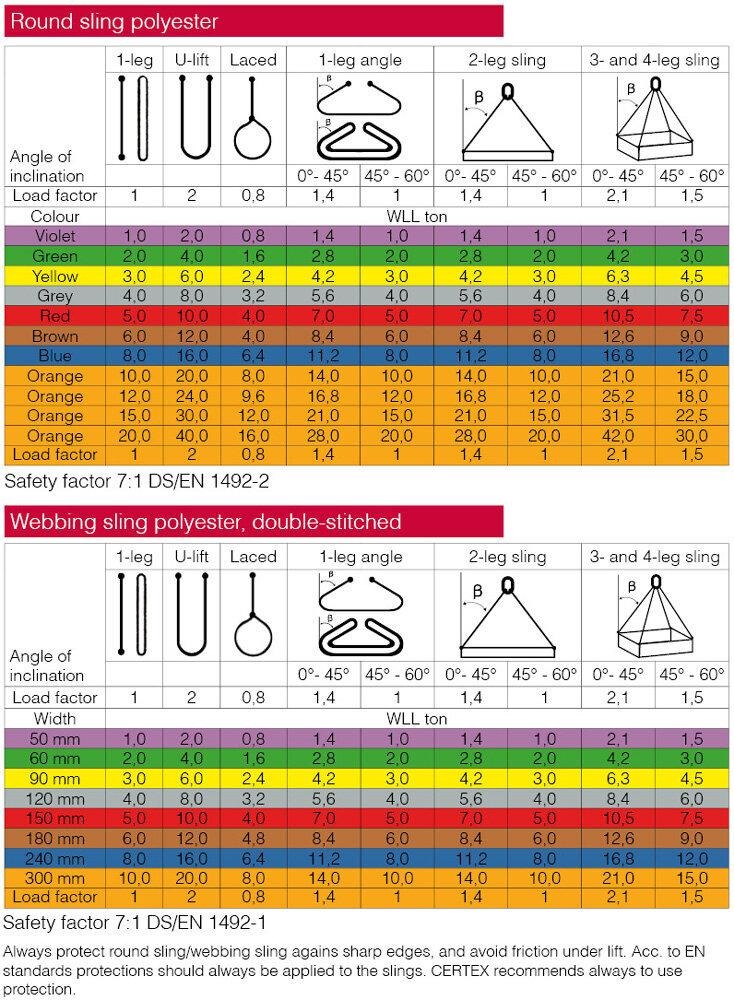
  • These values apply to vertical lifting only
  • Choker and basket configurations have different capacities

Labeling and Traceability

Every compliant sling must include:

  • CE marking
  • Working Load Limit (WLL)
  • material type
  • length
  • serial or batch number
  • manufacturing date

Non-negotiable rule: No tag = no use

If the label is missing or unreadable, the sling must be removed from service.

EN 1492-1 vs Other Standards

EN 1492-2 (Round Slings)

  • round shape
  • more flexible
  • better for irregular loads

ASME B30.9

  • US standard
  • 5:1 safety factor
  • no standardized color system

OSHA 1910.184

  • US regulation
  • focuses on usage and inspection
  • legally enforceable

Key difference:

  • EU focuses on design compliance
  • US focuses more on operational compliance

When to Use Webbing Sling vs Round Sling

Choosing the wrong type is a common mistake.

  • Webbing sling (flat)
    → best for stable loads and surface protection
  • Round sling
    → better for irregular or sharp-edged loads

Many field failures come from using the wrong sling type.

Common Mistakes in Using Webbing Slings

These are the real causes of failure:

  1. Ignoring sling angles → capacity drops significantly
  2. Using slings without labels
  3. Tying knots → strength can drop up to 50 percent
  4. Using wet nylon without adjusting capacity
  5. Dragging slings over rough surfaces
  6. No edge protection
  7. Wrong material for the environment

Reality check: Most failures are caused by misuse, not manufacturing defects.

Inspection and Rejection Criteria

Pre-use Inspection

Before every lift:

  • check label
  • inspect for cuts or abrasion
  • verify stitching condition

Periodic Inspection

  • performed by a competent person
  • typically at least once per year
  • more frequent in harsh environments

When to Reject a Sling

Remove immediately if:

  • label is missing
  • cuts or holes are present
  • abrasion exceeds 15 percent
  • heat damage or melting
  • chemical exposure
  • deformation or overload signs

Rule: If in doubt, do not use it

Real-World Applications

Construction

  • steel lifting
  • precast panels
  • structural components

Logistics

  • cargo handling
  • machinery loading

Oil and Gas

  • offshore lifting
  • sensitive equipment handling

Key advantage:
Webbing slings protect load surfaces better than wire rope.

Why EN 1492-1 Compliance Matters

Safety – Dropped loads can be fatal.

Legal – CE compliance is mandatory in the EU.

Financial – Failures lead to downtime, liability, and major losses. Cheap shortcuts often cost more in the long run.

How to Choose a Compliant Webbing Sling Supplier

Do not just buy based on price.

Check:

  • CE marking
  • proof load certification
  • traceable serial numbers
  • manufacturer credibility

This directly affects safety and liability.

What is EN 1492-1?

A European standard defining safety and design requirements for webbing slings.

What is the 7:1 safety factor?

The ratio between breaking strength and working load limit.

What do sling colors mean?

They indicate load capacity (WLL).

How often should slings be inspected?

Before every use and periodically by a qualified person.

When should a sling be discarded?

When damaged, overloaded, or missing identification.


This guide is based on:

PT. Sebatek Prima Tunggal  |  Lifting Equipment & Rigging Solutions

Supplying industrial lifting and rigging equipment tested to international standards – with the documentation to back it up.

© sebatek.id | “EN 1492-1 Webbing Sling Standard”  | Indonesia Polyester Manufacture