WhatsApp
+62818-0847-5888
Work Hours
Monday to Friday: 9AM - 5PM
WhatsApp
+62818-0847-5888
Work Hours
Monday to Friday: 9AM - 5PM

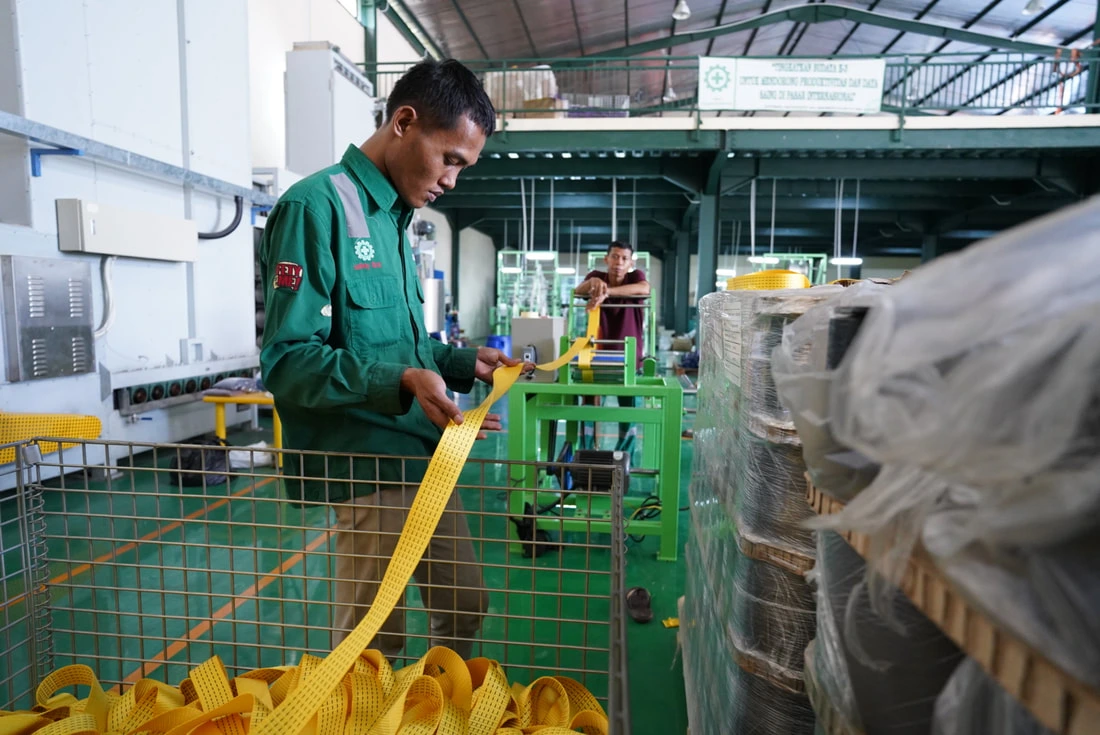
Every year, rigging failures cause serious injuries and fatalities on job sites around the world. Most of them are preventable. A lot of incidents trace back to one simple decision made before the lift even started: picking the wrong sling for the job. When it comes to webbing sling vs round sling, both are common, both are effective, and both can cause major problems if used in the wrong situation.
This guide breaks down the real differences between the two, so you can make a confident, safe choice for your next lift.
A webbing sling is a flat, ribbon-like lifting sling made from woven synthetic fibers, most commonly polyester or nylon. The flat construction makes it easy to wrap around loads, and it lies flat against the surface without bunching up. You’ll see these everywhere in manufacturing, logistics, and general rigging work.
Because of its flat profile, a webbing sling distributes pressure across a wider contact area than a wire rope would. That makes it particularly useful when lifting finished goods or loads where surface protection matters. It’s also easy to inspect visually, which is a practical advantage on a busy site.
A round sling (sometimes called an endless round sling or synthetic round sling) is a continuous loop of high-tenacity polyester yarn encased in a protective sleeve. The core is what carries the load; the outer cover is just protection. Because the load-bearing fibers run in a continuous loop rather than a woven flat band, round slings can achieve very high working load limits in a compact, flexible package.
Round slings are the preferred choice when you’re dealing with heavy, awkward, or irregular-shaped loads. They conform naturally to the shape of whatever they’re wrapping around, which reduces pressure points and protects both the sling and the load surface.
| Feature | Webbing Sling | Round Sling |
| Shape | Flat, ribbon-like | Cylindrical, tubular loop |
| Flexibility | Moderate; stays flat | High; wraps around any shape |
| Load Distribution | Wide surface contact | Conforms to load contour |
| Typical WLL Range | 1 to 10+ tonnes (vertical hitch) | 1 to 30+ tonnes (vertical hitch) |
| Durability | Good; sleeve wear visible | Core hidden; inspect sleeve for damage |
| Best Use | Flat, uniform, surface-sensitive loads | Heavy, irregular, or fragile-surface loads |
| Edge Sensitivity | Moderate; edge protectors recommended | Lower; cylindrical shape deflects edges |
The Working Load Limit is the maximum load a sling is rated to carry under normal, controlled conditions. Every certified sling has a WLL tag. Never exceed it. The WLL already accounts for a standard safety factor, but that buffer is there for dynamic forces, not as an invitation to push limits.
Most synthetic slings are designed with a 5:1 safety factor. That means a sling with a 2-tonne WLL is actually built to handle 10 tonnes before reaching its theoretical break point. But that safety margin assumes correct usage, proper inspection, and no hidden damage. Abuse the sling, and you’re eating into that margin fast.
This is where a lot of lifts go wrong. When you rig a sling at an angle rather than straight vertical, the actual tension in the sling increases significantly. At a 60-degree sling angle, your effective capacity drops to about 87% of the vertical WLL. At 30 degrees, you’re down to 50%. Rigging below 30 degrees is generally not recommended. The rule is simple: keep your sling angle as close to vertical as possible.
Using a choker hitch reduces the sling’s rated capacity to around 75-80% of its vertical WLL. A basket hitch, on the other hand, can increase effective capacity. Understand your hitch configuration before you lift, and check the capacity against the actual load weight including any rigging hardware.
You’re lifting a stack of pre-painted steel plates onto a fabrication table. The surface finish needs to stay intact, the load is uniform and flat, and the weight is manageable. A flat webbing sling is ideal here. It spreads the load across the contact surface without digging in, and the flat profile keeps the sling stable without slipping. Use edge protectors on any sharp corners, and you’re good to go.
You’re rigging a large pump casing that has protruding flanges, uneven surfaces, and a load weight pushing close to 15 tonnes. A round sling is the right tool here. Its cylindrical shape wraps around the contours naturally, distributes load across a broader contact zone, and its high-capacity ratings mean you’re not stringing together multiple lighter slings to hit the numbers. The round sling handles the complexity of the geometry without fighting it.
Sharp edges are a sling’s biggest enemy. A load with an exposed edge can cut through webbing or a round sling’s protective sleeve faster than you’d expect under tension. Cuts are not always easy to spot until a sling is under load, which is exactly when you don’t want to find out. Always use rated edge protectors when wrapping a sling around any sharp or angular surface.
A flat webbing sling that’s twisted before the lift doesn’t carry the load evenly across its full width. You’re essentially turning a wide-contact sling into a narrow one, which increases stress concentration and reduces effective capacity. Always make sure the sling lies flat and untwisted before signaling the crane operator to take the weight.
For round slings, the outer sleeve is your early warning system. Cuts, abrasions, UV degradation, or chemical exposure on the sleeve are signs the core fibers may be compromised. Unlike webbing slings where most damage is visible, a round sling can have internal core damage that isn’t obvious from the outside. If the sleeve is significantly worn or cut, retire the sling immediately. Don’t guess.
Reputable sling manufacturers and professional riggers work within established standards. Three of the most referenced are:
If you’re working on a regulated job site or supplying slings to clients, compliance with the relevant standard is not optional. Make sure any sling you purchase carries the correct certification markings.
There’s no universal winner in the webbing sling vs round sling debate. The right choice comes down to the specific load, the rigging configuration, and the working environment. Flat, uniform loads with surface-finish requirements are a natural fit for webbing slings. Heavy, irregular, or high-capacity lifts call for round slings.
What matters most is that you match the sling to the job, inspect it before every use, understand the capacity limits, and retire anything that shows signs of damage. A few seconds of decision-making before a lift can prevent a serious incident.
If you’re sourcing lifting slings for regular site use, working with a supplier that provides certified products, clear WLL documentation, and technical support will save you a lot of headaches. The right gear from a knowledgeable source makes every lift safer and more efficient.
PT. Sebatek Prima Tunggal | Lifting Equipment & Rigging Solutions
Supplying industrial lifting and rigging equipment tested to international standards – with the documentation to back it up.
© sebatek.id | “Choosing a Reliable Sling Manufacturer” | Indonesia Polyester Manufacture
