WhatsApp
+62818-0847-5888
Work Hours
Monday to Friday: 9AM - 5PM
WhatsApp
+62818-0847-5888
Work Hours
Monday to Friday: 9AM - 5PM

A custom webbing sling is a flat woven polyester sling built to a working load limit, width, length, and end configuration that a catalogue product does not cover. Most rejected deliveries in industrial lifting are not manufacturing failures. They are specification failures: an incomplete request that left the manufacturer guessing, and the guess did not match what the site needed.
This guide covers the six specifications that determine whether the sling you receive matches the sling you had in mind, and the questions worth asking a manufacturer before a purchase order is issued.
Catalogue webbing slings cover the majority of general lifting. They stop being viable in a few recognisable situations.
Load geometry is the most common trigger. A vessel with lifting lugs at a fixed spacing needs a sling length that puts the hook at a specific height, and rounding to the nearest catalogue length changes the sling angle. That angle change alters the tension in each leg, which is a load calculation problem rather than a convenience problem.
Surface protection is the second. Machined shafts, coated pipe, and polished stainless steel reject any sling that leaves a mark. That drives sleeve material and edge protection choices which catalogue products rarely offer.
The third is repeat operations. When the same lift happens daily, a sling built to that exact geometry removes the daily judgement call about which catalogue length is close enough. Consistency of rigging is itself a safety control.
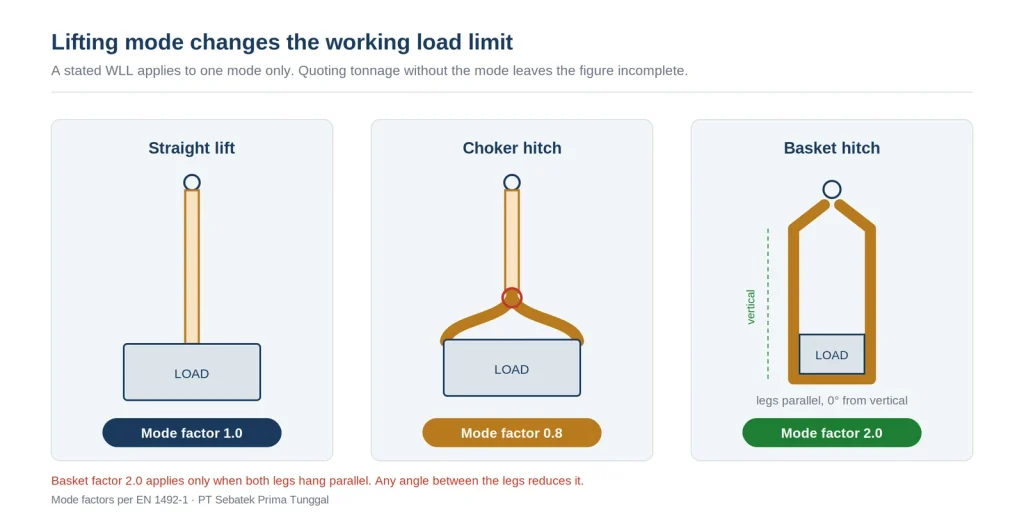
Working load limit is the figure everyone writes down. The standard it was derived under is the figure most people omit, and it changes the sling.
Under EN 1492-1, flat woven webbing slings are manufactured to a minimum safety factor of 7:1. Under ASME B30.9, synthetic webbing slings are rated at 5:1. Two slings marked with the same WLL can therefore be built from different amounts of material depending on which standard governs them.
This matters commercially. A buyer comparing quotes on price alone, where one manufacturer quoted to EN and another to ASME, is not comparing equivalent products. State the standard on the request, not just the tonnage.
State the lift configuration alongside it. WLL is quoted for a specific mode: straight lift, choker, or basket. A sling rated 3 tonnes in straight lift does not carry 3 tonnes in choker configuration, and the mode factor is not something to apply after delivery.
Width and ply together determine capacity, but they are not interchangeable. A single-ply sling at greater width and a double-ply sling at lesser width can reach the same WLL while behaving differently in service.
Single-ply conforms more readily around irregular loads and lies flatter against a surface. Double-ply carries more capacity per unit of width and resists abrasion better, at the cost of flexibility.
Width also has a practical constraint that specifications often miss: the sling has to pass through whatever hardware it will be used with. A wide sling that will not seat properly in a shackle bow or a hook throat is a sling that cannot be used safely, regardless of its rating.
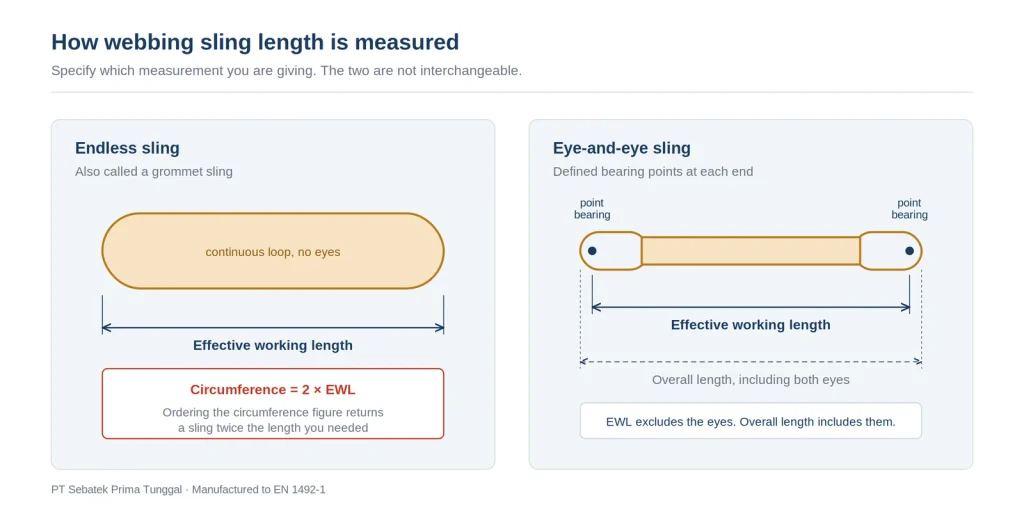
Effective working length, or EWL, is the measurement between the load-bearing points of the sling, not the overall length of the material. For an endless sling it is the loop measured flat. For an eye-and-eye sling it is bearing point to bearing point, excluding the eyes themselves.
Confusion between EWL and total length is one of the more expensive specification errors, because it produces a sling that is technically manufactured correctly and functionally the wrong size. Specify which measurement you are giving.
Manufacturing tolerance applies to length. Ask what tolerance the manufacturer works to and confirm it is acceptable for your application before the order is placed.
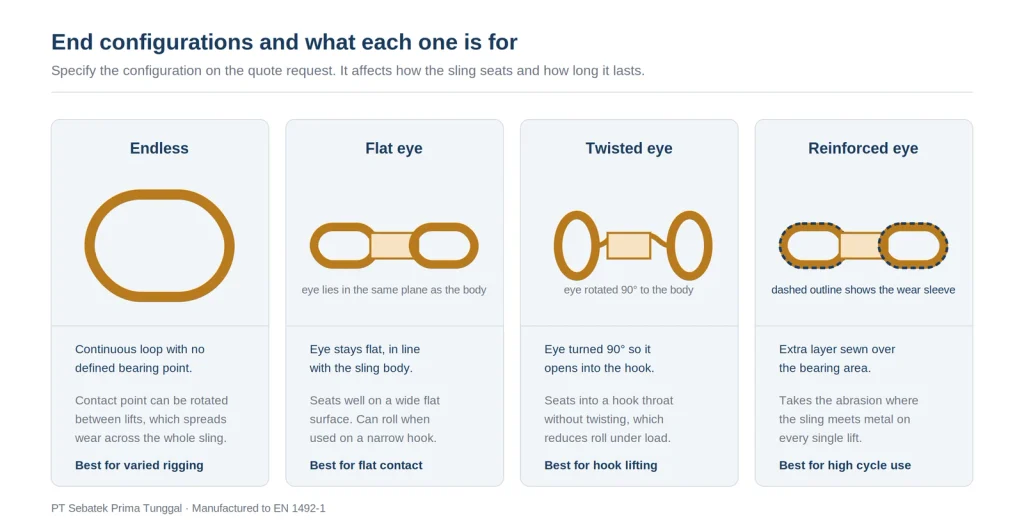
Endless slings, sometimes called grommet slings, offer the most flexibility in rigging and allow wear to be distributed by rotating the contact point.
Eye-and-eye slings provide defined bearing points, which makes them more predictable in repeat lifts. Eyes can be flat or twisted. Twisted eyes seat naturally into a hook throat, which reduces the tendency of the sling to roll under load.
Reinforced eyes with an internal sleeve extend service life considerably where the sling meets metal on every lift, which is worth specifying for high-cycle applications.
Where the sling terminates in hardware rather than a soft eye, the fitting becomes part of the assembly rating. The assembly is rated at the weakest component, so a fitting with a lower WLL than the webbing derates the entire sling.
Polyester webbing handles abrasion reasonably, but not against sharp edges. A load edge with a small radius can cut through a loaded sling far faster than most operators expect, because tension concentrates the cutting force at a single point.
Options worth specifying include a polyurethane coating for general abrasion resistance, a sewn-on wear sleeve at defined contact points, a sliding sleeve that can be positioned per lift, and separate corner protectors used with the sling rather than built into it.
Chemical exposure is a separate question. Polyester resists most mineral acids but degrades on contact with alkalis. If the sling will be used in a chemical environment, state the substance and its concentration in the request. Substituting a different fibre may be necessary, and that is a decision for the manufacturer’s engineering team rather than the buyer.
Every sling requires a durable label carrying at minimum the WLL, the standard of manufacture, the material, the length, the manufacturer identity, and a unique serial or batch reference.
The serial reference is what makes an inspection regime work. Without it, an inspector recording a defect has no reliable way to tie that record to a specific sling across its service life. For projects operating under a formal lifting equipment register, confirm the numbering format the manufacturer uses is compatible with your system before production begins.
Colour coding follows EN 1492-1 for slings built to that standard, where each WLL corresponds to a defined webbing colour. This gives crews a visual capacity check at a glance, which matters when several ratings are in circulation on one site.
What is the safety factor, and which standard is it derived from? A manufacturer who cannot answer this precisely is a manufacturer whose product you cannot verify.
Is testing done per batch or per unit? Both are legitimate. The difference determines what your certificate actually attests to, which matters when a client audits the lifting equipment register.
What documentation ships with the sling? A test certificate, a declaration of conformity, and material traceability are the baseline for industrial procurement. Ask whether these are issued as a matter of course or only on request.
What is the lead time for the specified configuration? Custom production has a genuine lead time. A supplier quoting the same turnaround as catalogue stock is either holding the material already or is a distributor rather than a manufacturer.
Can the manufacturer advise on the specification, or only quote against it? This distinguishes a production facility with engineering capability from an order-taker. If your application involves an unusual load geometry, that difference matters more than price.
Quoting WLL without the lifting mode leads to a sling that is correctly rated and incorrectly applied. Giving total length where EWL was required produces a sling that is dimensionally wrong despite being manufactured to the order. Omitting the sharp edge that everyone on site knows about but nobody wrote down. The manufacturer cannot specify protection for a hazard that was never communicated.
Ordering to a standard the client’s audit does not recognise. Confirm which standard the project specification requires before issuing a purchase order, not after the slings arrive. Treating the end fitting as an accessory rather than part of the rated assembly. The assembly rating is governed by its weakest component.
Send your load specification, lifting mode, and any edge or chemical exposure details to our production team in Citeureup. If the specification is still being drafted, our engineering team can review the load geometry and recommend a configuration before you commit to a purchase order.
A flat woven polyester sling manufactured to a specified working load limit, width, effective working length, and end configuration rather than supplied from a catalogue range. It is used when load geometry, surface protection requirements, or repeat lifting operations make a standard sling unsuitable
Effective working length is measured between the load-bearing points of the sling. Total length includes the eyes and any hardware. Specifying one when the other was intended is a common source of dimensional error.
Not necessarily. Unit cost depends on material volume and construction rather than on whether the dimensions are catalogue or bespoke. Custom production does carry a lead time that stock does not.
EN 1492-1 and ASME B30.9 are both widely accepted in Indonesian industry. The determining factor is usually the project specification or the client’s audit requirement. EN 1492-1 uses a 7:1 safety factor and ASME B30.9 uses 5:1 for synthetic webbing, so the two are not directly interchangeable on capacity alone.
Service life depends on load cycles, abrasion exposure, chemical contact, and storage conditions rather than on elapsed time. Withdrawal from service is determined by inspection against defined criteria, not by age.
