WhatsApp
+62818-0847-5888
Work Hours
Monday to Friday: 9AM - 5PM
WhatsApp
+62818-0847-5888
Work Hours
Monday to Friday: 9AM - 5PM

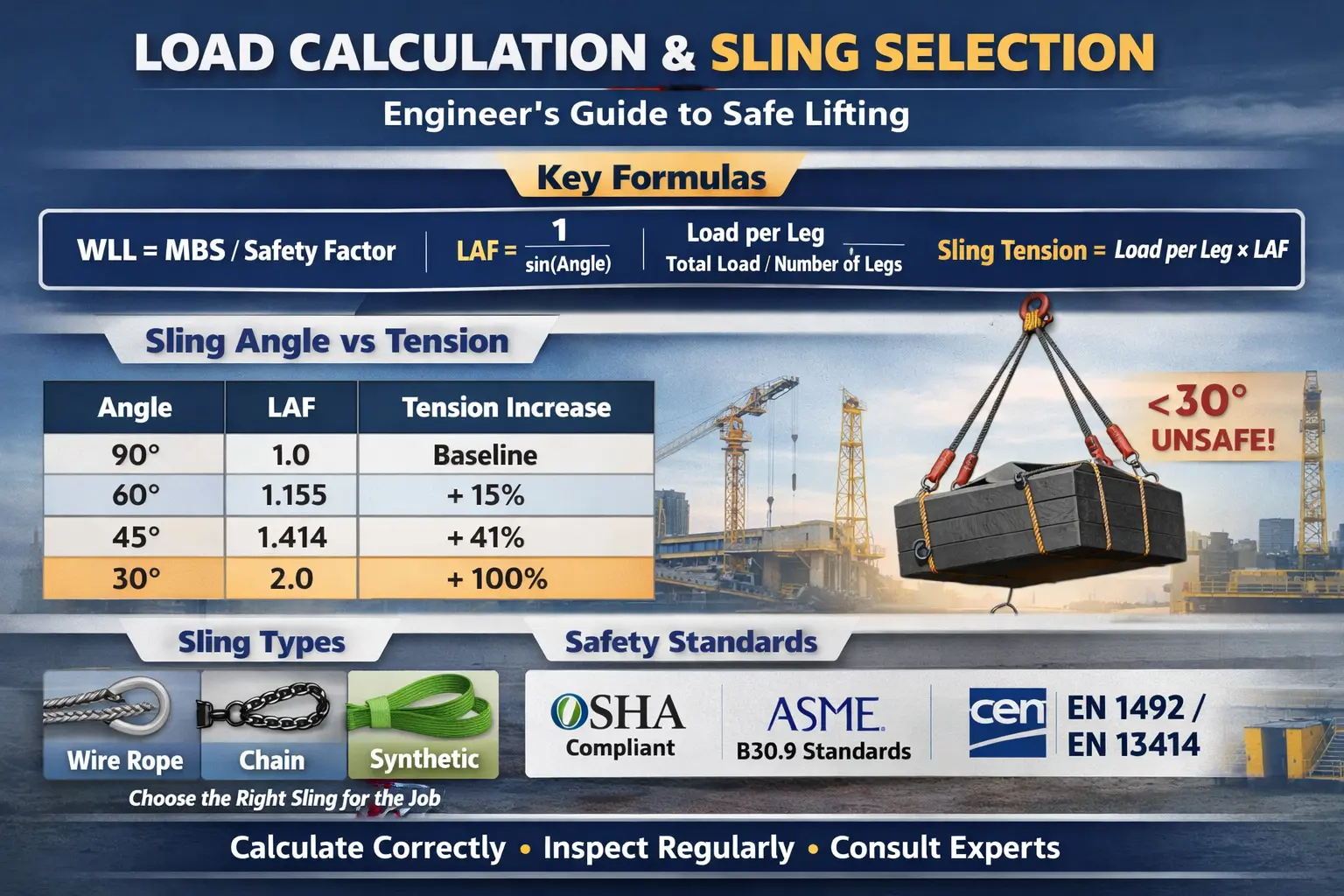
A dropped load is rarely caused by weak equipment. In most cases, the failure starts with a wrong calculation. A sling that looks strong enough can still fail if the actual tension exceeds its Working Load Limit. This often happens when sling angle and load distribution are ignored.
In real job sites, this mistake leads to:
This guide explains how to calculate lifting loads correctly and how to select the right sling based on real working conditions.
You will learn:
What is load calculation in lifting?
Load calculation determines the actual force applied to each rigging component based on weight, sling angle, number of legs, and center of gravity.
What is sling selection?
Sling selection is choosing the correct sling type and capacity so its WLL exceeds the calculated tension during lifting.
What is the minimum safe sling angle?
30 degrees from horizontal. Below this, tension increases rapidly and becomes unsafe under OSHA and ASME standards.
Use this as your field cheat sheet:
If you remember only one thing:
-> Angle increases tension. Always calculate it.
WLL is the maximum load a sling can safely handle under normal conditions.
This is the number you must never exceed.
SWL depends on how the sling is used.
Different configurations like vertical, choker, or basket will change the actual safe capacity.
MBS is the load at which the sling fails.
It is not a working value.
Example:
If MBS = 80,000 kg and safety factor = 4
→ WLL = 20,000 kg
Use actual weight, not estimation.
If CoG is off-center, load distribution becomes uneven.
For a 2-leg sling:
Load per leg = Total load ÷ 2
But this only works if CoG is centered.
This is where most failures happen.
As sling angle decreases, tension increases. A wider angle means each sling leg carries more force to support the same load.
| Angle | LAF | Tension Increase |
| 90° | 1.0 | baseline |
| 60° | 1.155 | +15% |
| 45° | 1.414 | +41% |
| 30° | 2.0 | +100% |
| <30° | unsafe | not allowed |
Load = 4,000 kg
2-leg sling
Angle = 45°
-> If you ignore the angle, you undercalculate by 40%+
Below 30 degrees:
Standards from
Occupational Safety and Health Administration and
American Society of Mechanical Engineers
set this as a minimum limit.
Best for heavy lifting and general industrial use.
Use when:
Best for extreme conditions.
Use when:
Best for sensitive surfaces.
Use when:
Avoid when:
-> Following standards is not optional. It directly impacts safety and liability.
Load = 1,800 kg
Angle = 60°
-> Sling must exceed this value, not original load.
-> Most failures come from these, not from equipment defects.
Lifting safety is not about using stronger equipment. It is about using the right calculation.
Key takeaways:
To reduce risk on site:
If the calculation is wrong, everything else fails. Do the math before the lift.
PT. Sebatek Prima Tunggal | Lifting Equipment & Rigging Solutions. Supplying industrial lifting and rigging equipment tested to international standards – with the documentation to back it up.
© sebatek.id | “Load Calculation & Sling Selection” | Indonesia Polyester Manufacture
